
LOS ANGELES — When I boarded a plane to Israel with students from de Toledo High School in February, I knew the trip would carry unusual weight.
After all, we were resuming our Jewish day school’s exchange programs in Israel for the first time since the trauma of the Oct. 7 attack in 2023. For many Jewish communities, that day reshaped how we think about Israel, security and the relationship between American Jews and the Jewish state.
Our students and parents understood that context. They knew we were traveling to a country still healing from profound loss. And as the departure date drew near, they also knew there was a possibility war could break out during our stay.
Much has been written about today’s teenagers. They are often described as fragile or ill-equipped to face adversity. In the Jewish world, there is a parallel concern, that young American Jews are increasingly distant from Israel, even ambivalent about its future. Polls show that this concern is not unfounded.
But standing in bomb shelters in Jerusalem with a group of my students, I saw something very different.
Our first few days in Israel went according to plan. The students visited a kibbutz in the Negev, hiked through the desert, floated in the Dead Sea, climbed Masada and experienced the unique beauty and history of the land of our people.
By Friday afternoon, we arrived in Jerusalem and settled into a hostel for Shabbat. On Saturday morning, we were planning to take a short walk to a synagogue led by a rabbi who is one of our school’s proud alumni. But that morning, the first sirens sounded — the war with Iran had begun.
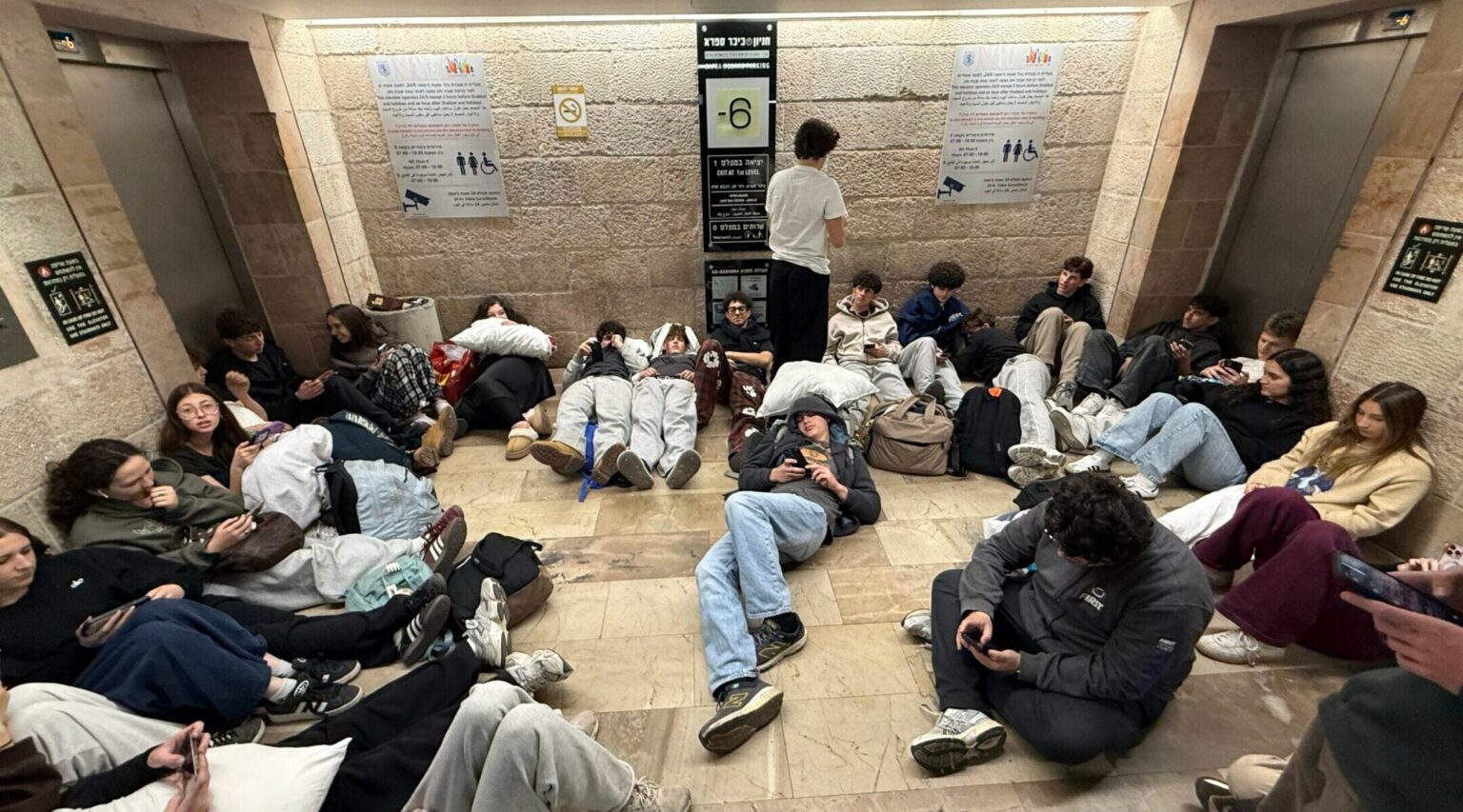
Anyone who has spent time in Israel knows the routine. When the alarm goes off, you move quickly to the nearest protected space — a mamad, miklat or shelter. For us, that meant descending into a six-story underground parking structure. Dozens of people gathered there, waiting out the alert. Some sat quietly. Some rested. Some ate.
For the first 48 hours, the alerts came every few hours, so we decided to relocate our group to a hotel with shelters on every floor, allowing us to shelter quickly when needed.
It was not the itinerary we had planned. But the experience revealed something powerful about the young people in our care.
What I saw in those shelters was not panic. It was grit. It was strength. It was solidarity.
Students checked in on one another. They reassured friends and texted worried parents back home. They thanked hotel staff who had opened their doors to us during a moment of uncertainty. As we were checking out, the hotel’s general manager pulled me aside to tell me how impressed she was by the group — how respectful they were toward staff, how calm they remained amid sirens, and how appreciative they were even in the middle of a crisis.
“These are remarkable young people,” she said. She was right.
There is a widespread belief today that young people lack resilience. That they retreat from difficult realities. That is not what I saw. I saw teenagers who understood that being part of the Jewish story sometimes means standing shoulder to shoulder as one people.
And I saw how deeply connected they felt to Israel.
As the days passed, and it became clear we would have to stay in our hotel to be close to our shelter, the prudent decision was to take our students back home.
And yet the reaction from many of our students was not relief. It was reluctance. Several told me they did not want to leave Israel. Many of their parents said the same. For Israelis, living with sirens and shelters is a difficult but familiar reality. For these American teenagers, it was something entirely new. Yet their instinct was not to run from the experience. It was to remain connected to it.
That reaction continues to stay with me.
Eventually what followed was a complicated journey out of the region — buses south, border crossings, and hours waiting in a single airport terminal in Taba, Egypt, before boarding a flight to Rome and then to Los Angeles.
Our students have been safely at home in the United States for weeks now. But I know this experience will stay with them for the rest of their lives — the sirens, the shelters, the kindness of strangers and the sense of community they felt with Israelis.
Those lessons cannot be taught solely in a classroom. They are experiences that must be lived. They offer lessons that shape identity, strengthen character and deepen responsibility.
Our experience in Israel leaves me more confident about the future of the Jewish people than I have been in a long time. I have seen the resilience of the next generation of Jews. And if the young people I traveled with are any indication, our people’s future is in very capable hands.
Passover may be over, but your chance to support independent Jewish journalism isn’t. Help JTA keep reporting the stories that define our era.

is head of school at de Toledo High School in Los Angeles.
The views and opinions expressed in this article are those of the author and do not necessarily reflect the views of JTA or its parent company, 70 Faces Media.