
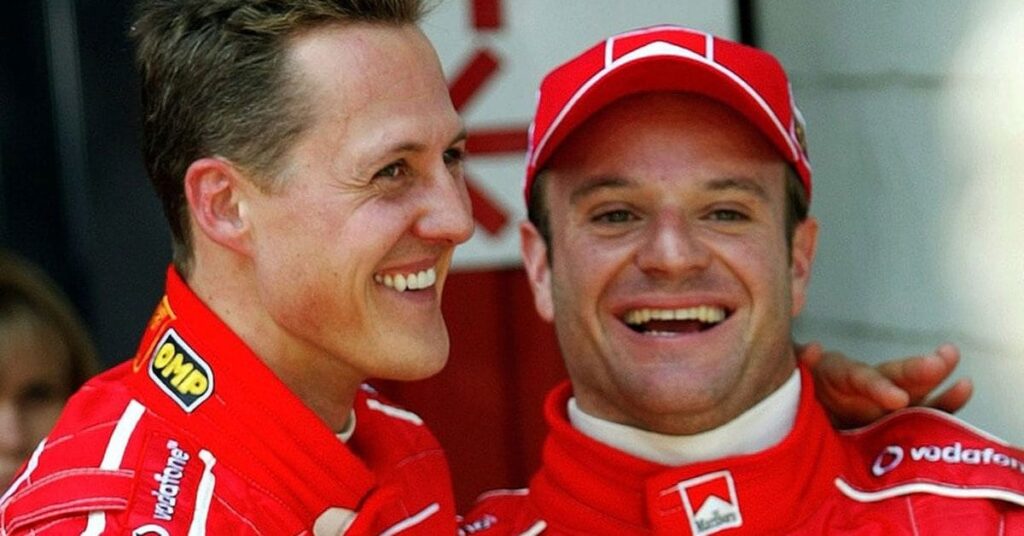
Team orders have never been a rarity in the world of Formula 1. While they are relatively common, they almost always spark controversy and can generate negative reactions from fans and observers alike. One of the most iconic and debated examples remains Ferrari’s decision during the 2002 Austrian Grand Prix. On that occasion, just moments before crossing the finish line, Rubens Barrichello slowed down to allow his teammate Michael Schumacher to take the win, enabling the German driver to extend his championship lead to 27 points over Juan Pablo Montoya.
Looking back, history showed that Michael Schumacher had no real need for that team order. The German, often referred to as “the Kaiser,” went on to dominate the season and secured the title as early as July. However, at that specific point in time — it was only the sixth race of the season — the championship standings were still relatively close, and Ferrari was determined to avoid any potential surprises in the second half of the campaign.
The decision triggered an immediate and intense backlash. During the podium ceremony, the crowd reacted with loud boos, clearly expressing their disapproval. Fully aware of the damage to Ferrari’s public image, Michael Schumacher handed the winner’s trophy to Rubens Barrichello in a symbolic gesture. Despite that, the Scuderia was fined one million dollars for failing to follow proper podium procedures. Former Ferrari general manager Jean Todt has since defended the decision, while also pointing to Barrichello’s actions as a key factor in the controversy.
Jean Todt explains Ferrari’s decision
“The fear of losing has always been a nightmare. We lost so many times at the final race. In some years, we probably should have been less cautious, but for the sake of team discipline, at a certain point in the season priority was given to one driver,” Jean Todt explained during the High Performance podcast. “In that race, we had agreed that if Rubens had been ahead of Michael before the final pit stop, he would have had to let him pass. Whether it was right or wrong, it had been agreed and accepted. In hindsight, it might have been the wrong decision, but at that moment it might not have been. And in any case, it was a decision that everyone had accepted and was fully aware of.”
“Rubens did not want to respect what had been decided, which created a very uncomfortable situation. I have to say he did not handle it well, and he put the team in a very controversial position. It was extremely embarrassing, and Michael was also very embarrassed. Normally, I would not intervene on the radio, as there were engineers and Ross Brawn handling those communications. But on that occasion, I had to step in and remind him of what had been agreed. It was part of my job — being the leader of a team also means being a firefighter. If there is a fire, you have to put it out. You cannot let it keep burning. We were criticized, yes, but it was just smoke. It is better to be criticized for securing a one-two finish than for a retirement,” he concluded.
The ongoing debate for 2031 confirms that the “engine-first” philosophy of 2026 is now widely seen as a strategic misstep. By decoupling the sport’s environmental image from complex, heavy batteries and shifting it toward carbon-neutral fuels, F1 has a unique window to return to lighter, louder, and more aggressive machines. The real challenge, as the text notes, will be ensuring that the “show” doesn’t suffer as a result of performance convergence.
Apr 15, 2026David Carter
Let other Scuderia Fans know about us


