
Between Syria and Iraq: Uncertainty over the location of Albanians in conflict zones

Express newspaper
15/04/2026 23:03
As government forces took control of Kurdish strongholds in northern Syria, while thousands of prisoners suspected of links to IS were transferred to Iraq, new concerns have been raised about the fate of citizens from the Western Balkans who had gone to Syria, including Albanians. The lack of confirmed data and the lack of response from some institutions in the region make it unclear whether citizens from Albania, Kosovo and North Macedonia have been included in these movements, while families continue to await answers about their whereabouts.
Thousands of people suspected of links to the Islamic State (IS) terrorist organization, who were being held in prisons in northeastern Syria, were transferred to Iraq in early 2026. Although media reported that among them were Albanians from Kosovo, Albania, and North Macedonia, their authorities have not provided official confirmation.
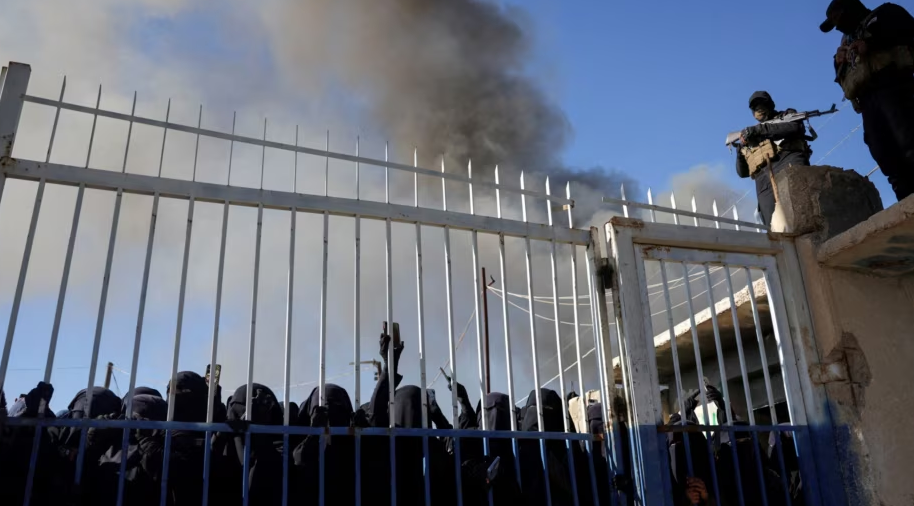
The prisoner transfer came amid concerns about the security of the detention centers and escapes, after fighting between the Syrian army and the Kurdish-led Syrian Democratic Forces forced the latter to surrender control of the territory where the prisoner camps were located.
The transfer of detainees began on January 21, 2026, and lasted about 23 days, ending in mid-February. During this operation, more than 5.700 men suspected of being IS fighters were sent to detention centers in Iraq, under the coordination of US forces and Iraqi authorities.
Information circulated in the Albanian media that among the displaced were eight Albanian citizens, three from Kosovo and one from North Macedonia.
These figures were confirmed to Radio Free Europe/Radio Liberty (RFE/RL) Kosovo Service by security expert from the International Counterterrorism Center, Adrian Shtuni. According to him, a total of 37 people have been transferred from the Western Balkan countries.
Meanwhile, the Iraqi Supreme Judicial Council told REL’s Balkan Service that 22 men were from Bosnia and Herzegovina, but it did not answer the question of how many citizens from other Balkan countries were part of this transfer.
“Unfortunately, we cannot disclose this information at this time,” was the Iraqi institution’s response.
The Albanian Ministry of Foreign Affairs stated to REL’s Kosovo Service that “the Albanian state… is taking all actions to identify, verify and locate Albanian citizens who are supposedly in these territories [Iraq, Syria].”
Meanwhile, the authorities of Kosovo and North Macedonia did not respond to questions regarding their citizens.
According to Shtun, this entire process has had “truncated transparency.”
He explains that Iraq has expressed readiness to repatriate the suspects, calling on about 60 countries to take responsibility for their citizens. So far, according to public information from Iraq, there have been no requests for repatriation from any country.
Saturday says Iraq has said that “repatriation can only occur after preliminary investigations of each case, and only if the suspects are judged to pose a low risk… and have not committed serious terrorist crimes related to the Islamic State on Iraqi territory or against Iraqi nationals.”
He adds that “one of the extreme possibilities is the death penalty,” although these sentences have not been carried out for European citizens so far.
Shtuni argues that this situation is the result of a long-standing neglect of the repatriation process from countries of origin. The danger that arises from this, according to him, is related to Iraq’s lack of capacity for transparent and fair trials.
“Trials in Iraq are often criticized for being conducted hastily and superficially, based largely on confessions [even through pressure], rather than evidence,” he says.
The anxious wait for relatives in Albania
A woman from Albania, speaking on condition of anonymity to the REL editorial office in Pristina, says that her nephew, AT, now 15 years old, is in a detention center for minors, having gone to Syria in 2013, together with his parents.
After his parents died and the boy grew up a little, the relative says he was taken from the Syrian Al-Hol camp – emptied under unclear circumstances along with several camps where relatives of suspected IS prisoners were being held – and sent to a detention center.
“All the boys who turned 12 or 13 were taken from the camp” where women and children were housed, she claims.
Since then, the Albanian woman says she has no clear information about her grandson’s future, and is seeking intervention from the authorities.
“I pray that something be done for those children who lost their childhood there in the midst of the chaos,” she says.
The woman adds that the family has been living in uncertainty for years, receiving only partial information about his condition.
Based on what she has heard from others, she suspects that conditions in these detention centers are poor, with a lack of food and various mistreatment.
For him, every new development in Syria or Iraq raises fears that he could be displaced without his family’s knowledge.
Another story is that of Azgane Dibra, who says her sister and niece are still in Syria, having gone there about a decade ago, along with the rest of her family. One of the girls returned to Albania several years ago, but the others still remain there.
“My sister is still there, she left the camp, and they are living in a rented house. They are waiting for them to be taken in,” she says, adding that the family is awaiting a decision on repatriation.
According to Dibra, the family had gone to Syria with the belief that they would live in a better place, without knowing what would happen next.
She says that, upon arrival, they had informed relatives that they were fine, but that the situation quickly changed as the conflict escalated.
Dibra says that her family members went through the Al-Hol camp, where they experienced difficult conditions and instances of violence, and were later displaced from the camp and currently live in unsafe conditions in Syria.
The family says they try to help their relatives in Syria financially whenever possible, sending money from time to time. However, contact is limited, and information about the situation on the ground remains partial.
Security expert Shtuni sees as very necessary “the controlled repatriation of all citizens who are in Iraqi prisons and not only”, although recent developments, according to him, complicate the situation.
“Transfer to Iraq undoubtedly complicates and delays the repatriation process. This has the same effect on their potential reintegration process in the future, which certainly becomes more difficult.”
In some cases, return has been possible, but difficult. Eva Dumani returned to Albania in February of this year, after spending several years in Syria, where she had gone as a child with her father, brother, and grandmother.
Her father and grandmother lost their lives during the conflict, her brother was repatriated in 2020, while she remained alone for a period.
Her uncle, Xhetan Ndregjoni, says that the 21-year-old, after returning, is attending school and an English language course, and that she is trying to build a normal life.
“When she goes out on the streets and looks for work like my daughters, I can say she’s living a normal life,” he says.
Silence for Kosovar citizens in Syria
In addition to the fact that the authorities have not provided updated information regarding Kosovo citizens in Syria, family members of those who are there are reluctant to speak to the media.
Since the beginning of the war in Syria, hundreds of Kosovo citizens have traveled to conflict zones, mainly in the period 2012-2015, while after the fall of IS in 2019, many of them remained in camps or detention centers.
Some of them have been repatriated over the years. In the latest action, in July 2021, 11 Kosovo citizens, mainly women and children, returned from Syria, as part of the institutions’ ongoing efforts to return citizens remaining in conflict zones.
Authorities said they need support and reintegration, while those suspected of criminal offenses will face justice.
However, a significant number of Kosovars continue to remain in Syria. According to previous estimates, around 100 citizens – including men, women and children – were still in the conflict zones, while institutions have not published any new figures.
Most of them, women and children, were housed in camps such as Al-Hol and Al-Roj, controlled by Kurdish forces. Another part was outside the camps, in other areas of Syria, often in unsafe conditions and with limited access to humanitarian aid.
Kosovo – which established diplomatic relations with Syria in October last year – was among the first countries in the region to undertake large-scale repatriation operations, including the return of 110 citizens in 2019, mostly women and children. This process was carried out with the support of international partners, including the United States.
Upon return, many of them have been included in reintegration and deradicalization programs, which include psychological support, education, and institutional monitoring.
Prisoner transfers in Iraq
Syria is today led by a government led by Ahmed Al-Sharaa, who overthrew the regime of former President Bashar al-Assad in 2024.
Since then, the new government has taken several actions to bring territories formerly controlled by the Kurds under control.
In northeastern Syria, Kurdish forces had exercised extensive territorial and administrative control for years, through autonomous civil and military structures, playing a key role in holding detainees suspected of links to IS, including controlling camps such as Al-Hol.
During the first days of the operation in 2026, Syrian forces managed to take control of some territories, while other parts still remained under the control of Kurdish forces.
The parties agreed to a ceasefire, but without a final solution to the situation on the ground.
In this situation, concern also grew about the security of prisons where suspects with links to IS were being held.
To prevent escapes and maintain control over the detainees, US forces announced that, in coordination with authorities in Baghdad, they had decided to transfer them to Iraq.
According to official data, the detainees are from more than 60 countries, including 4.253 Arabs and 983 non-Arabs. Of these, 467 are Iraqi citizens, while 3.543 are Syrian citizens.
Authorities in Iraq said the classification of detainees was based on a database provided by an international coalition, which includes countries such as Canada, the United States, the United Kingdom, Ukraine, India, Australia, Belgium, Georgia and Denmark. /REL