
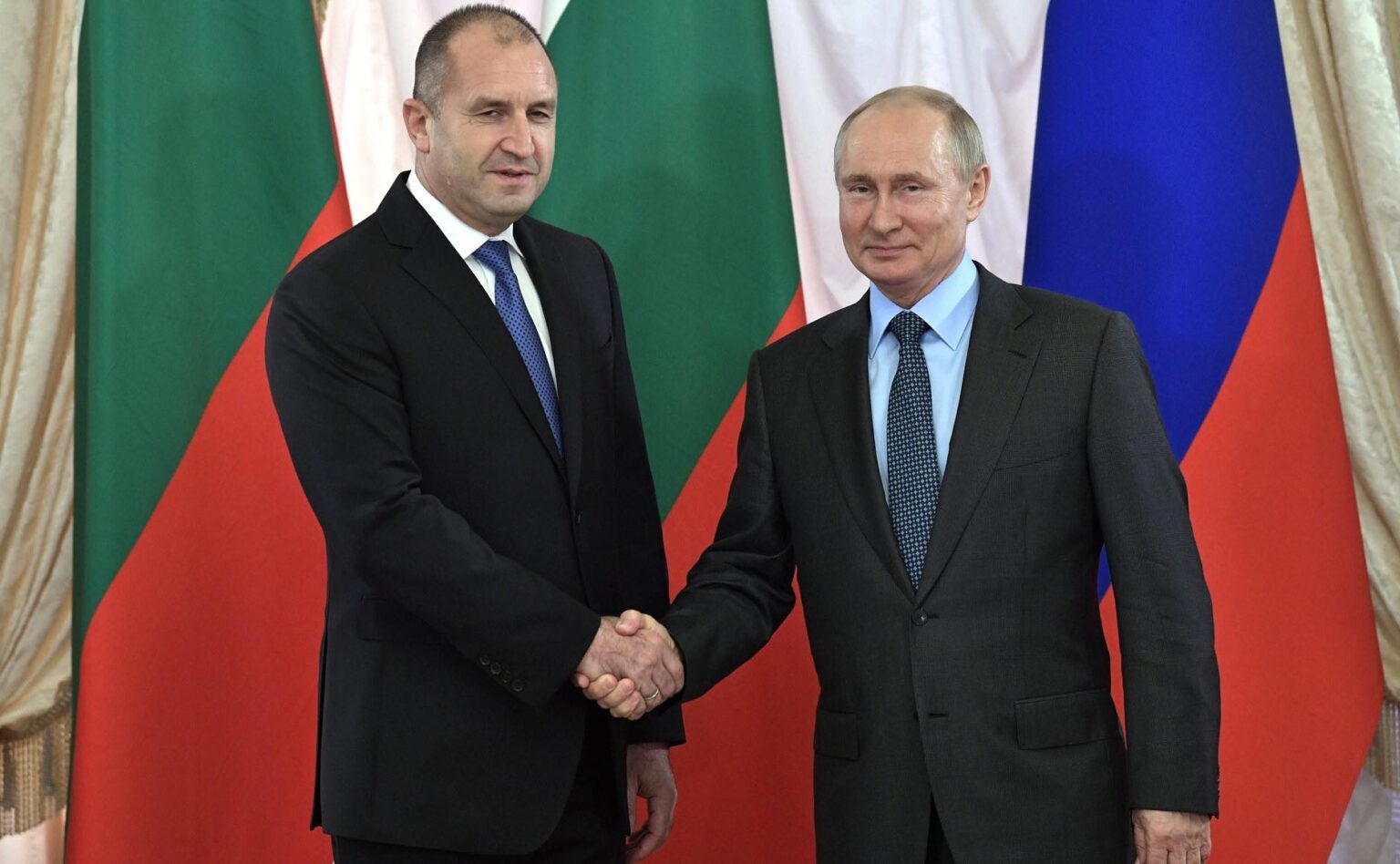
The figure in question, Rumen Radev, is no fringe agitator but a former president now leading the polls ahead of parliamentary elections on an avowedly anti-corruption platform. Yet behind the rhetoric of reform lies a more disquieting reality: a political project that appears, at best, ambivalent about the European Union’s strategic direction, and at worst, sympathetic to the Kremlin’s worldview.
According to recent reporting, Radev’s newly formed Progressive Bulgaria movement is polling at around 30 per cent, placing it well ahead of its rivals in a fragmented political landscape shaped by eight elections in five years. That such volatility exists is itself telling. Bulgaria, despite nearly two decades of EU membership, remains beset by corruption, institutional fragility and regional disparities—conditions in which populist and anti-establishment figures flourish.
Radev has skilfully tapped into these grievances. His campaign promises to dismantle oligarchic networks and restore dignity to a political system widely viewed as compromised. This is familiar ground in Central and Eastern Europe, where anti-corruption narratives often serve as vehicles for broader ideological repositioning. But the Bulgarian case carries an added dimension: the candidate leading this insurgency has consistently taken positions at odds with the EU’s collective stance on Russia.
He has opposed deeper integration with the eurozone, resisted closer security cooperation with Ukraine, and argued for the restoration of ties with Moscow. These are not incidental policy differences; they amount to a strategic divergence at a moment when European unity is under strain. In effect, Radev offers a vision of Bulgaria as a bridge to Russia—an argument that may resonate domestically but sits uneasily within the EU’s broader geopolitical posture.
This matters all the more given the shifting political landscape elsewhere. In Hungary, the electoral defeat of Viktor Orbán—long seen as the European Union’s most prominent pro-Kremlin voice—was widely interpreted as a turning point. For years, Orbán’s government had tested the limits of EU cohesion, leveraging nationalist rhetoric and cultivating ties with Moscow. His removal suggested, at least to some observers, that the European electorate was beginning to turn away from such politics.
Yet Bulgaria now threatens to fill that vacuum. As one analysis notes, Radev is positioning himself as perhaps the only remaining EU leader willing to openly advocate improved relations with Russia despite the ongoing war in Ukraine. The symbolism is difficult to ignore. No sooner has one pro-Kremlin figure exited the stage than another steps forward, buoyed by domestic discontent and electoral fragmentation.
It would be a mistake, however, to dismiss Radev simply as a Russian proxy. His appeal is rooted in genuine frustrations. Rural regions remain underdeveloped; political elites are widely mistrusted; and repeated elections have eroded confidence in democratic institutions. In such conditions, calls for “strong leadership” and systemic overhaul can carry considerable weight. The danger lies not in the diagnosis but in the prescription.
For Europe, the broader question is whether there remains space—politically or morally—for leaders who espouse what might be termed post-Soviet reflexes: a suspicion of Western integration, a tolerance for authoritarian models, and a readiness to accommodate Russian interests. The past decade, marked by annexations, invasions and hybrid warfare, has provided ample evidence of the risks involved.
The blunt truth is that the European project was built, in part, to ensure that such ideologies would recede into history. The Cold War’s end was not merely a geopolitical shift but a normative one: a rejection of spheres of influence, coercive diplomacy and ideological blocs. To see echoes of those ideas resurface within the EU’s own membership is, at best, disheartening.
“The Evil Empire is dead; let us keep it that way.” The phrase may sound like a relic of another era, yet it captures a sentiment that remains relevant. Europe cannot afford complacency when confronted with narratives that seek to normalise or rehabilitate the Kremlin’s worldview. Nor can it assume that economic integration alone will inoculate member states against such currents.
Bulgaria’s election will not determine the fate of the European Union. But it will serve as a barometer of its internal resilience. If a candidate with openly pro-Russian inclinations can rise to prominence on the back of legitimate grievances, it suggests that the Union’s political centre remains more fragile than many would care to admit.
The challenge, then, is twofold. First, to address the underlying conditions—corruption, inequality, institutional weakness—that give rise to such movements. And second, to draw a clear line on the principles that underpin European cooperation. Engagement with Russia may one day resume, but it cannot come at the expense of those principles.
For now, Bulgaria stands at a crossroads. Whether it chooses a path aligned with Brussels or one that leans, however subtly, towards Moscow will be watched closely across the continent. The lesson of recent years is that such choices rarely remain confined within national borders.
Main Image: http://en.kremlin.ru/events/president/news/60676
Post Views: 835