
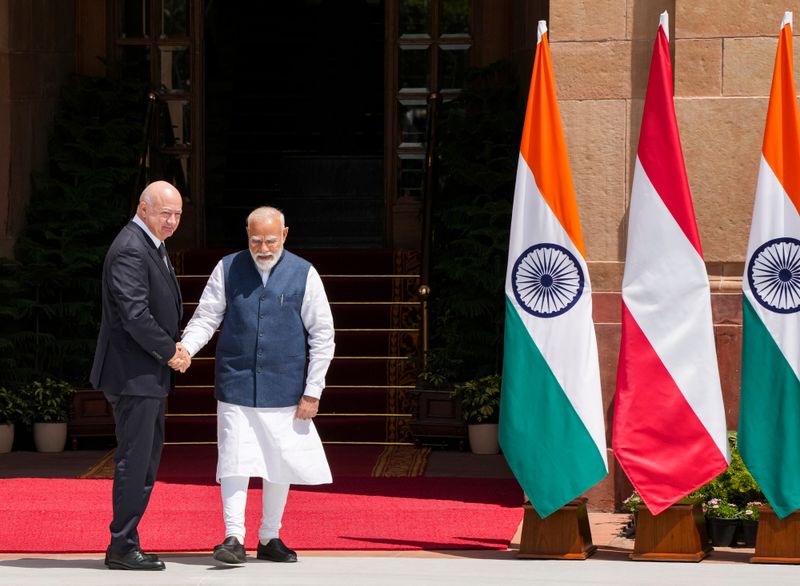
India and Austria on Thursday unveiled a sweeping set of agreements across defence, high technology, skills and investment, with Prime Minister Narendra Modi declaring that the partnership is entering a “new era” driven by innovation and strategic convergence.
Addressing a joint press interaction with Austrian Chancellor Christian Stocker, Modi said the visit — first by an Austrian Chancellor in 40 years — comes at a “significant moment” following the India-EU Free Trade Agreement, and would inject fresh energy into bilateral ties.
“By combining Austria’s expertise with India’s speed and scale, we aim to build reliable technologies and supply chains for the world,” he said, identifying defence, semiconductors, quantum technology and biotechnology as priority areas.
Among the key outcomes is a fast-track mechanism to resolve investment bottlenecks and improve ease of doing business. A Letter of Intent on military cooperation and another on a Joint Working Group on Counter Terrorism signal a clear expansion of strategic and security engagement.
High-technology collaboration has been positioned as a central pillar, with joint R&D planned in areas such as advanced materials, machine learning and clean technologies. The two sides also agreed to launch a cybersecurity dialogue and deepen startup linkages under the India-Austria Startup Bridge.
In the education and skills domain, a pact between IIT-Delhi and Montan University will boost research collaboration, alongside a broader push for vocational training, mutual recognition of qualifications and student mobility. The Working Holiday Programme has also been operationalised, while mobility in sectors such as nursing will be expanded.
Highlighting longstanding cooperation, PM Modi pointed to Austrian contributions to projects such as the Delhi Metro and the Atal Tunnel, as well as railways, ropeways and urban development.
On global issues, both leaders voiced concern over rising tensions, asserting that conflicts — from Ukraine to West Asia — cannot be resolved through military means. They also called for reforms of global institutions and reaffirmed a shared commitment to combating terrorism.
Additional agreements included cooperation in food safety and audio-visual co-production, further widening the engagement.
With a strong business delegation accompanying the Chancellor, the visit signals a decisive broadening of India-Austria ties — positioning the partnership as a key pillar of New Delhi’s deepening engagement with Europe.