
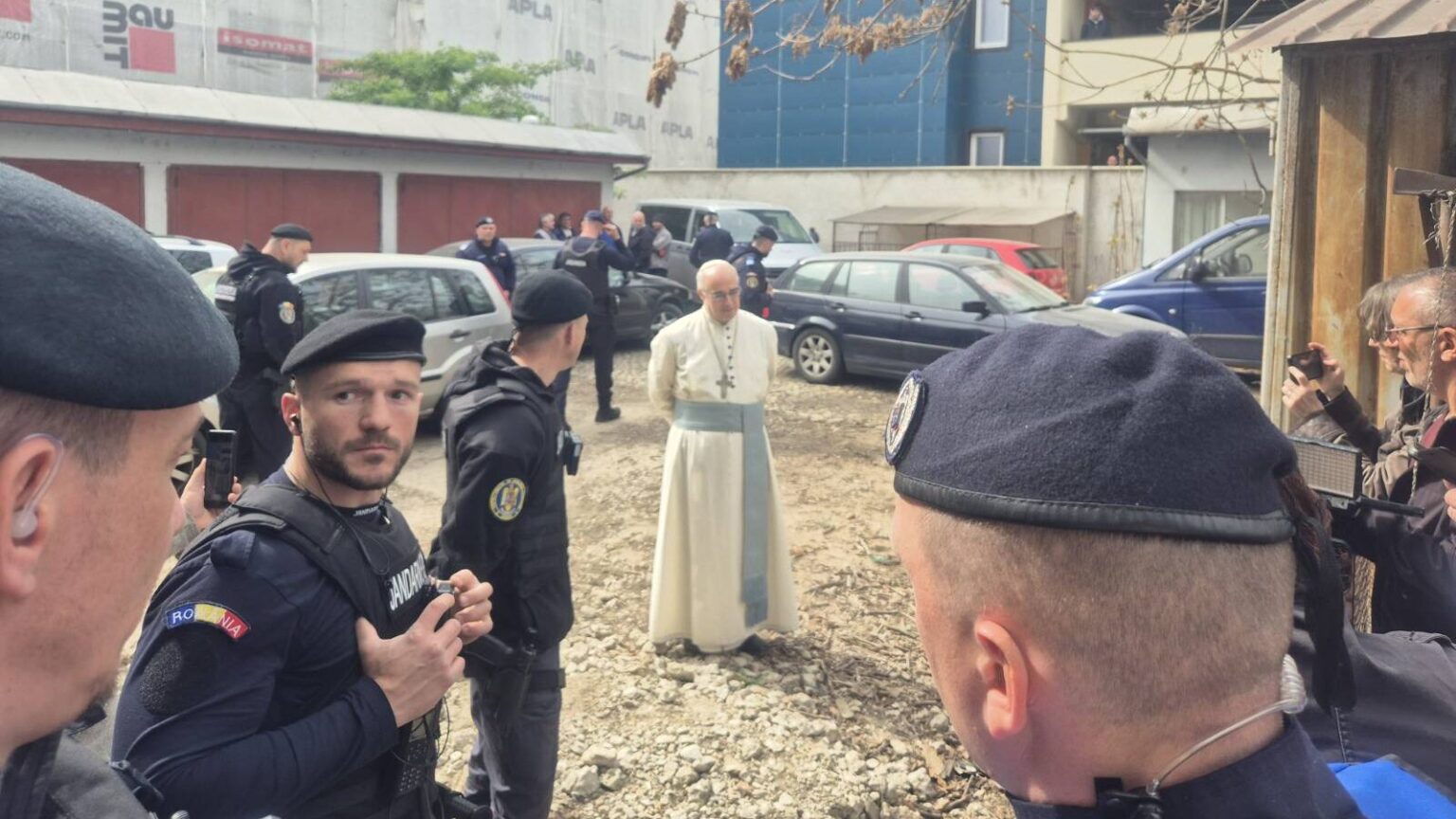
Armed Romanian gendarmes and police entered a Catholic church in Oradea (Nagyvárad), Transylvania, during a Hungarian-language Mass on 14 April to enforce the eviction of Premonstratensian abbot Rudolf Anzelm Fejes.
According to reports, officers entered the Church of Our Lady of Sorrows while the Mass was underway, before withdrawing from the nave and returning after the service ended. They then attempted to access the sacristy, where the abbot and parishioners physically blocked their entry, resulting in a prolonged standoff with a court bailiff present.
The eviction stems from a long-running legal dispute over ownership of the church complex, parts of which were confiscated during Romania’s communist era and later repurposed. The municipality of Oradea maintains that certain rooms currently used by the Premonstratensian Order belong to the city and form part of a school building slated for renovation. The abbot, however, argues that the property belongs to the Order and that the eviction procedure is unlawful.
A lower court ruled in January in favour of the municipality and authorized the eviction. Although the decision is under appeal, Romanian authorities proceeded with enforcement, citing legal provisions allowing execution despite ongoing proceedings. Earlier attempts to carry out the eviction in February were halted after hundreds of worshippers gathered to prevent it, prompting a temporary postponement.
The situation has drawn particular attention due to the manner in which enforcement was carried out. Critics, including the abbot and several Hungarian political figures, have argued that the presence of armed officers inside a church during a religious service raises serious concerns about proportionality and respect for religious space.
‘Earlier attempts to carry out the eviction in February were halted after hundreds of worshippers gathered to prevent it’
The dispute is further complicated by a planned €20 million renovation project linked to the adjacent Mihai Eminescu High School, which is expected to receive EU funding. The municipality argues that resolving the ownership issue is necessary to proceed with the investment, while opponents contend that EU-backed development should not take place amid unresolved legal claims over church property.
László Toroczkai, leader of the hard right Mi Hazánk (Our Homeland), was present at the site and described the operation as an excessive use of force against a small religious community. In a post on X, he wrote that he ‘never thought’ he would witness ‘armed Romanian gendarmes and police break into a Catholic church during a Hungarian-language Mass’, adding that nearly a hundred officers had been deployed against the congregation. He also warned that ‘if they can do this…here and now, they can do it anywhere in the future’, framing the incident as a broader precedent. Former Reformed bishop László Tőkés, a symbolic figure of the 1989 Romanian revolution, also appeared at the scene in support of the parishioners.
Nem gondoltam volna, hogy még megérem azt, hogy egy magyar nyelvű szentmise közben tör be egy katolikus templomba a felfegyverzett román csendőrség és rendőrség.
Ma átéltem ezt Szent László városában, Nagyváradon, a 18. században épült premontrei templomban, ahova azért… pic.twitter.com/bUa1eQldNi
— Toroczkai László (@ToroczkaiLaszlo) April 14, 2026
The incident happened just two days after Hungary’s high-stakes parliamentary election, which resulted in a landslide victory for the opposition Tisza party, ending the 16-year rule of Viktor Orbán and Fidesz–KDNP. Besides the two major political forces, only Our Homeland managed to enter the incoming parliament, making it entirely composed of right-wing parties, which are expected to pay special attention to Hungarian communities beyond the country’s borders.
Yet neither the outgoing nor the incoming government commented on the incident—although this is somewhat explainable during a period of political transition—and there was no immediate response from the Democratic Alliance of Hungarians in Romania (RMDSZ), which sparked outrage among many Hungarians living in Romania. Toroczkai called for both the outgoing Hungarian government and the incoming administration to intervene diplomatically.
What happens now regarding the church remains unclear. The eviction is incomplete: authorities have entered parts of the complex and inventoried property, but the abbot and a group of parishioners continue to resist removal from the sacristy. The appeal before the Oradea Court of Appeals is still pending, leaving the final legal outcome uncertain.
Related articles: