
Talha Ozturk
17 April 2026•Update: 17 April 2026
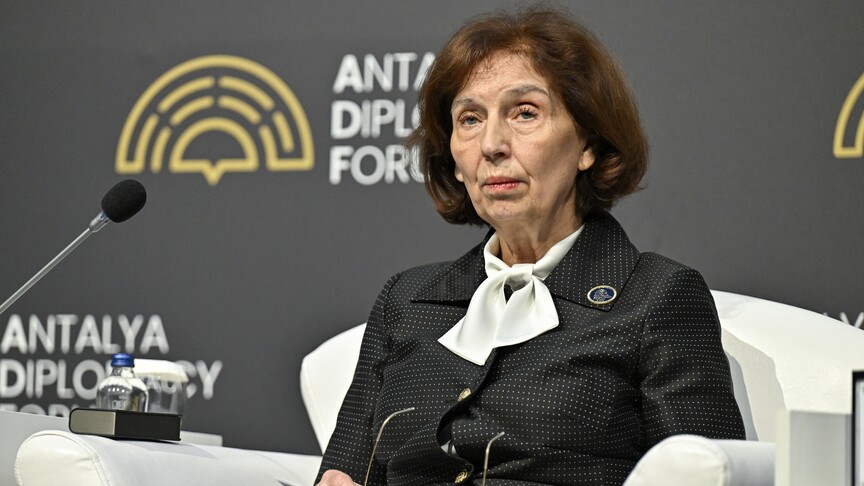
North Macedonia’s President Gordana Siljanovska-Davkova warned Friday of growing global instability, democratic decline and rising security threats, calling for stronger international cooperation and European Union enlargement.
Speaking at a panel titled “Mapping Tomorrow, Managing Uncertainties” at the Antalya Diplomacy Forum 2026, Siljanovska-Davkova said the world is increasingly shaped by power rather than law.
“The world today is based more on might than on right,” she said, pointing to what she described as a “crisis of democracy,” rising authoritarianism and deepening global inequalities.
She warned of growing security risks, including military uncertainty, hybrid threats, disinformation and cyberattacks, as well as increased global spending on arms.
Citing data from the Stockholm International Peace Research Institute, she said global military expenditures reached $2.7 trillion in 2024, describing the trend as “very worrying” amid a broader period of rearmament.
Siljanovska-Davkova also criticized the weakening of multilateralism and called for reforms to international institutions, including the UN.
“We need to strengthen the role of the General Assembly and re-examine the composition of the Security Council,” she said, also advocating for the election of a woman as UN secretary-general.
Turning to the Western Balkans, she said the region has historically been a testing ground for major powers but remains an integral part of Europe.
“The Balkans have always been historically, geographically and culturally part of Europe,” she said.
She stressed that EU enlargement should be treated as a security issue, not just a political one, arguing that resilience against external threats can only be achieved through full integration.
“Negotiations are the only path to restore peace,” she added, calling for an end to double standards in international relations and a renewed commitment to international law.
The Antalya Diplomacy Forum, hosted by Türkiye, brings together global leaders and policymakers to address geopolitical, economic and security challenges.