
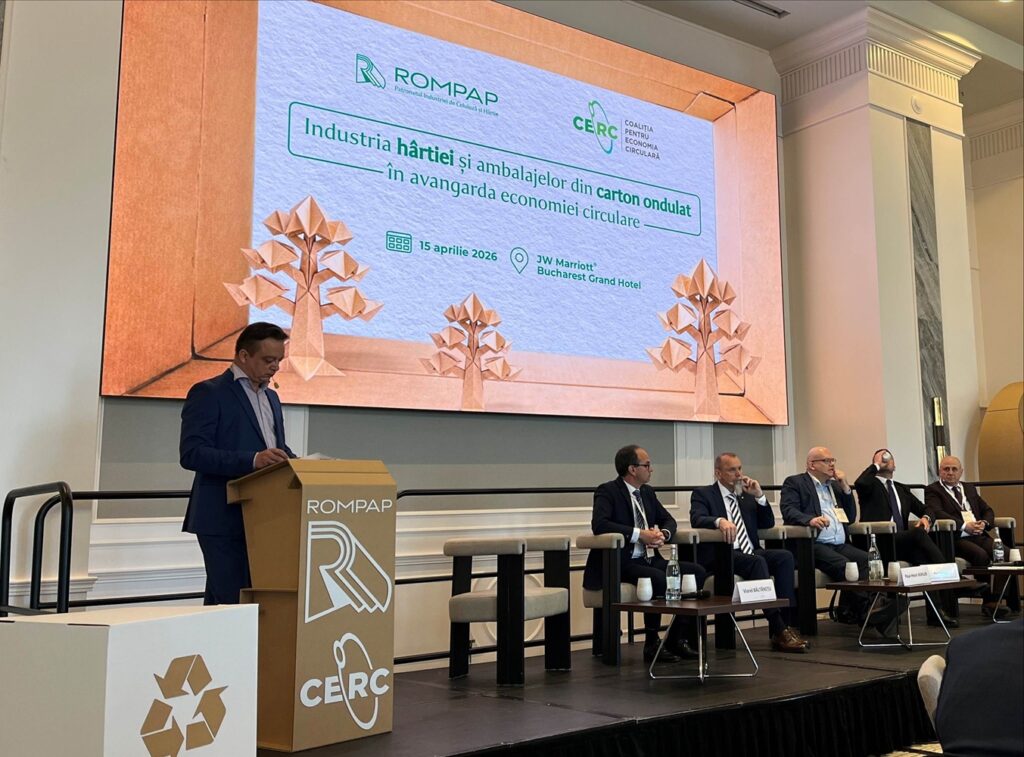
The Employers’ Association of the Pulp and Paper Industry organized in Bucharest the conference “The Paper and Corrugated Cardboard Packaging Industry at the Forefront of the Circular Economy,” a landmark event aimed at shaping the sector’s strategic directions in a context marked by energy pressures and intensifying unfair external competition. Discussions highlighted the need for a coherent support framework to ensure the competitiveness of Romanian producers and to meet national sustainability objectives.
Organized in partnership with CERC (the Circular Economy Coalition), the event provided a platform for dialogue between industry companies, representatives of relevant ministries (Environment, Economy, Energy), Members of the European Parliament, and the leadership of CEPI and FEFCO. The agenda focused on optimizing waste collection systems and identifying solutions to strengthen the industry in the face of current challenges.
“The paper industry plays an essential role in the national economy, supplying products to numerous strategic sectors and contributing directly to the circular economy. However, its high energy consumption makes it vulnerable to energy price fluctuations, and in this context Romanian producers face a significant competitive disadvantage compared to competitors outside the European Union, who benefit either from lower costs or from national support policies,” said Paul-Henri Kohler, President of ROMPAP.

Cristian Bușoi, State Secretary within the Ministry of Energy, confirmed the institution’s openness to identifying solutions to these challenges, in the context of pressures generated by unfair competition from outside the European Union.
He emphasized that two major factors influence the industry’s competitiveness: access to raw materials and energy costs. Regarding raw materials, he highlighted instances of unfair competition from outside the European Union, particularly in relation to Turkey, and stressed the need for cooperation with the Ministry of Foreign Affairs to identify the best solutions at the European level. At the same time, in the energy sector, Romania and the European Union are pursuing short- and medium-term price reductions as part of efforts to enhance competitiveness, a strategic direction that complements energy security and decarbonization objectives.

Viorel Băltărețu, State Secretary at the Ministry of Economy, underlined the importance of the sector and noted that, at the governmental level, support measures for energy-intensive industries are being analyzed to help them cope with the current geopolitical-driven energy pressures.
He also pointed to the issue of unfair competition from Turkey, which has introduced tariff barriers for European producers in the absence of reciprocal measures from the European Union. He added that trade relations with Turkey fall under the single market’s trade policy and that several response mechanisms already exist at the European level, including protective measures for certain product categories. He mentioned that the topic has been discussed within the Ministry of Economy and expressed openness to further developing it in order to build a solid case to be presented to the European Commission.

Nicu Ștefănuță, Vice-President of the European Parliament, stated that he will support raising this issue at the European level. He noted that access to other markets depends on policies set at the European Union level and emphasized his willingness to contribute both nationally and through the European Parliament, as well as openness to involving other relevant stakeholders in a constructive dialogue.
Marius Juncanariu, Vice-President of ROMPAP, highlighted the challenges related to recycling at the population level and the importance of public communication.

“There are still real difficulties when it comes to recycling at the population level, particularly due to misconceptions about what happens to waste after collection. It is essential to improve communication and develop educational campaigns that explain both the correct way to carry out separate collection and the importance of this process. People need to understand that maintaining the quality of collected waste is crucial for recycling and that it has real economic value. Without this understanding, collection efforts risk being perceived as ineffective or lacking impact,” he emphasized.
The conference highlighted the need for an integrated approach combining European and national policies with investments in infrastructure, consumer education, and industry support.
Participants emphasized that achieving circular economy objectives depends on coherent regulations, competitive production costs, and the continuous improvement of actual collection and recycling rates.