
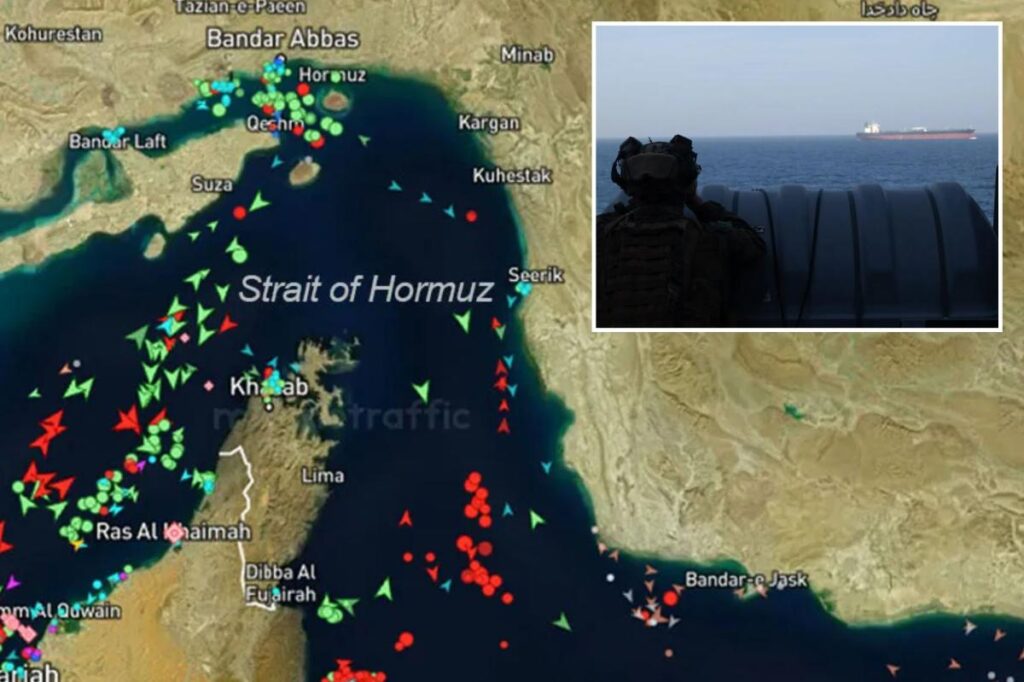
Iran’s foreign minister announced Friday that the Strait of Hormuz is now “completely open” for all commercial ships — as President Trump said the US would take all of Tehran’s leftover nuclear fuel.
The developments are being viewed by markets and world leaders as steps in the right direction, and while the Iranian regime is still quibbling and contradicting Trump, he appears optimistic that remaining disagreements will be ironed out.
“In line with the ceasefire in Lebanon, the passage for all commercial vessels through the Strait of Hormuz is declared completely open for the remaining period of the ceasefire,” Iranian Foreign Minister Seyed Abbas Araghchi said in a post to X.
He did not specify whether that was the 10-day cease-fire between Israel and Lebanon went into place on Friday or the one between the US and Iran that is ending on Tuesday.
U.S. Marines from the 31st Marine Expeditionary Unit, and Sailors assigned to the amphibious transport dock ship USS New Orleans. US Central Command
However, the foreign minister added that the critical passage is only open “on the coordinated route,” referring to a pathway approved earlier this month by Iran’s Islamic Revolutionary Guard Corps in connection with its plan to charge a toll to transit through the strait.
All commercial ships planning to sail through must also receive permission from Iran’s Revolutionary Guard, a senior Iranian official told Reuters.
The official added that military vessels were still prohibited from crossing the strait.
Trump later took to Truth Social to tout the news himself, but said that the reopening of the critical chokepoint — which carries roughly 20% of the world’s oil — would instead be permanent.
“Iran has agreed to never close the Strait of Hormuz again,” he wrote. “It will no longer be used as a weapon against the World!”
Increased marine traffic in and around the Strait of Hormuz at 11 PM local time, April 17, 2026. MarineTraffic.com
Marine traffic at 6:30 PM local time, April 17, 2026. MarineTraffic.com
The commander-in-chief, however, insisted that the US naval blockade on Iranian ships and ports would remain until Tehran signed a deal with Washington to end the war.
Maintaining the blockade allows the US to hold its leverage against Iran — to force the theocratic regime to come to the table for peace talks and agree to a fair deal, while allowing commercial ships to access the waterway.
Iran, however, has threatened to take “necessary measures” if the US does not lift the blockade.
“If the other side chooses to break its commitments, which it appears it intends to do, and if the naval blockade continues, the Islamic Republic of Iran will in response take the necessary measures, and there is no doubt about this,” Iranian Foreign Ministry spokesman Esmail Baghaei said in remarks to state-run media.
Baghaei claimed “contradictory positions” have been put out by the Trump administration.
Trump, speaking to reporters in Phoenix, downplayed the notion there were “significant differences” between Washington and Tehran.
“Well, there could be, let’s see what happens,” the president said.
“If there are, we’ll have to straighten it out. But I don’t think there’s too many significant differences,” Trump insisted.
Trump also said that Iran and the US were working together to remove all sea mines in the strait. Iran had littered the passage with explosives during the war.
Once those are cleared, there would not be a reason for ships to be required to sail only along Iranian-approved routes.
“Iran, with the help of the U.S.A., has removed, or is removing, all sea mines! Thank you! President DJT,” he wrote on Truth Social.
President Trump and Iranian Foreign Minister Seyed Abbas Araghchi on Friday announced that the Strait of Hormuz is now “completely open” for all ships, so long as the Israel-Lebanon cease-fire remains in place. AP
Crude oil prices plummeted after the announcement, with Brent crude dropping 11% to $88 per barrel and West Texas Intermediate declining 10% to $81.
United Nations Secretary-General António Guterres called the reopening of the strait “a step in the right direction.”
Meanwhile, it was unclear whether the reopening meant Iran would stop charging commercial vessels tolls in order to pass through the strait safely.
“It seems to me that he [the foreign minister] is saying that any country now can get through, but they still have to pay the toll,” Trita Parsi, executive VP of the Quincy Institute in Washington, DC, told CNN.
After the announcement, Trump railed against NATO, blasting the alliance as a “Paper Tiger.”
The US will maintain its blockade of Iranian ports — which does not impede other traffic — to keep the pressure on for Tehran to come to the table for a peace deal, he added. US Central Command
“Now that the Hormuz Strait situation is over, I received a call from NATO asking if we would need some help. I TOLD THEM TO STAY AWAY, UNLESS THEY JUST WANT TO LOAD UP THEIR SHIPS WITH OIL. They were useless when needed, a Paper Tiger!” President DJT” he wrote on Truth Social.
Trump also announced in a separate Truth Social post that Iran would turn over all remaining enriched uranium — a key point he had been seeking since well before the war began.
“The U.S.A. will get all Nuclear “Dust,” created by our great B2 Bombers – No money will exchange hands in any way, shape, or form,” he said.
He later confirmed it to Reuters, saying the US would recover uranium from Iran at a “leisurely pace.”
“We’re going to get it together. We’re going to go in with Iran, at a nice leisurely pace, and go down and start excavating with big machinery… We’ll bring it back to the United States,” he said.
Iran’s foreign ministry spokesman, however, was adamant the radioactive material wouldn’t be leaving the country.
“Iran’s enriched uranium will under no circumstances be transferred anywhere,” Baghaei said on state-run TV.
“Transferring uranium to the United States has not been an option. Just as Iran’s soil is sacred, enriched uranium is the same,” he added.
“There is no ambiguity regarding any part of the negotiations,” Baghaei continued. “We have clearly stated our positions.”
The Iranian official noted lifting of sanctions and compensation for war damages were of “particular importance” to the regime.
As part of a first phase of a potential deal to end the war, the US is considering releasing $6 billion in frozen Iranian assets, with the potential to ultimately release a total of $20 billion over a two-to-three year period, a source familiar with discussions exclusively told The Post on Friday.
The asset release would be contingent on Iran meeting certain conditions. It is unclear what those conditions would be.
The president, in another announcement on Truth Social, stressed that the achievement is not dependent on Israel’s war with Lebanon — as Iran’s foreign minister had suggested — while also putting the Jewish state on notice.
“This deal is in no way subject to Lebanon, either, but the USA will, separately, work with Lebanon, and deal with the Hezboolah [sic] situation in an appropriate manner. Israel will not be bombing Lebanon any longer. They are PROHIBITED from doing so by the U.S.A. Enough is enough!!! Thank you! President DJT,” he wrote.
U.S. Marines from the 31st Marine Expeditionary Unit, and Sailors assigned to amphibious transport dock ship USS New Orleans (LPD 18) support blockade operations against Iran, on April 16. US Central Command
Follow The Post’s coverage on the latest in the war with Iran:
Iran had initially claimed that Lebanon was included in the US-Iran cease-fire, but Washington held firm that Israel’s battle with the Iranian proxy group was not included.
Meanwhile, a group of around 20 ships, including container ships, bulk carriers and tankers, was seen sailing in the Gulf towards the exit via the Strait of Hormuz on Friday evening, ship-tracking data showed.
Data from shipping tracker MarineTraffic showed that the cruise ship Celestyal Discovery was the first passenger vessel to transit the Strait of Hormuz since the start of the conflict.
The US-Iran cease-fire — which is set to expire Tuesday — has set the stage for peace talks between the two countries. There has been no agreement to extend the US-Iran cease-fire.
Mediator Pakistan is working to arrange a second round of talks, but the parties have yet to formally commit.
A senior White House official told the Wall Street Journal that negotiations are likely to take place in Islamabad on Monday.
With Post wires