
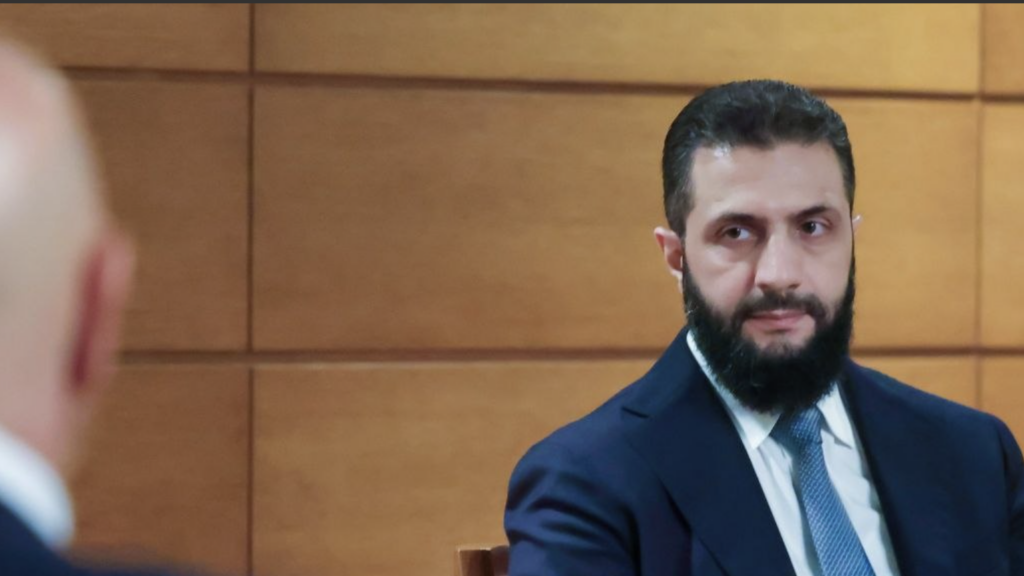
[DAMASCUS] Syrian President Ahmed al-Sharaa revealed new details about indirect negotiations with Israel, saying the contacts were meant to contain growing regional tensions and open channels for de-escalation despite ongoing political and military tensions.
Al-Sharaa explained, in statements carried by Turkish media, that the negotiations were not direct but were conducted through regional and international intermediaries. He noted that their primary objective was to reduce the likelihood of sliding into a broader confrontation, particularly amid rising tensions on multiple fronts.
These remarks come against the backdrop of a highly tense environment, as the region has witnessed months of increasing military escalation, whether along the Lebanese-Israeli border or the indirect confrontation between Israel and Iran through multiple regional actors.
Syria remains an arena of overlapping regional and international influence, making any political or negotiating move subject to complex calculations that go beyond a bilateral framework to broader balances between major powers and local actors.
Indirect negotiations reflect a recurring pattern in the management of the Arab-Israeli conflict, where communications are often conducted through intermediaries to bypass political sensitivities and the absence of direct recognition.
Al-Sharaa, who is participating in the Antalya Forum in Turkey, added that these contacts have focused on sensitive issues, including security arrangements and efforts to regulate the pace of confrontation, as well as the introduction of the possibility of interim understandings, without rising to the level of a comprehensive agreement.
This approach indicates that the negotiations, in their current phase, fall within what is known as “conflict management” rather than a final resolution, as the parties seek to minimize losses and prevent a major escalation instead of addressing the deeply rooted core issues.
The Syrian president stressed that his country is not seeking escalation but, at the same time, will not make concessions that affect its sovereignty or strategic interests. This position reflects the balance Damascus is attempting to maintain between engaging in de-escalation efforts and avoiding the appearance of political retreat.
He pointed out that intermediaries have played an important role in conveying messages between the two sides, given the lack of trust and the absence of direct communication channels, which makes these negotiations complex and slow-moving.
This suggests that the success of this track depends largely on the effectiveness of the mediators, who are often regional or international powers capable of influencing the decisions of the parties, whether through pressure or political incentives.
At the same time, these channels remain vulnerable to collapse at any moment, particularly if military operations on the ground intensify— something al-Sharaa identified as a decisive factor in the continuation or suspension of the negotiations.
These developments point to a gradual shift in the approach to the conflict, where military confrontation is no longer the primary tool and indirect diplomacy is playing an increasing role even between parties that do not maintain official relations.
The moves also reflect a mutual recognition that slipping into a full-scale war could be costly for all sides, prompting a search for temporary de-escalation frameworks despite the persistence of deep disagreements.
At the same time, the lack of trust and the significant divergence in strategic objectives make it difficult to achieve a real breakthrough in the near term, suggesting that these contacts may remain within the scope of crisis management rather than resolution.
In his concluding remarks, al-Sharaa stated that the current phase requires a high degree of caution in handling sensitive issues, affirming that his country is monitoring these contacts within a broader vision aimed at safeguarding regional stability.
The future of these negotiations appears likely to remain contingent on developments on the ground, as well as on the willingness of the parties to make mutual concessions, an area where indicators remain limited so far.