
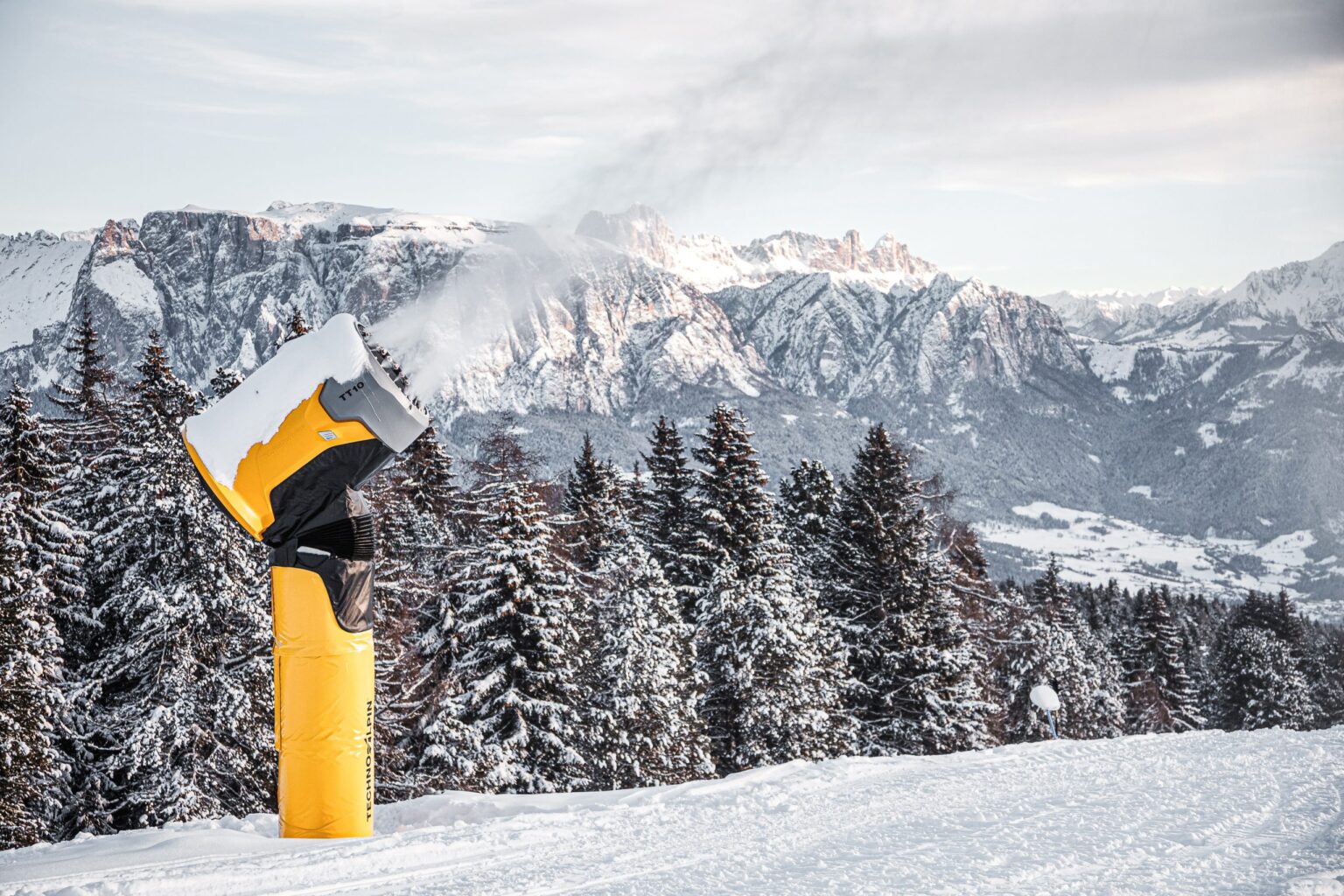
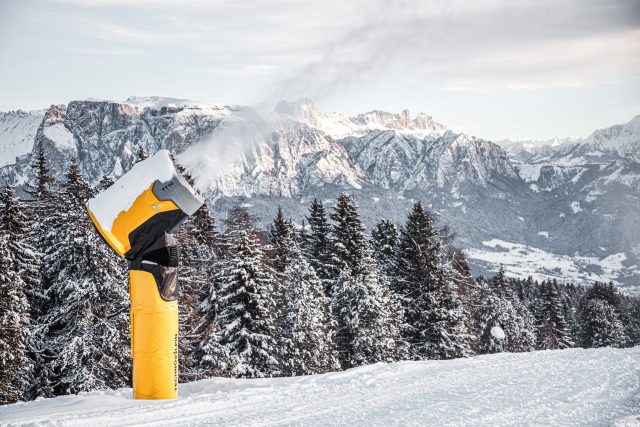
 All snowmaking is not created equal — TechnoAlpin TT10 snow cannon. | Image: TechnoAlpin
The familiar argument that skiing in the era of climate change, which has increasingly become reliant on snowmaking, is environmentally indefensible is facing new scrutiny from a recent study. New research from the University of Innsbruck challenges the assumption that snowmaking inherently carries a large carbon footprint. Instead, the 2026 study emphasizes that the key variable is the energy mix behind the snow making.
The study by Günther Aigner et al estimates total annual snowmaking emissions in Austria at between 6,246 and 7,424 tonnes of CO₂, which equates to roughly 120 to 140 grams of CO₂ per skier visit. The result sits in stark contrast to a Canadian study from 2023 which calculated a nationwide CO₂ emission of 130,095 tonnes annually for snowmaking, or 6,670 grams per skier visit (based on 19.5 million skier visits for Canada). The difference between the Canadian and Austrian study are two-fold. Data from the Austrian study is more recent, using data from the 2022-23 and 2023-24 season, while the Canadian study based in on data from the previous 15 years (2008-2023). In that time, snowmaking technology has evolved significantly, resulting in more energy-efficient systems. More importantly however, the CO₂ emission is directly connected to the energy mix.
Austrian snowmaking carries a light carbon footprint for a structurally simple reason. In 2024, renewable energy made up 88.6% of Austria’s total electricity generation, with hydropower alone accounting for up to 67%. In Austrian ski resorts, 100% of the energy comes from hydropower, so when a snow gun fires up in the Arlberg or the Kitzbühel Alps, it is powered by water falling through turbines in the same mountain range that surrounds it. Aside from the use of renewable energy, Austrian snow making systems are highly efficient. The electricity requirement for Austrian snowmaking of 281 GWh per season corresponds to just 0.46% of Austria’s total national energy consumption 0.009-0.01% of Austria’s annual national emissions of 72.8 million tonnes.
The Canadian study, covering 136 ski areas across Alberta, British Columbia, Ontario, and Quebec, tells a story of extraordinary internal divergence driven almost entirely by provincial electricity grids. Quebec, powered by 94% hydropower and 5% wind, is Austria’s North American twin. Its snowmaking emissions run at just 17 grams of CO₂ per skier visit (based on 103 tonnes of CO₂ emission and 6 million skier visits). The number for Quebec sits significantly below Alberta, whose electricity grid is dominated by natural gas and coal. Alberta by contrast carries a carbon intensity of 7,370 grams of CO₂ per skier visit. British Columbis comes in at 554 grams, while Ontario sits at 520 grams according to Knowels et al. The massive difference between Alberta and Quebec means that despite producing only 39% of Canada’s machine-made snow, Alberta is responsible for 96% of the country’s entire snowmaking carbon emissions.
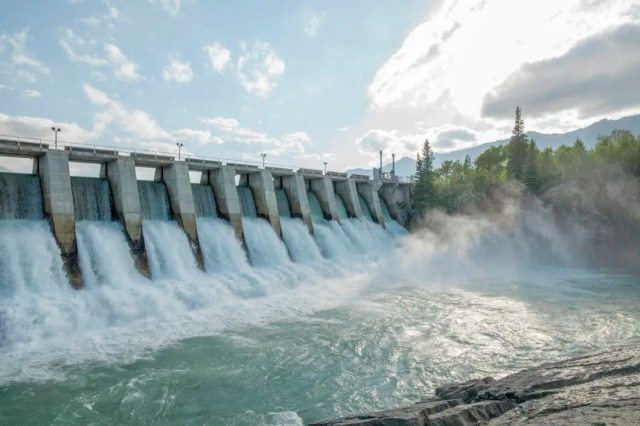 The most important variable is the energy mix. | Image: Waterpower Canada
Austria or Quebec’s near-negligible snowmaking footprint is not the result of more virtuous resort operators or superior engineering — it is the structural dividend of an electricity system built on alpine hydrology. Austria has a statutory target of 100% renewable electricity by 2030, and its last coal plant closed in 2020. Likewise, under current Canadian policy to decarbonize provincial electricity grids, even a scenario of 81% more snowmaking by the 2050s would result in national snowmaking emissions falling by 96% to around 4,700 tonnes of CO₂ — a number that would finally be comparable to Austria’s present-day baseline. The emissions problem is not intrinsic to snowmaking. It is intrinsic to fossil fuel electricity.
Both studies converge on a conclusion that the ski industry finds simultaneously reassuring and uncomfortable: snowmaking is not the primary sustainability problem in either market.
The Canadian researchers offer a particularly striking illustration. Quebec’s estimated 103 tonnes of annual snowmaking CO₂ enables nearly six million skier days of activity. The same emissions would be generated by roughly 65 round-trip flights from Montreal to Vancouver to ski at Whistler. In other words, the climate impact of snowmaking in a low-carbon grid province is marginal compared to long-distance travel.
The Innsbruck study reinforces this framing from a different angle, noting that snowmaking emissions per skier visit are equivalent to driving roughly 0.9 kilometers (0.6 miles) in a petrol or diesel car. When powered by low-carbon electricity, the climate impact of snow production becomes comparatively small, particularly when set against transportation to and from ski resorts. With a 66%-share of foreign guests to Austrian ski resorts, traveling large distances by car or plane from Germany, the Netherlands, or even further afield, the path to climate-neutral skiing is not driven by improvements in snowmaking efficiency but rather by improvements in environmentally friendly guest travel options.
The Canadian study reaches a similar conclusion and notes that Quebec’s snowmaking emissions, while enabling millions of skier visits, would be entirely outweighed if even a small fraction of skiers were forced by poor local conditions to fly elsewhere for their winter holidays. In that scenario, reduced snow reliability could increase total emissions rather than reduce them. So in a way, the considerable snowmaking infrastructure in Quebec actually helps keep travel to a minimum and reduces the province’s CO₂ emissions.
Across both datasets, the pattern is consistent: transportation and accommodation dominate the carbon footprint of ski tourism, while snowmaking represents a relatively small share of total emissions.
This has important implications for the United States, where ski resorts operate across highly divergent electricity systems. California’s rapidly decarbonizing grid, driven by large-scale solar, wind, and hydropower, supports a lower-carbon operating environment. Colorado is mid-transition, with growing renewable capacity offset by continued natural gas reliance. Utah remains more fossil-fuel dependent, increasing the carbon intensity of otherwise identical snowmaking systems. In the Northeast, states such as New York and Vermont benefit from a comparatively cleaner mix that includes hydropower, nuclear generation, and expanding offshore wind.
For ski resorts, this means emissions are not solely an operational choice. The same snowmaking system can produce radically different climate outcomes depending on the underlying electricity grid. That reality places electricity policy at the centre of ski industry decarbonization. While improvements in snowmaking efficiency continue to deliver incremental gains, the studies suggest that the largest emissions reductions will come from grid-level change rather than equipment upgrades. In practical terms, what powers the snow gun matters far more than the snow gun itself.
The technology, in other words, has already evolved. The electricity grid is what needs more transition in North America to effectively reduce the carbon footprint of snowmaking.
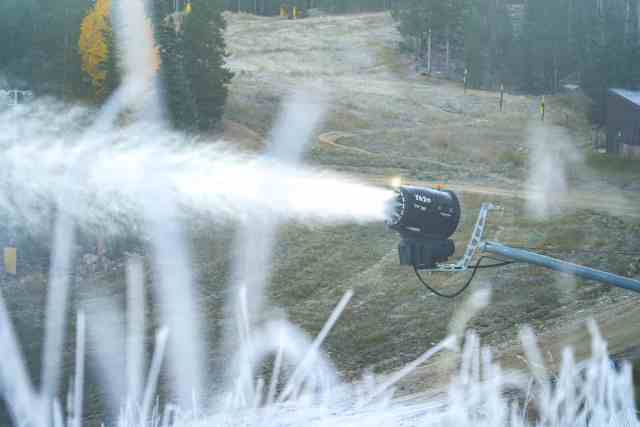 Snowguns blazing at Keystone Resort, CO. | Image: Katie Young / Keystone Resort