
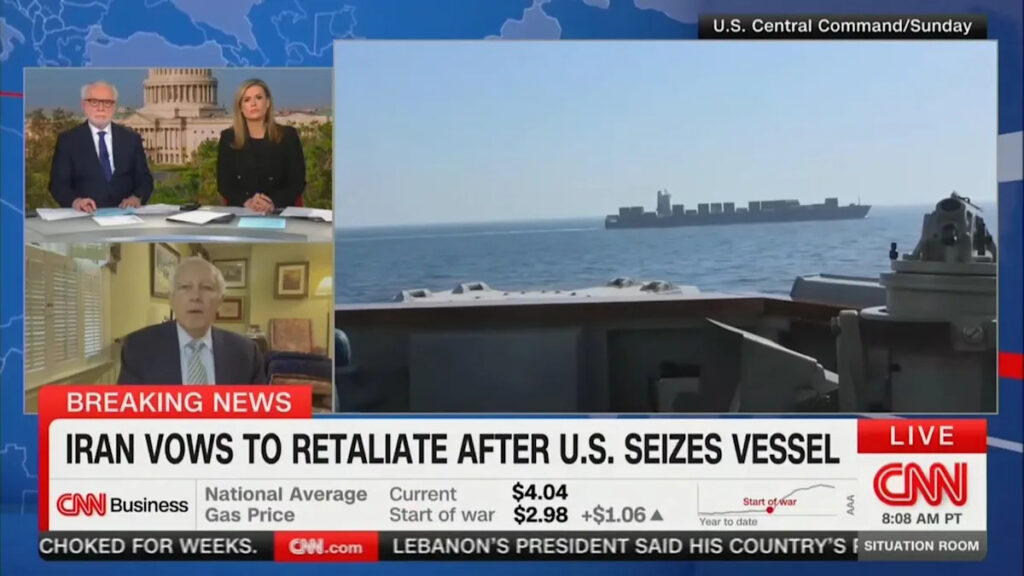
Wesley Clark, the retired U.S. Army General and former Supreme Allied Commander Europe (NATO), joined CNN anchors Wolf Blitzer and Pamela Brown on Monday morning to discuss the latest developments in President Donald Trump’s military campaign against Iran.
Blitzer began the discussion by asking, “How important was it for the U.S. to actually have a show of force and seize that Iranian vessel?”
“I think it was critical that we did that. I mean, we said there was going to be a blockade. They ran the blockade, we took the ship. That’s what we had to do,” replied General Clark unequivocally.
Brown added, “So, just to follow up on that, what do you make of this Iranian ship trying to — apparently according to U.S. Central Command — break this blockade during this very fragile ceasefire period? And why is it that the U.S. has the capability to effectively keep Iran’s ports closed but is unable to keep the Strait of Hormuz open?”
General Clark replied at length, “Well, I’m sure the Iranian ship was in contact with Iranian authorities. It was an Iranian-owned ship, so they would have had control of it. It was a test. They wanted to see if we would stop it. We did stop it; they wanted to see how we would do it. Opening the Strait of Hormuz by force — that’s an entirely different issue. That’s a much, much tougher problem. I don’t know if we have a military option to do it, really. People talk about the mines, but it’s the mines, the speedboats, the missiles, the sea-skimming missiles, cruise missiles, ballistic missiles, possible artillery fire that could be brought to bear.” He continued:
This is a very constrained area. It’s been fortified for years, and the Iranians have certainly taken lessons. They have Chinese technology. They’ve got real-time observation of our fleet as we’re moving in it. This would be a real dogfight if we went in there, and it’s much more than simply saluting a couple of destroyers with guns bristling, or putting a minesweeper in. This is not the late 1980s tanker war.
This is something entirely different. And the Iranians now know they’ve got a real strategic asset — more useful than a nuclear weapon. And they’ve used it, and they don’t believe we have an answer for it. They know we don’t want to commit ground troops. They know we don’t want to take losses. We don’t get our ships close enough to be hit by their missiles. They’ve practiced using the Houthis to go against our ships. They know how good we are and how good they are. And so this is a real tough military problem. That’s unfortunate, because it’s driving their stance in the negotiations.
Blitzer followed up, “President Trump, as you know, general, has threatened — in his words — ‘no more Mr. Nice Guy’ if Iran doesn’t come to a peace agreement with the U.S. How hopeful are you that a deal will be reached before this very, very fragile ceasefire ends this week? It’s supposed to be over this week — how hopeful are you that it could be extended and that real peace could eventually emerge?”
General Clark answered, “I think it will be extended, but just imagine how complicated these negotiations are. First of all, you’ve got multiple issues: you’ve got the nuclear issue, the militia issue, Hezbollah, the Houthis, the missile issue, and then who’s in charge in Iran. And then you’ve got U.S. politics involved — the president and the way he leads and works it — and then you’ve got the mediators, and then China on the outside pushing on Pakistan and on the Iranians.” He concluded:
Very, very complicated, very difficult. So when we say a solution, maybe you get a fragment of a solution — some talking points — but you’ve got to be careful, because talking points aren’t complete and they can be misunderstood. Maybe that’s what happened on Friday and Saturday when the president said the strait was going to be open.
He took it as you would and said, “By golly, we’ve won. We got this thing open.” And then it was not so fast. So this is a really, really complicated negotiation. The problem we’ve got is you can’t solve this with a couple of handshakes and four hours on the ground in Islamabad. If you can’t solve it that way, I guess you’re going to extend it. And we’ve said all along we didn’t want it to be extended — we wanted to set a hard deadline and force Iran to come to the table — because we believe it’s in their interest, not ours, to keep dragging this out, because they think we have a shorter timeline than they do.
We think their timeline is short because we’re going to cut off their economy. They think our timeline is short because the price of gasoline is going to go up and there’s an election cycle coming — an election this year. So they think they’ve got a squeeze on us if they can extend this. All of these factors are involved in this negotiation. But if I had to guess, I’d say 70-30, 80-20 — it gets extended.
Watch the clip above via CNN.
The post ‘Critical’: Ex-NATO Leader Praises Trump for Seizing Iranian Ship first appeared on Mediaite.