
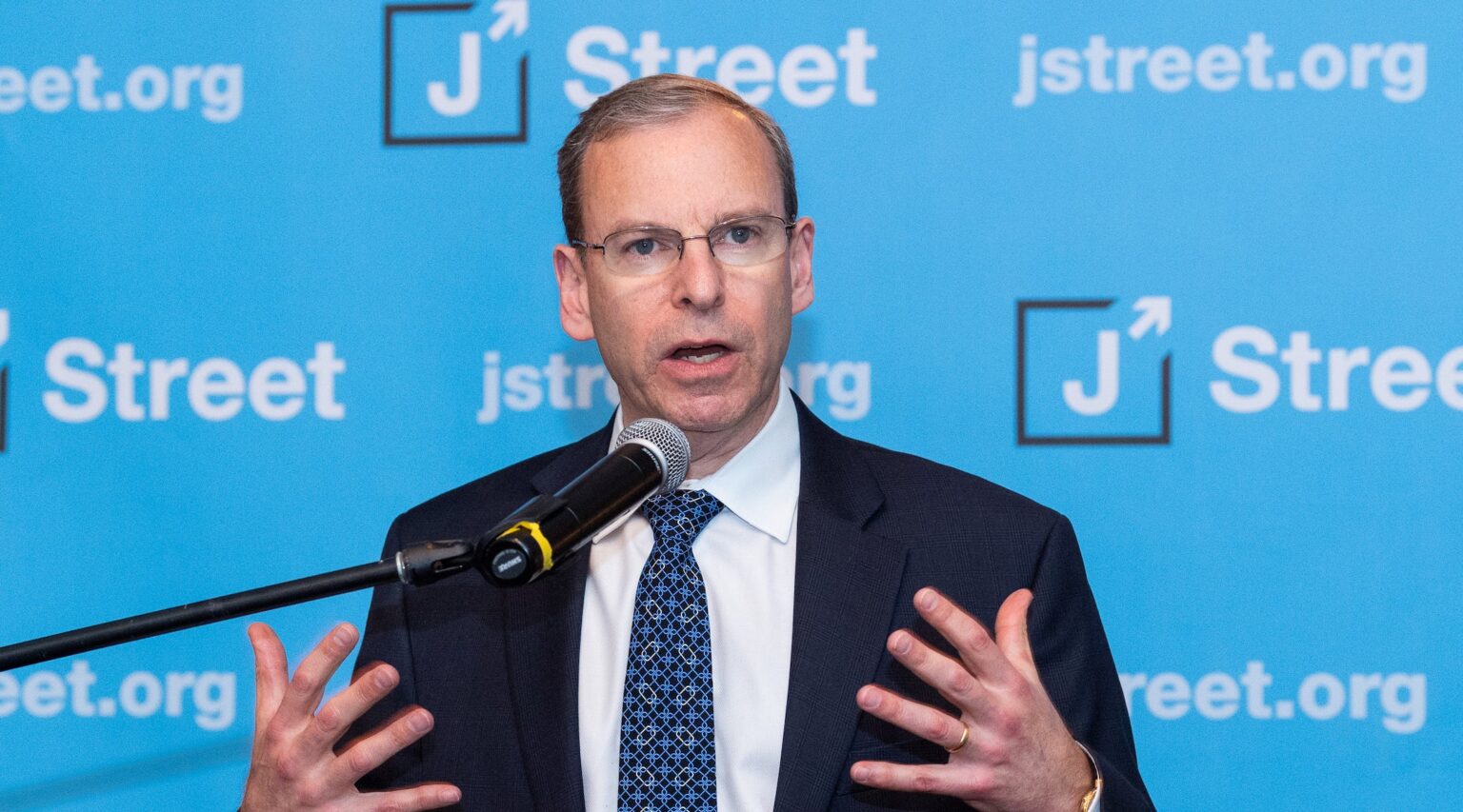
J Street founder and President Jeremy Ben-Ami was in Pittsburgh last month participating in the Jewish Community Center of Greater Pittsburgh’s inaugural “Come Curious. Leave Wiser” series. He appeared alongside New York Times opinion columnist Bret Stephens.
While the JCC event was not open to the press, Ben-Ami recently spoke with the Chronicle about some of the topics raised during his conversation with Stephens, as well as other issues relevant to Pittsburgh’s Jewish community.
This interview was edited for length and clarity.
Rep. Summer Lee recently appeared with Hasan Piker at a campaign event in Michigan for Senate hopeful Abdul el Sayed. I’m wondering what your thoughts were about the event.
Well, I’ll just say that in the Senate race in Michigan, J Street is publicly endorsing Mallory McMorrow. We’re happy to make that clear. We are very excited by her candidacy, and think she really represents J Street’s values. So that’s who we’re supporting in that particular race. And you know, I think I’ve also said publicly … that it is so unhelpful to have these polarizing media figures like Piker who are not helping our politics and not helping our country in coming together. The way in which he operates is not helpful. I don’t think that candidates need to avoid going on his show, but I do question when they appear on the campaign trail publicly with him. I think those are two different things.
J Street has endorsed Summer Lee in the past. That is not the case now. Why?
Well, it’s mutual. It’s our whole endorsement process. Every cycle is mutual. And you know this was a mutual parting of the ways, because we’re not as aligned as we might have thought.
Where is the line? Lee has said Israel is committing genocide, but so has McMorrow. I think you came out and said you believe that, as well. So, can you clarify.
The specific thing I said on the genocide issue is that I’m not going to argue against people who say it is. And you know, J Street as an organization doesn’t unendorse people for calling it a genocide — a lot of folks have at this point. You know, that is not a standard for us, but it’s not a word that I use. I don’t use that word. I’m very uncomfortable with it, and J Street doesn’t proactively call it that either, but we’re not unendorsing people who do use that, who are on our list. So that was not the issue. This is a new [election] cycle and Summer Lee did not ask for our endorsement. We didn’t offer our endorsement, and it was a mutual parting.
In the last week, J Street has come out and said the United States should end its financial support for arm sales for Israel, correct?
Yes. When the MOU (the Memorandum of Understanding, signed in 2016 and ending in 2028, in which the U.S. pledged $38 billion to Israel) ends, then there’s got to be a new arrangement. And our view is that it’s a good thing for Israel to take this issue out of the political maelstrom. It’s a wealthy enough and prosperous enough country, it can afford to buy the weapons that it needs, and that specifically includes Iron Dome. I mean, I want to make that clear. We really value Iron Dome and think that it’s important, and it was jointly developed, and it’s just that Israel can now pay for it.
So you have no problem with the United States selling weapons to Israel?
No.
I think the statement I saw was that the United States should treat Israel the same way it does other allies. But that seems to beg the question: Doesn’t the U.S. fight many wars for its allies? Are you afraid of the consequences of how it might turn out if the U.S. treats Israel like it does all of its other allies?
I think that there’s a range of very important relationships that the U.S. has with industrialized and developed nations all over the world, whether it’s Japan or South Korea or Australia or NATO, and Israel’s relationship with the U.S. should be the same as those relationships. It should be a very solid security relationship — military cooperation, intelligence sharing, sales, technology development. That’s how other countries operate with the U.S., and that’s the way Israel should operate with the U.S.
J Street has pivoted from talking about a two-state solution between Israel and the Palestinians to a 23-state solution. Given the events of the last few years in the Middle East, do you believe that’s a viable option?
I hope so. It’s the most important and significant positive development that has happened in the course of Israel’s history. And one hopes that this government of Israel hasn’t pursued a path that makes it hard to get back to. That opportunity is so important. So, you know, there’s an election coming up in Israel in October, and hopefully these wars are winding down. And my hope, as somebody who cares deeply about Israel, is that there is going to be an opportunity with a new government of Israel to pursue full regional normalization.
And how does the 23-state solution that J Street is promoting differ from the Abraham Accords?
The key difference is that one of the 23 states is the state of Palestine. The process of completing regional normalization has to include the development and creation of a successful Palestinian state. And that’s a condition on the side of the Arab countries at this point, as well. You know that they are not going to proceed any further with normalization, until the fundamental conflict here, which is between Israelis and Palestinians, has a pathway to being resolved.
Do you believe the 23-state solution will end the existential threat to Israel?
I think the real existential threat to Israel as a Jewish and democratic state, and Ehud Barack said this about 20 years ago, is the failure to figure out what to do about the Palestinians. You know, if you continue to have more Palestinians living between the river and the sea than Jews, and you don’t give them rights, you are really putting the whole project of Israel at existential risk. So, that is the existential risk, and the only way to solve that is for Palestinians to have a state of their own. PJC
David Rullo can be reached at drullo@pittsburghjewishchronicle.org.