
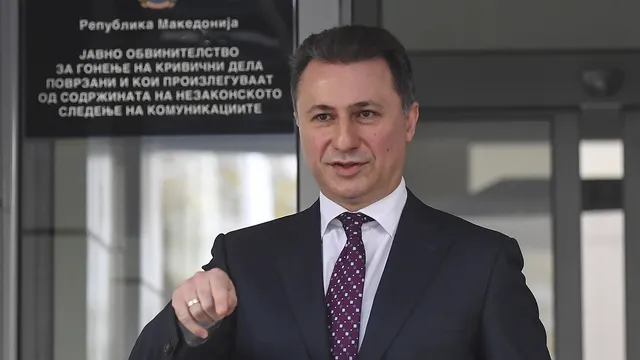
The opposition says the former prime minister is being shielded from extradition, with Budapest and Belgrade accused of helping keep him out of the reach of Macedonian justice.
Former PM Nikola Gruevski’s passports have become a new flashpoint in North Macedonia’s political clash. The Social Democratic Union (SDSM) said it had received information that the former prime minister now holds Hungarian and Serbian passports, while the government is taking no steps to bring him back to Macedonia and have him face justice.
SDSM says that if the information about the Serbian and Hungarian passports is true, it would mean that Gruevski still has political allies and protectors behind him. In the party’s statement, Viktor Orban and Aleksandar Vučić are named as such figures, and are also linked to the current authorities in Macedonia.
At the centre of the reaction is also the issue of Gruevski’s extradition from Hungary. SDSM said the government’s inaction and its persistent refusal to send a new extradition request leave him room to manoeuvre and, in practice, amount to political protection for Gruevski.
The party compares the conduct of the Macedonian government with that of other countries, saying Poland acted quickly in similar situations, while the current prime minister, according to SDSM, is “buying time” for Gruevski.
Hungarian outlet Telex reported a few days ago that the extradition request submitted by the previous government of North Macedonia had expired and that the current authorities had not renewed it. In addition, there is no active Interpol warrant against him. Nikola Gruevski currently has political refugee status in Hungary. This status protects him from extradition, but it is not permanent and can be revoked if the Hungarian authorities determine that the original grounds for granting asylum were not valid.
The issue of politically sensitive asylum cases in Hungary has returned to the spotlight following recent political developments and calls for a review made by Péter Magyar, leader of the opposition Tisza party and Hungary’s future prime minister. He said the country is not a dumping ground for internationally wanted criminals and announced that several high-profile asylum cases, including that of the former Macedonian prime minister, would be reviewed.
Gruevski ruled North Macedonia, then the Republic of Macedonia, single-handedly for 10 years. In September 2018, he was sentenced to two years in prison. Days before his arrest, on November 12, 2018, he illegally left North Macedonia with the help of the Hungarian police, travelling through Albania, Montenegro and Serbia. Under a fast-track procedure, Orban granted Gruevski asylum later that same November.
Gruevski and former president Gjorge Ivanov were key implementers of the “antiquisation of Macedonia” project, which marked the beginning of the country’s international isolation, permanently blocked its European integration and turned the country into a vassal of Serbia. It was Gruevski who named the current prime minister in Skopje as his successor at the head of VMRO-DPMNE.
After being granted political asylum in Hungary, Gruevski set up a company registered in an uninhabited house in the village of Pécel, with almost negligible turnover. | BGNES