
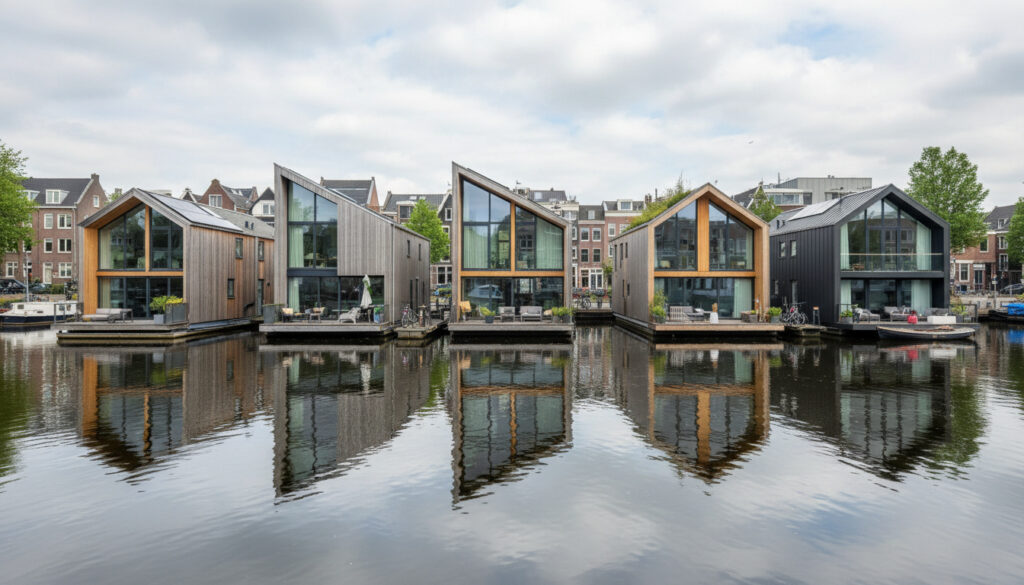
The Netherlands is probably the only country in the world that exists because its inhabitants decided that the sea did not rule over them. A quarter of the territory of the Netherlands is below sea level. Without the system of dikes, dams, and pumping stations built over centuries, cities like Amsterdam, Rotterdam, and The Hague simply would not exist.
The Dutch have always been water engineers.
But with climate change raising sea levels and intensifying rainfall, even the most sophisticated dikes have their limits.
The question that Dutch architects asked themselves was: what if, instead of fighting against the water, we lived on top of it?
The Waterbuurt neighborhood in Amsterdam: houses that really float
In IJburg, a neighborhood built on artificial islands in eastern Amsterdam, there is the Waterbuurt, the water neighborhood.
There are dozens of houses that float on Lake IJ.
Each house is built on a hollow concrete foundation that functions like a boat.
This base is tied to stakes at the bottom but has the freedom to rise and fall as the water level changes.
When the tide rises, the houses rise with it. When it falls, they fall.
The residents hardly notice the movement. It is as smooth as the sway of a large boat.
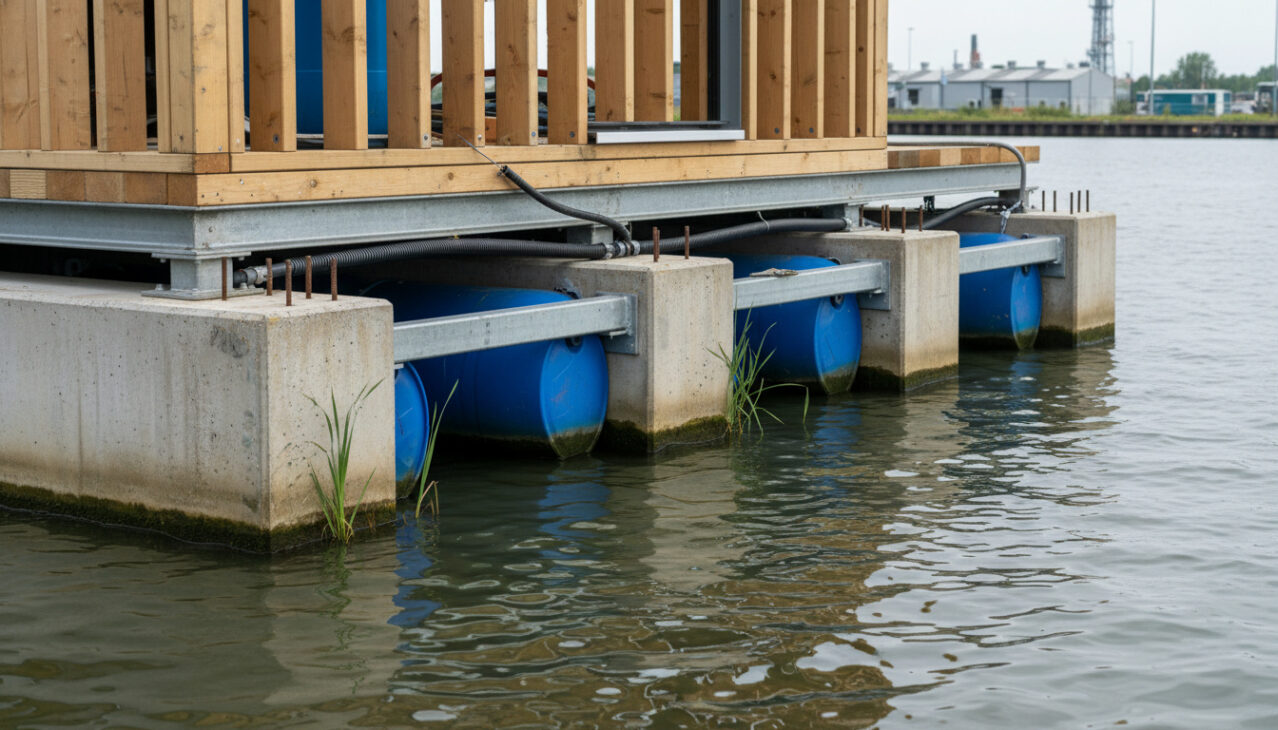 Detail of the floating foundation of a Dutch house showing how it rests on the water.
The architect who designs cities on water
The biggest name in floating architecture in the world is the Dutch Koen Olthuis, founder of the Waterstudio office.
Olthuis designs not only houses but also neighborhoods, parks, and even farms that float.
One of his most well-known projects is a floating farm in Rotterdam that produces milk and yogurt on the water of the harbor.
Olthuis’s idea is that the cities of the future will have part on solid ground and part on water.
He calls this amphibious cities.
Works like a normal house, but floats
Inside, a Dutch floating house is identical to any house on land.
It has a bathroom, kitchen, bedrooms, central heating, electricity, and internet.
The difference lies in the foundation.
Instead of a concrete foundation buried in the ground, the base is a lightweight, waterproof concrete coffin that floats.
The connections for water, sewage, and electricity are flexible, like hoses, to accommodate movement.
The cost of a floating house is about 10 to 25% higher than an equivalent conventional house on land.
But for those living in a country threatened by floods, this extra cost can be the difference between having a home or losing everything.
Why the whole world is watching the Netherlands
With sea levels rising and extreme rainfall becoming more frequent, coastal cities around the world face the same problem.
Miami, Jakarta, Bangkok, Venice, Recife, all are at risk of flooding in the coming decades.
The Netherlands, having faced this problem for 800 years, is decades ahead in the solution.
Delegations of urban planners from more than 30 countries have already visited Waterbuurt to study the model.
The Maldives, a country that could disappear with rising sea levels, is developing a floating city with Dutch technology.
The limitations of life on water
Not everything is perfect in floating life.
The houses rely on moorings and stakes that require maintenance.
In strong storms, the sway can be noticeable.
Pets need to adapt; dogs can’t just run into the yard.
And resale is more complex because not all buyers are willing to live on water.
But for a country that literally invented land where there was once sea, living on water is just another chapter in an 8-century story.
And perhaps, for the rest of the world, it is the next chapter.