
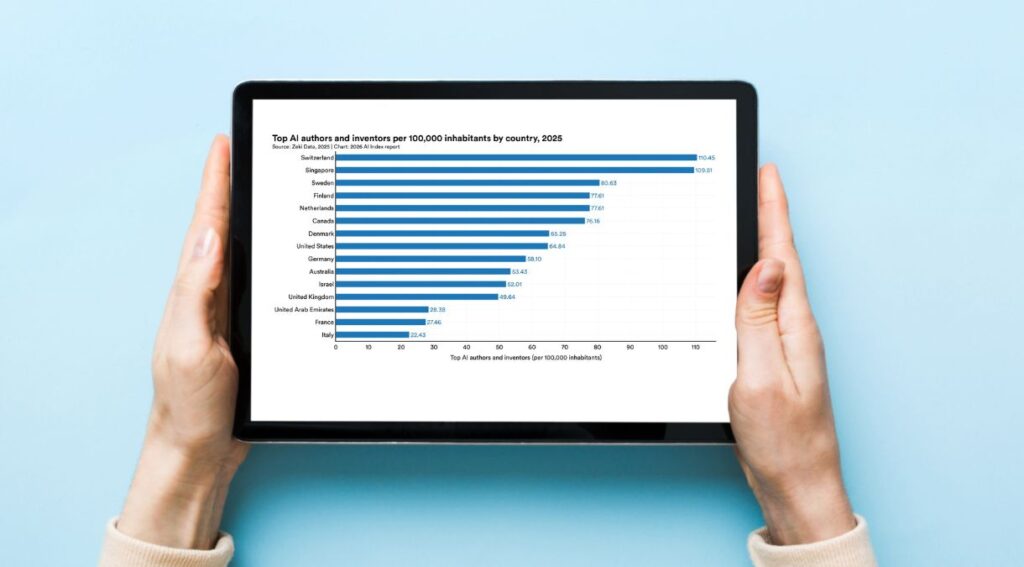
Despite large jurisdictions like China and the US lead the world in artificial intelligence (AI) funding and development, smaller countries like Switzerland and Singapore lead in AI research.
According to a new report by the Stanford University’s Human-Centered Artificial Intelligence (HAI), Switzerland had 110.5 AI authors and inventors per 100,000 inhabitants in 2025, followed closely by Singapore with 109.5.
 Top AI authors and inventors per 100,000 inhabitants by country, 2025, Source- 2026 Artificial Intelligence Index Report, Stanford University’s Human-Centered Artificial Intelligence (HAI), Apr 2026
Switzerland also has one of the highest share of PhD holders at 43.6%, behind the UK (51.1%), and Australia (50.5%). This underscores the country’s robust foundation of advanced education and highly specialized expertise, which directly fuel its leadership in AI research and innovation.
Switzerland also maintains a relatively high concentration of AI talent. LinkedIn’s metrics on the concentration of AI talent within countries and the movement of that talent across borders show that in 2025, Switzerland held the fifth highest concentration of AI talent among LinkedIn members, with a 1.25% share. Singapore ranked second with a 1.82% share.
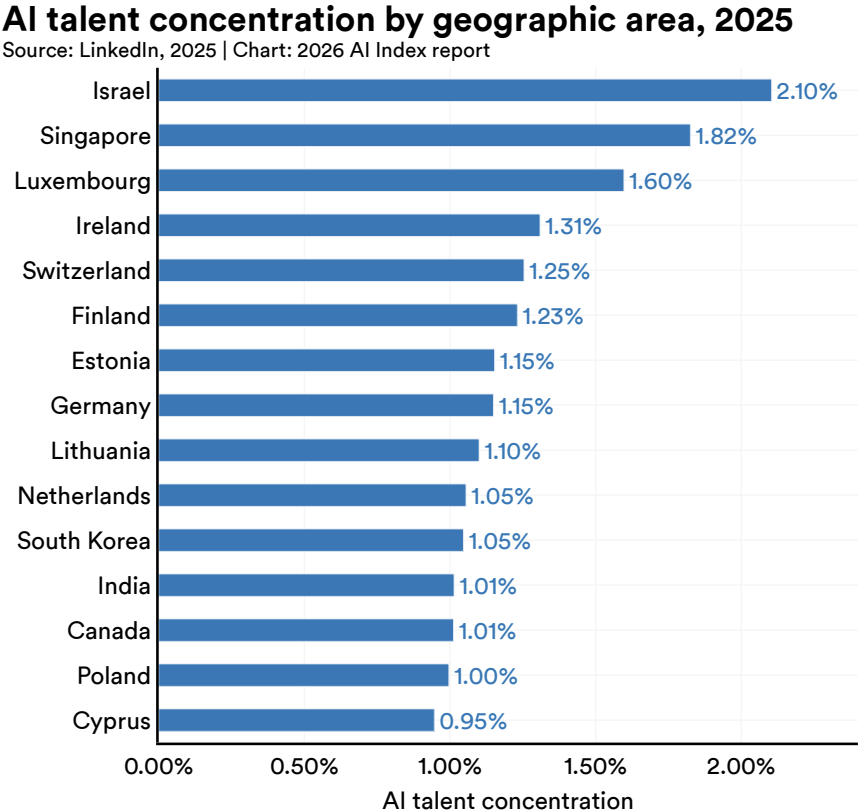 AI talent concentration by geographic area, 2025, Source: 2026 Artificial Intelligence Index Report, Stanford University’s Human-Centered Artificial Intelligence (HAI), Apr 2026
Migration patterns, which illustrate the dynamic global redistribution of AI talent, reveal that in 2025, Switzerland recorded the fifth highest net inflow relative to other tracked countries, with 1.72 per 10,000 LinkedIn members. This suggests that Switzerland is successfully attracting international AI experts, effectively competing against much larger economies.
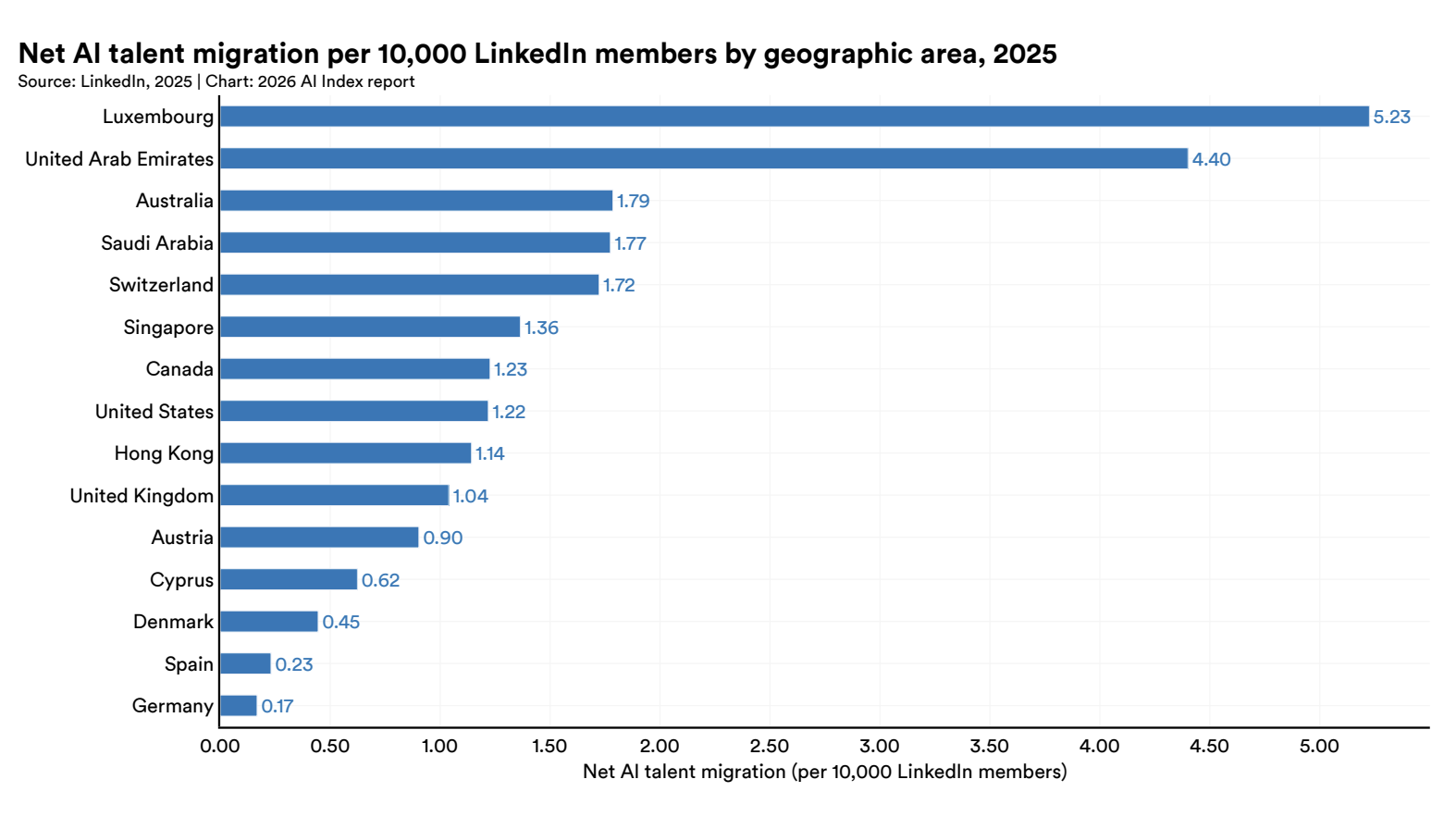 Net AI talent migration per 10,000 LinkedIn members by geographic area, 2025, Source: 2026 Artificial Intelligence Index Report, Stanford University’s Human-Centered Artificial Intelligence (HAI), Apr 2026
Switzerland also ranks relatively high in “AI diffusion”, a metric which measures how widely AI tools are being adopted across populations, countries, occupations, and everyday tasks. By the end of 2025, AI adoption in Switzerland reached 34.8%, ranking 15th globally.
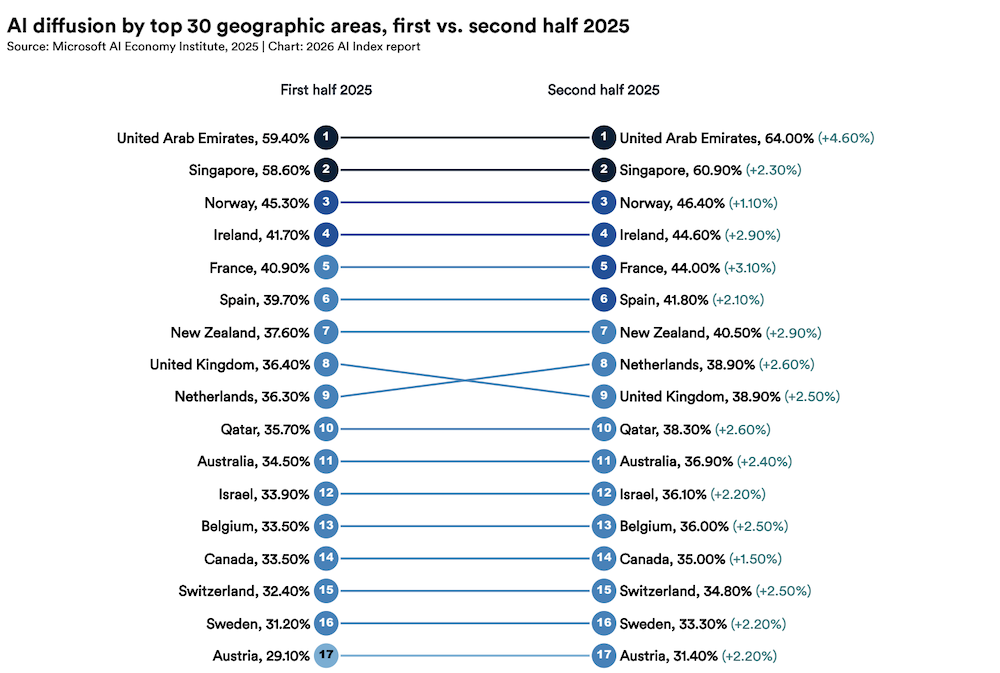 AI diffusion by top 30 geographic areas, first vs second half 2025, Source: 2026 Artificial Intelligence Index Report, Stanford University’s Human-Centered Artificial Intelligence (HAI), Apr 2026
Despite these strengths, Switzerland demonstrates relatively low excitement about AI, a trend consistent with the rest of Europe, where populations are generally clustered at lower levels of excitement and higher levels of nervousness.
This suggests that while the Swiss ecosystem is highly successful at the expert level because of rigorous academic standards, the general public remains wary of the implications, privacy concerns, and rapid disruption associated with AI.
In contract, Asian countries showcase among the highest levels of excitement, and the lowest levels of nervousness. The most eager jurisdictions are Indonesia and China, which show the highest levels of excitement, with nervousness remaining below 50%.
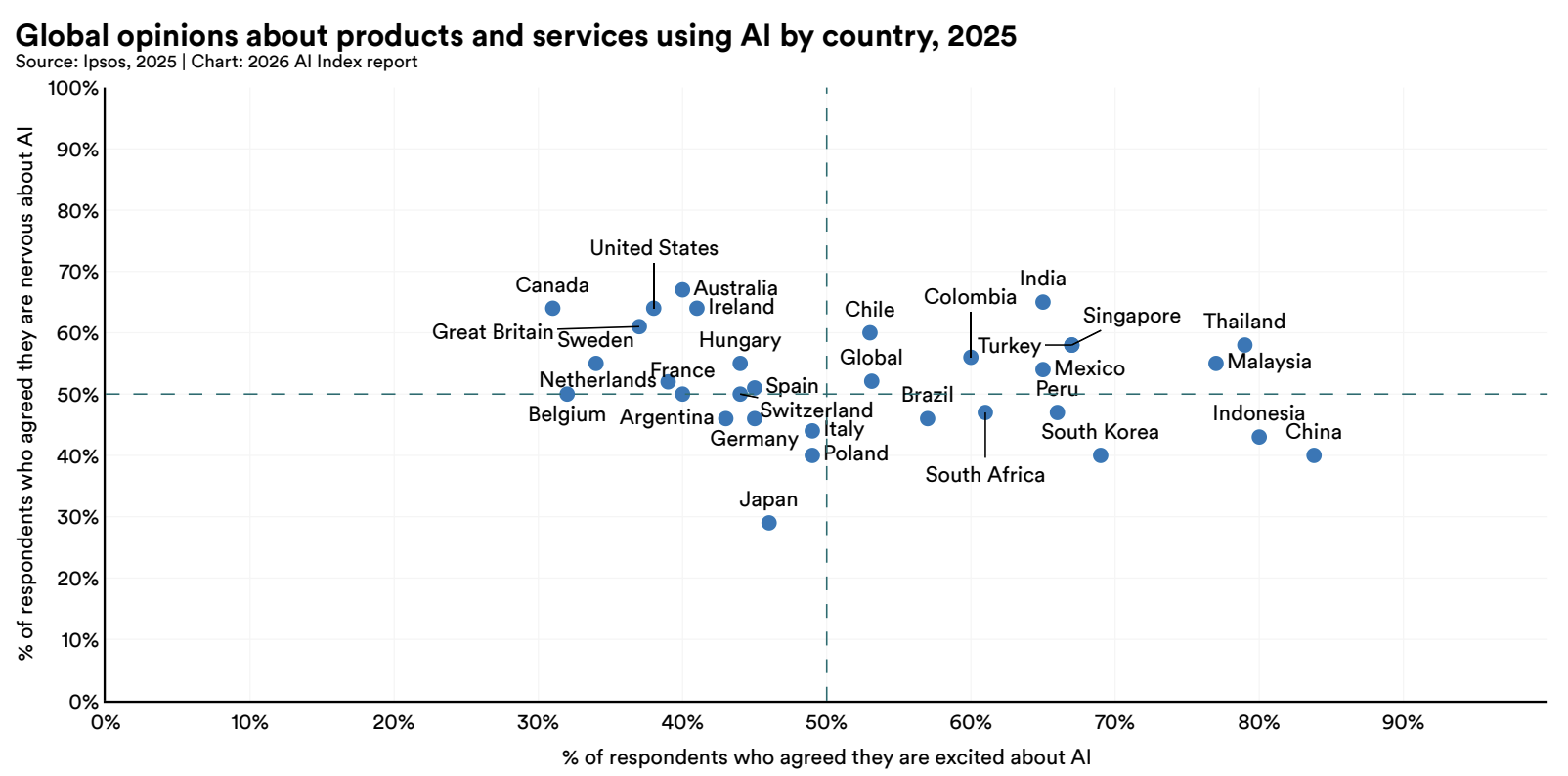 Global opinions about products and services using AI by country, 2025, Source: 2026 Artificial Intelligence Index Report, Stanford University’s Human-Centered Artificial Intelligence (HAI), Apr 2026
Globally, many respondents associate AI with practical personal benefits, particularly time savings and entertainment. In 2025, 56% of individuals believed that AI would reduce the amount of time it takes them to get things done, a figure rises to 78% in China and exceeds 60% in Southeast Asian countries.
Similarly, Swiss respondents identified these as the primary benefits, with 46% citing time savings, and 43% citing entertainment.
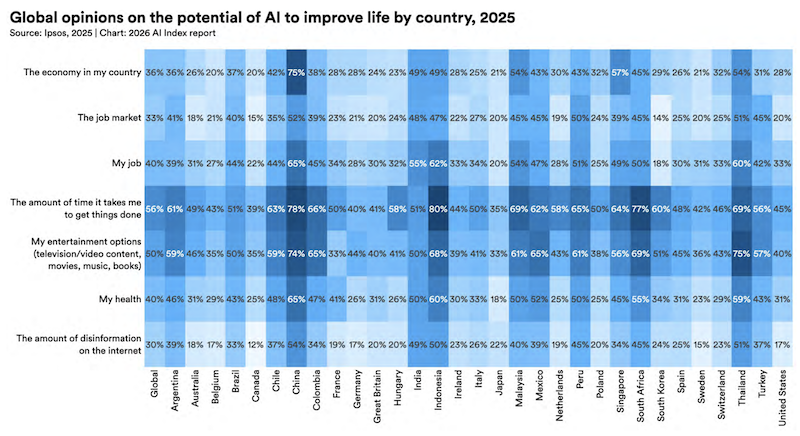 Global opinions on the potential of AI to improve life by country, 2025, Source: 2026 Artificial Intelligence Index Report, Stanford University’s Human-Centered Artificial Intelligence (HAI), Apr 2026
AI capabilities and adoption progress
Globally, AI capability is advancing and adoption is accelerating. In 2025, industry produced over 90% of notable frontier models, with a small set of organizations accounting for a large share of release. Top contributors in 2025 were OpenAI, with 19 models, Google with 12, and Alibaba with 11. Several of those models now meet or exceed human baselines on PhD-level science questions, multimodal reasoning, and competition mathematics.
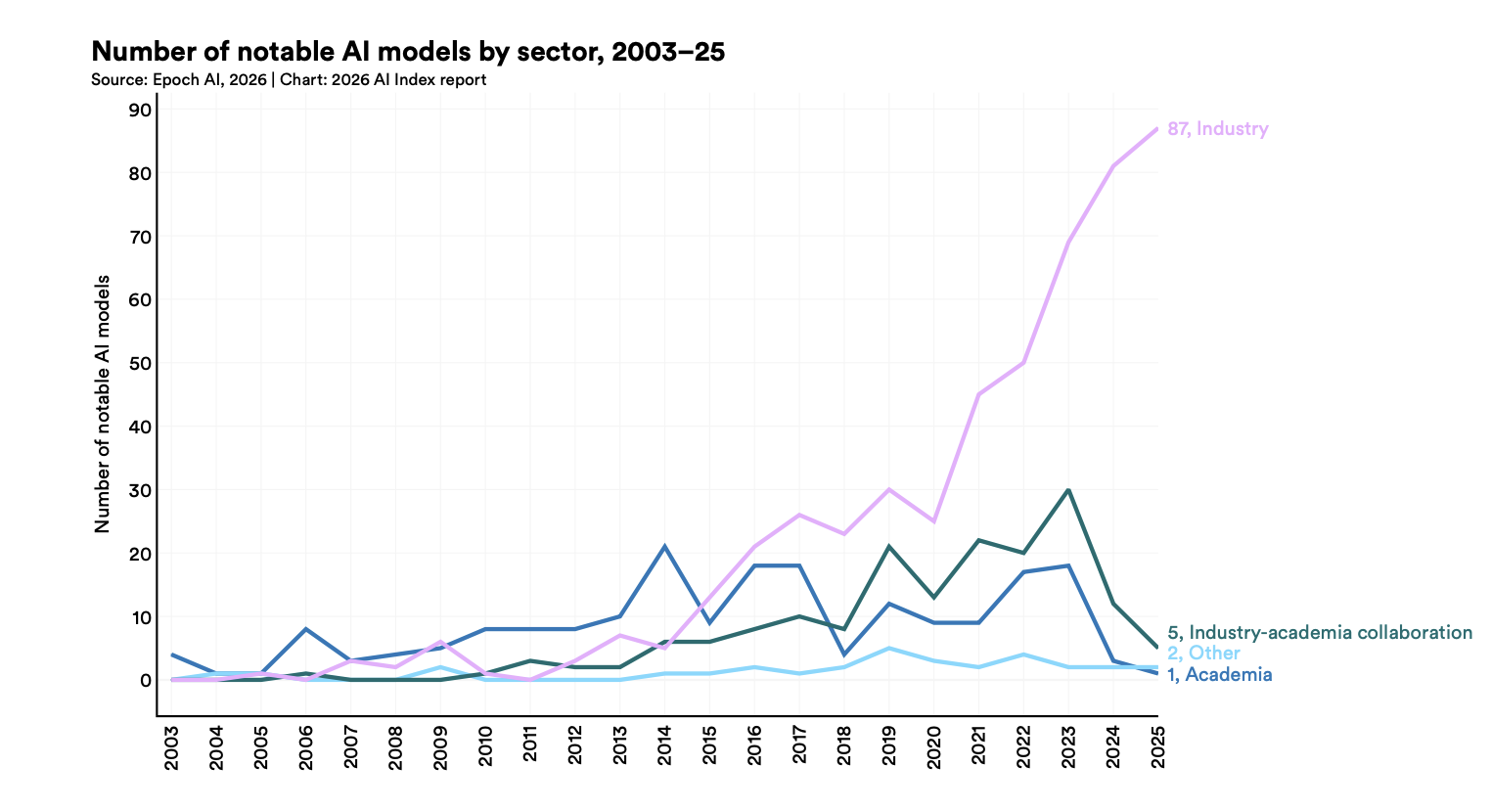 Number of notable AI models by sector, 2003-2025, Source: 2026 Artificial Intelligence Index Report, Stanford University’s Human-Centered Artificial Intelligence (HAI), Apr 2026
However, the most capable modern models are also the least transparent. The Foundation Model Transparency Index, which measures how openly major AI companies disclose details about their models’ training data, compute, capabilities, risks, and usage policies, saw average scores drop from 58 in 2024 to 40 in 2025. This may suggest that as AI systems become more powerful and complex, major players are increasingly prioritizing proprietary secrecy and competitive advantage over public disclosure and safety oversight.
The report also highlights the narrowing performance gap between the US and China. In February 2025, DeepSeek-R1 briefly matched the top model in the US. By March 2026, however, Anthropic’s leading model held a 2.7% advantage over its top Chinese rival. Over the past year, the gap has fluctuated between near parity and low single digits.
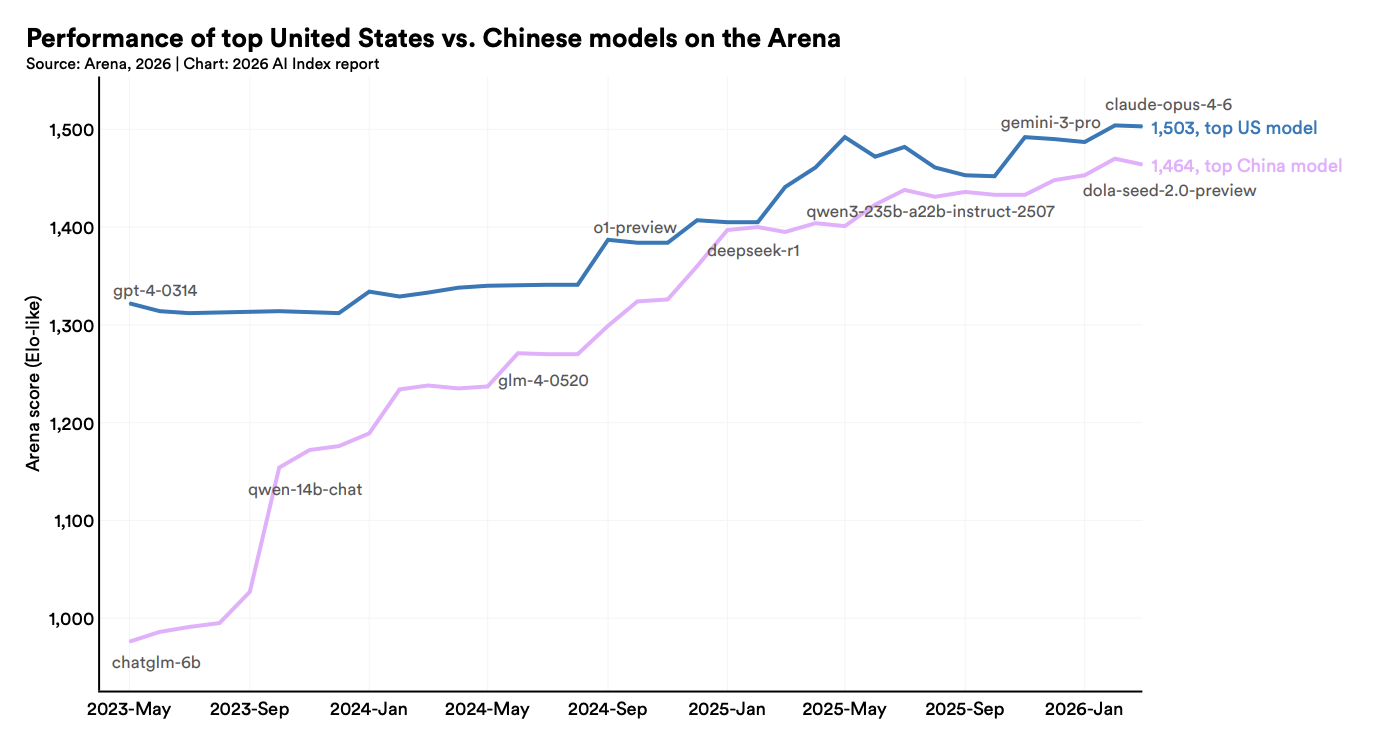 Performance of top US versus Chinese models on the Arena, Source: 2026 Artificial Intelligence Index Report, Stanford University’s Human-Centered Artificial Intelligence (HAI), Apr 2026
Overall, the US remains an undisputed global leader in AI. In 2025, the country hosted the most AI data centers with 5,427 facilities, more than ten times any other country. Germany, the UK, and China followed with 529, 523, and 449 data centers, respectively.
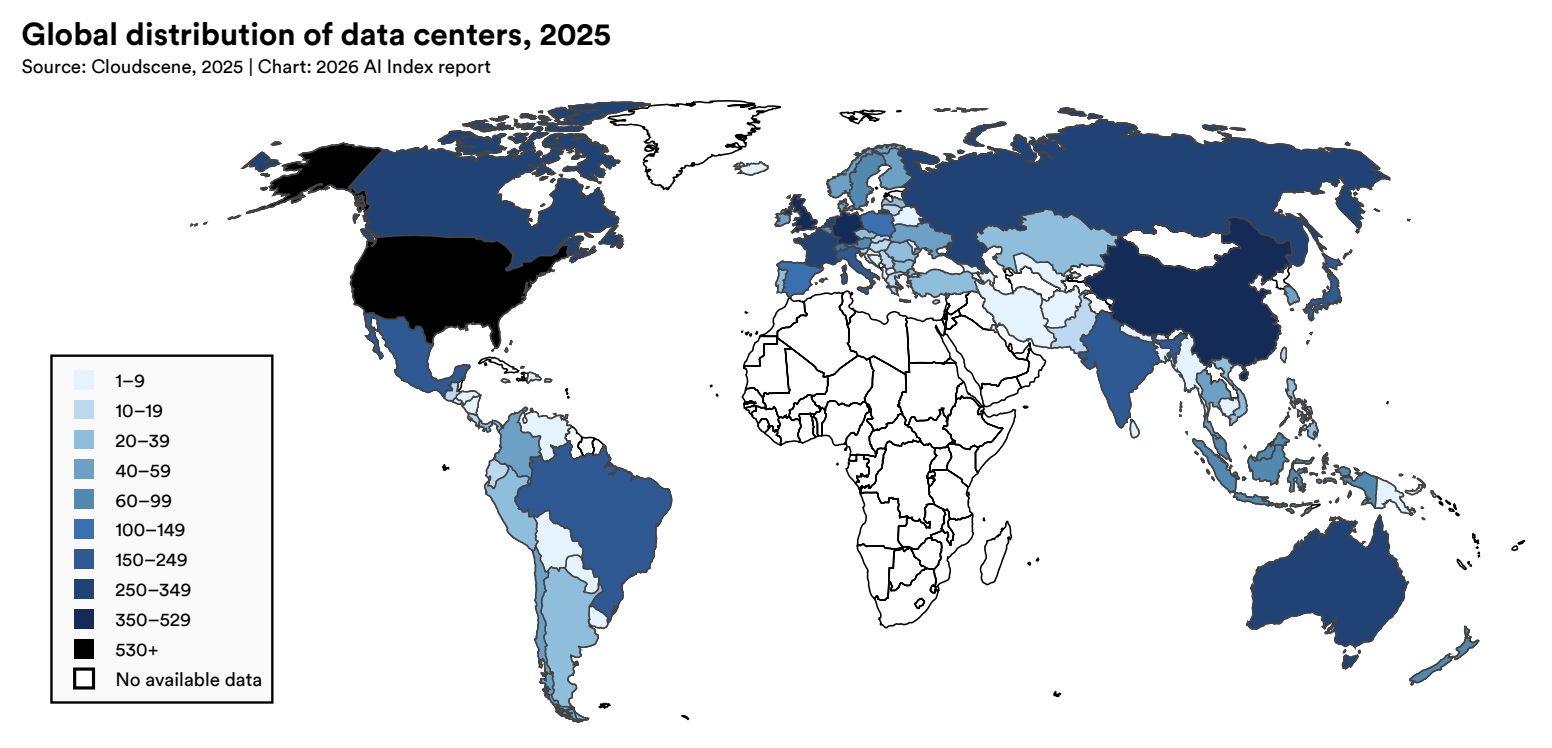 Global distribution of data center, 2025, Source: 2026 Artificial Intelligence Index Report, Stanford University’s Human-Centered Artificial Intelligence (HAI), Apr 2026
The US also leads in AI investment and entrepreneurial activity. In 2025, US AI investment totaled nearly US$285.9 billion, 23.1 times greater than the amount invested in the next highest country, China, with US$12.4 billion, and 48.5 times the amount invested in the UK with US$5.9 billion.
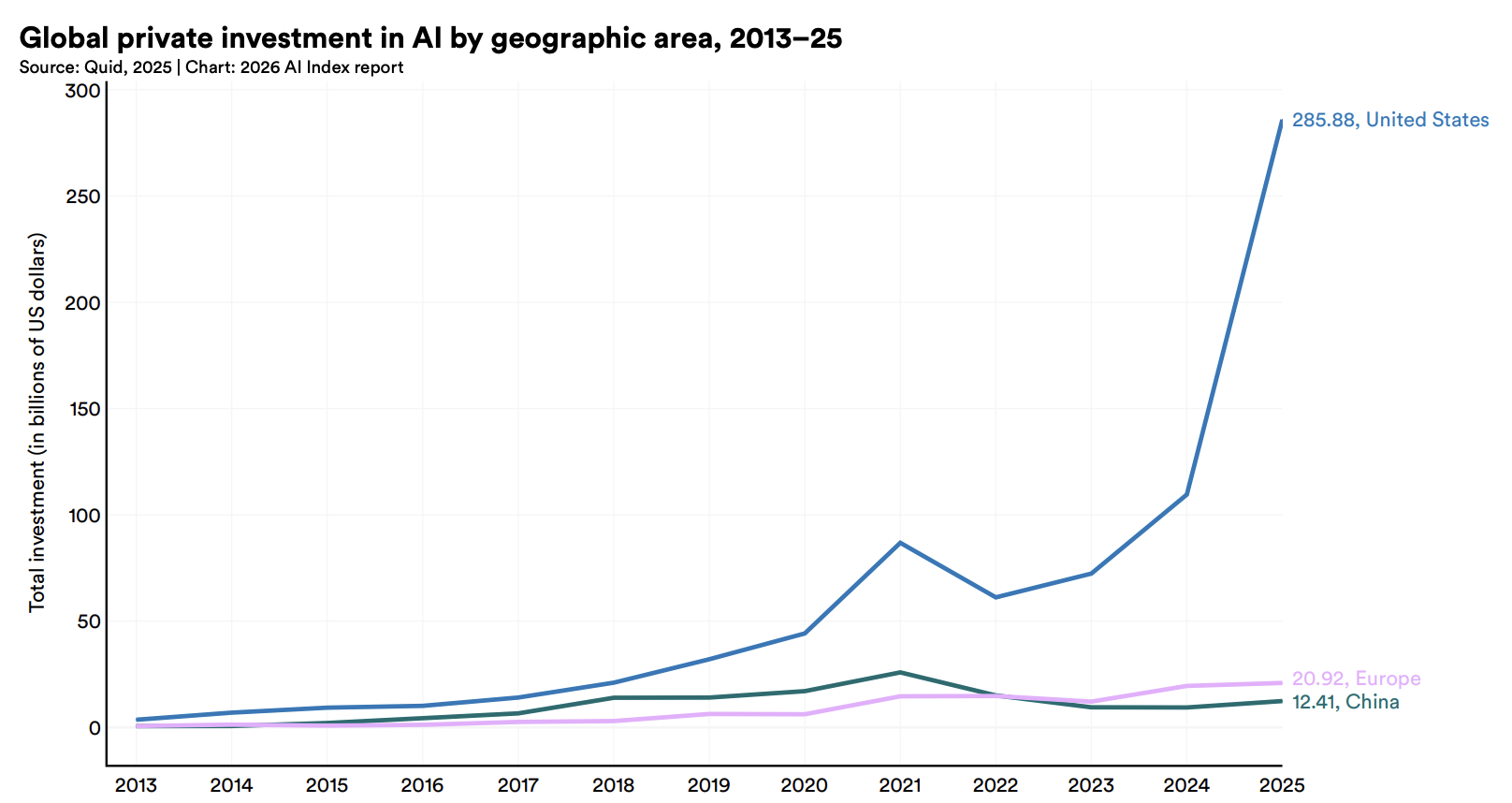 Global private investment in AI by geographic area, 2013-2025, Source: 2026 Artificial Intelligence Index Report, Stanford University’s Human-Centered Artificial Intelligence (HAI), Apr 2026
That same year, the US saw 1,953 newly funded AI companies, more than ten times the next closest country, the UK, with 172 companies, and China, with 161 ventures.
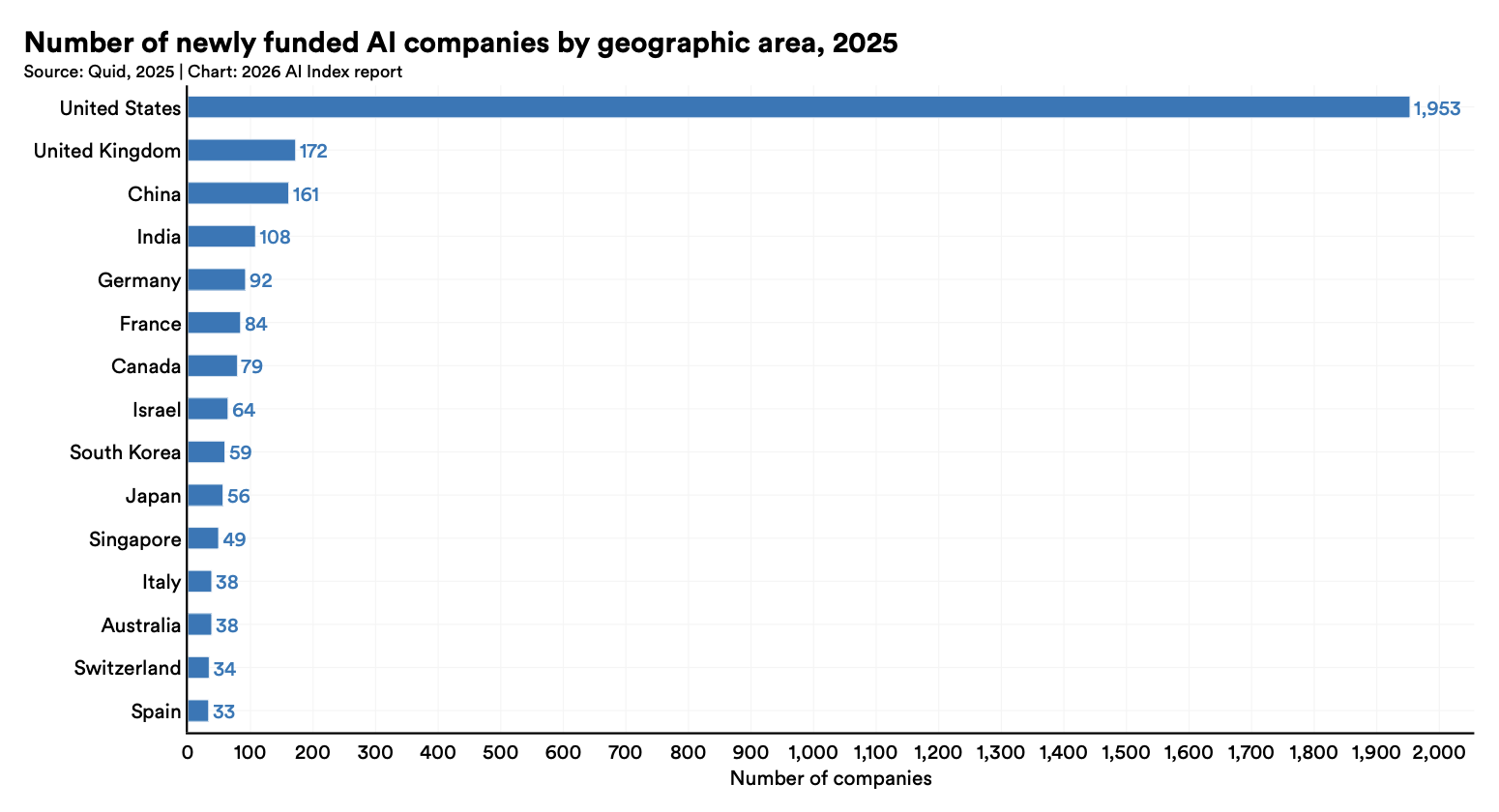 Number of newly funded AI companies by geographic area, 2025, Source: 2026 Artificial Intelligence Index Report, Stanford University’s Human-Centered Artificial Intelligence (HAI), Apr 2026
These developments come on the back of soaring AI adoption. Within just three years, generative AI (genAI) reached 53% population adoption, well above the initial trajectories of the personal computer and the Internet over comparable time frames.
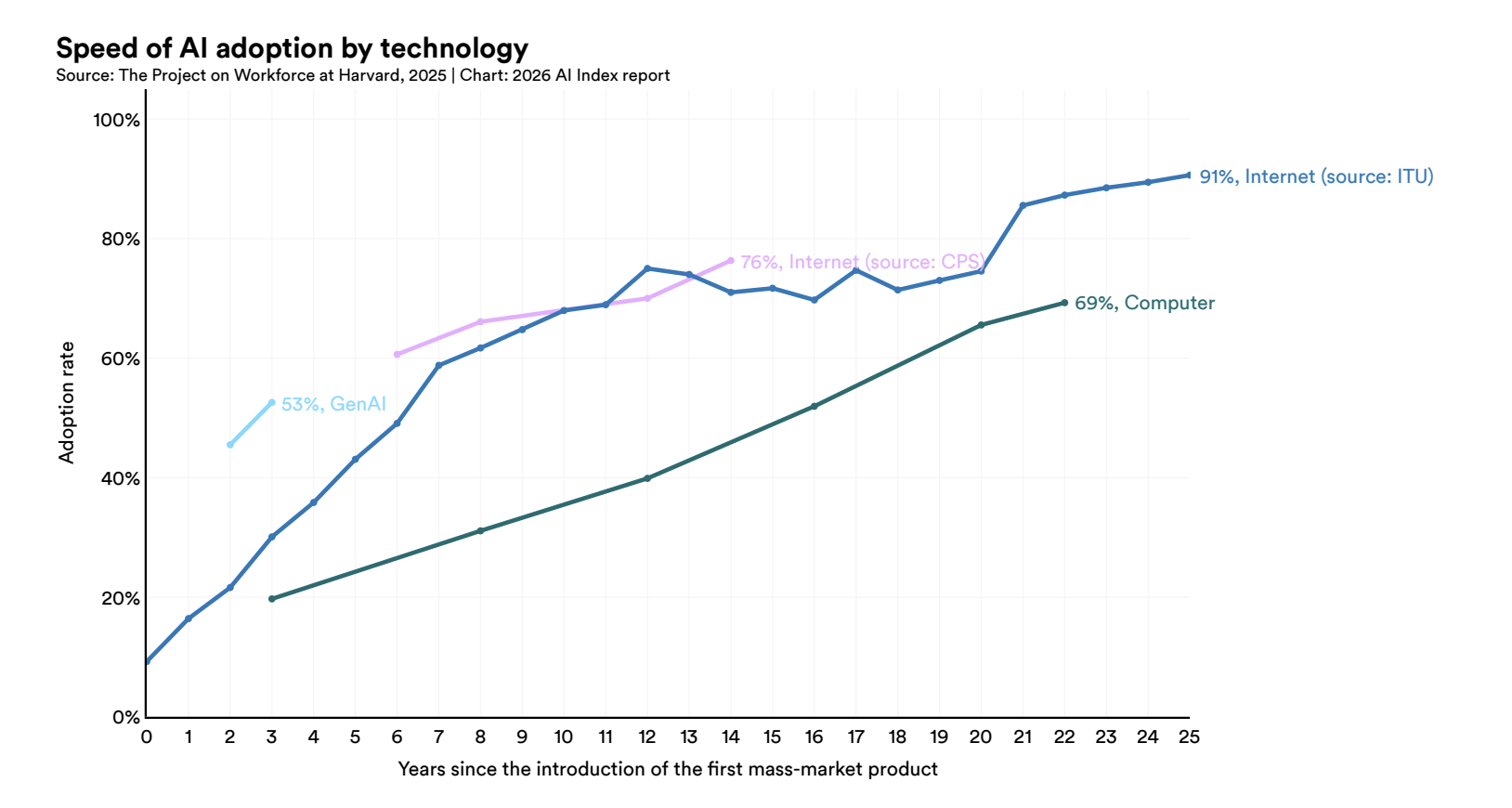 Speed of AI adoption by technology, Source: 2026 Artificial Intelligence Index Report, Stanford University’s Human-Centered Artificial Intelligence (HAI), Apr 2026
However, adoption varies widely from one country to another. As of the end of 2025, the United Arab Emirates (UAE) and Singapore were the biggest adopters of AI, posting adoption rates of 64% and 60.9%, respectively.
Featured image: Edited by Fintech News Switzerland, based on image by sosiukin via Freepik