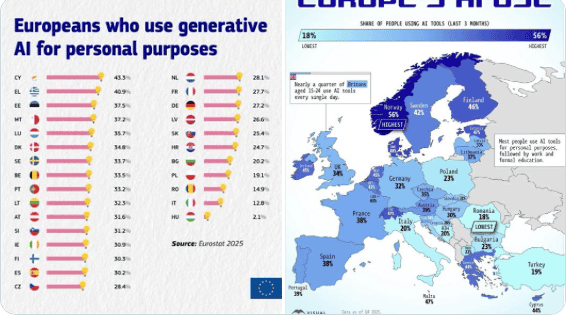
The survey, published in December 2025, showed that 44.2% of Cypriots aged 16 to 74 used generative AI tools in the three months prior to the study, well above the EU average of 32.7%. Only Denmark, Estonia, and Malta recorded higher usage rates.
Among young users, adoption surged even further. In Cyprus, 76.5% of those aged 16 to 24 used generative AI tools, while Greece recorded an even higher rate at 83.5%, placing both countries among the EU’s top performers in youth engagement with the technology.
Globally, the AI landscape consolidated around a handful of dominant platforms. ChatGPT led the market with 388 million monthly active users and nearly 5.84 billion website visits in August 2025. In Europe, it held more than 80% market share, followed by tools such as Google Gemini, Microsoft Copilot, Perplexity AI, and Claude. Other widely used platforms included CapCut, Canva, and Notion, all of which integrated AI features.
Despite strong personal uptake, Cyprus displayed a stark gap in business adoption. Only 9.27% of companies with at least ten employees used AI technologies in 2025—less than half the EU average of nearly 20%. Denmark led business adoption at 42%, while Cyprus ranked near the bottom alongside Greece, Bulgaria, Poland, Turkey, and Romania.
Researchers noted that countries with high individual AI use typically showed strong business adoption due to advanced digital infrastructure and workforce familiarity with technology. However, Cyprus diverged from this trend, with individuals adopting AI rapidly while many companies lagged behind.
The impact of AI on productivity remained contested. A 2025 developer survey found that while 84% of developers used or planned to use AI tools, positive sentiment declined amid concerns about accuracy. A study by the Model Evaluation and Threat Research found that developers who believed AI improved productivity were, in some cases, slower due to time spent reviewing outputs.
At the enterprise level, results also varied. While early adopters reported strong returns, between 70% and 85% of AI initiatives failed to meet expectations, according to analysis by Fullview.