
PORTLAND, Ore. (KATU) — Political violence in the United States may feel uniquely alarming right now, but it is not unprecedented, according to Laura Appleman, the Van Winkle Melton Professor of Law and University Research Integrity Officer at Willamette University.
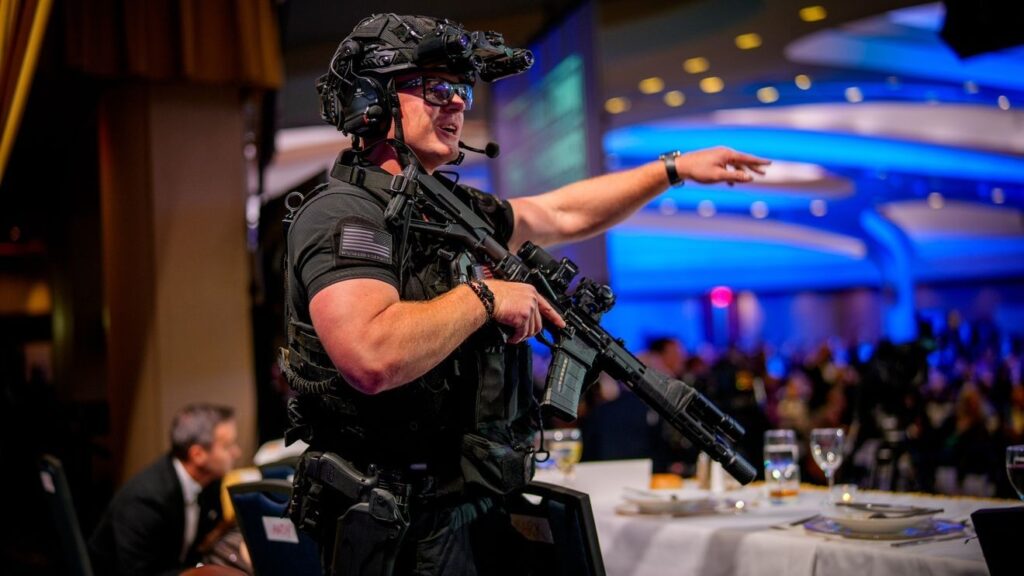
After a shooter opened fire at the White House Correspondent’s Dinner over the weekend, the third time in less than two years a gunman has gotten close to the president, the debate of perhaps worsening political violence in the country surfaces again.
SEE ALSO | Third close call in two years puts Secret Service under scrutiny
Appleman said American history includes repeated periods of intense political violence, beginning with the nation’s founding.
Speaking with KATU, she pointed to the Revolutionary era, including tarring and feathering, which she described as stripping a person, pouring boiling tar on them and covering them with feathers; an act she said often led to death or severe infection and disfigurement. She also described parts of the Revolutionary conflict, particularly in the middle colonies, as brutal guerrilla warfare.
Appleman said the period she considers the most politically violent in U.S. history began around 1850 and stretched through the years before and after the Civil War into the early 1900s.
She cited “Bleeding Kansas” and the violent fight over whether Kansas would be a slave or free state, as well as the beating of Sen. Charles Sumner in Congress over his abolitionist views and the assassination of President Abraham Lincoln.
The professor also pointed to violence during Reconstruction, including the rise of the Ku Klux Klan, and described the era’s brutality both before and after slavery, including convict leasing and debt peonage. She also referenced labor unrest, saying the period into the 1900s included “all the Union revolts.”
Appleman said another major era of political violence came in the 1960s, citing the killings of John F. Kennedy, Robert F. Kennedy and Martin Luther King Jr., along with violence on college campuses. She said that period is often what people “in living memory” compare to today.
In discussing more recent events, Appleman said social media has added a “somewhat disturbing” new dimension by creating feedback loops in which people consume news from a narrow subset of sources and are repeatedly exposed to the same viewpoints, including violent rhetoric “on either side of the spectrum.” She said social media and the internet also mean people know more details about events as they unfold, and have easy access to information about prior attacks and attempts.
Appleman also referenced a series of high-profile incidents, including President Donald Trump’s third time facing an assassination attempt over the weekend, the incident in which a person attempted to assassinate Justice Brett Kavanaugh in 2022, the attack on Paul Pelosi, Nancy Pelosi’s husband, that same year, “the tragic deaths of Melissa Hortman and her husband,” the Minnesota House of Representatives Speaker who was killed in 2025, and the arson at Pennsylvania Gov. Josh Shapiro’s home also in 2025.
She said people are “very fraught right now” and “very polarized,” and that polarization is being exacerbated by social media and the internet.
Appleman said conspiracy thinking and distrust are not new in American life. She pointed to the lead-up to the Civil War as an example of extreme polarization, and said conspiracy narratives were also prominent during Reconstruction, including claims used to justify the rise of the Ku Klux Klan.
She also cited the resurgence of the KKK in the 1920s and 1930s, and referenced Father Coughlin’s radio broadcasts promoting conspiracy theories and antisemitic rhetoric, along with anti-Catholic speech and Charles Lindbergh running against President Franklin D. Roosevelt.
A key difference today is the fragmentation of news consumption, she said.
Appleman said that until roughly 10 to 15 years ago, most Americans still got their news from the same sources, such as newspapers, radio, and later a handful of television networks, but that is no longer the case.
She added that local news has a larger audience share than national outlets such as CNN or C-SPAN, and said the fractured media environment has helped drive current polarization. Even so, she said she does not believe today’s polarization is worse than what the country has experienced before.
Oregon’s piece of the puzzle
Appleman also discussed Oregon’s history and how it fits into the broader picture.
She said Oregon’s territorial charter did not allow Black citizens to live in the territory, and described the state as having “always been a very white state.” She said Oregon saw a resurgence of the Ku Klux Klan in the 1920s.
She also referenced the U.S. Supreme Court case Apodaca v. Oregon, describing it as a case that allowed nonunanimous juries and saying it was “finally overturned by the Supreme Court” two years ago. Appleman said the case involved a Jewish defendant and that Oregon at the time wanted to ensure the defendant was convicted.
In more recent history, she cited the occupation of the National Wildlife Refuge area involving Ammon Bundy, the Jan. 6 Capitol takeover in 2021 in which five people died, and violent clashes in downtown Portland during the Black Lives Matter protests between “so-called Antifa” and the “so-called proud boys.”
She also described a political divide between the Portland area, which she said “tends to be more blue,” and much of the rest of the state, which she said “tends to go a little more red,” referring to the Democratic party’s prevalence in Portland compared to the Republican party in some other parts of the state.
Appleman said Oregon has experienced political violence but has not seen the kind of “stalking and murder” that other states have had involving state legislatures or governors.
RELATED | Appeals court says federal officers can use tear gas against Portland ICE protesters
She also referenced recent demonstrations against ICE and ongoing legal disputes, including yesterday’s decision by the 9th U.S. Circuit Court of Appeals to pause a case involving an apartment building in Gray’s Landing in which a district court had ruled the case could stop ICE from using chemical munitions, but the 9th Circuit put that on hold “until the full appeal.”
Overall, Appleman said periods of political violence are not uncommon in U.S. history, and that while social media may intensify polarization and spread unfiltered information, the country has endured similarly severe—and in some eras worse—political violence before.