
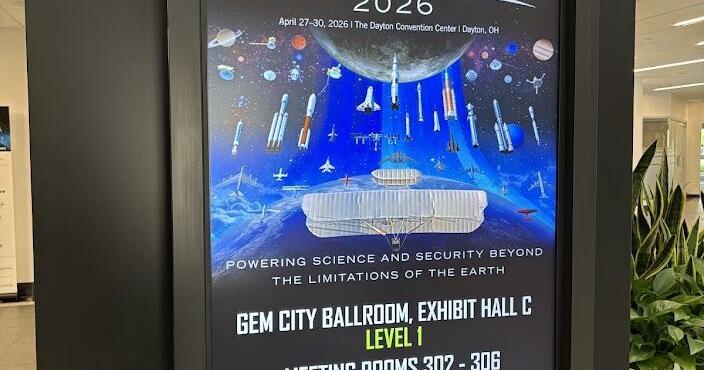

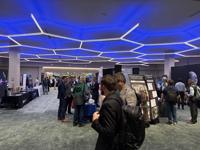
Attendees at the Nuclear and Emerging Technologies for Space (NETS 2026) conference at the Dayton Convention Center on Tuesday, April 28, 2026. THOMAS GNAU/STAF
The American Nuclear Society’s NETS 2026 conference is drawing to Dayton this week some of the sharpest minds concerned with harnessing the atom to power space exploration and defense.
The Nuclear and Emerging Technologies for Space 2026 conference opened Monday, April 27 at the Dayton Convention Center.
For Chadwick Barklay, a University of Dayton Research Institute scientist and director of UD’s Space & Power Systems research division, this moment represents a “full circle” return.
Barklay is a veteran of the former Mound U.S. Department of Energy facility in Miamisburg, which developed the radioisotope thermoelectric generators that powered the Galileo mission to study Jupiter, and the ULLYSSES mission to study the sun (among other innovations).
“We’re coming full circle,” Barklay said in an interview this week. “Mound being the genesis for technologies started in the 1950s.”
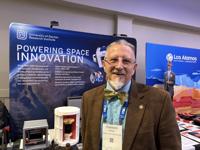
Chadwick Barklay, director of Space & Power Systems at the University of Dayton Research Institute, at the American Nuclear Society’s Nuclear and Emerging Technologies for Space (NETS 2026) conference on Tuesday, April 28, 2026. THOMAS GNAU/STAFF
Many of the people concerned with those technologies are in Dayton this week.
Space poses real challenges when it comes to staying warm, staying alive and moving from point A to point B — and solar power isn’t always enough to meet those challenges, Barklay said.
The conference is happening at a heady time. The United States is aiming for the return of Americans to the moon by 2028, the building of a lunar outpost by 2030, with a faster cadence of space launches expected in coming months and years.
If a spacecraft requires ample power for defense capabilities or maneuvers, “If you’re thinking in a defensive posture, you can’t do that (with only solar power),” Barklay said. “If you think about a fighter aircraft, it’s got multiple sensors out there, the pilot has to make decisions. All of that requires enormous amounts of power.”
The “lunar night” lasts two weeks, he added. To survive that, sustained power on the moon is necessary. That might require a radioisotope system, a reactor-based system — or a combination of those, Barklay said.
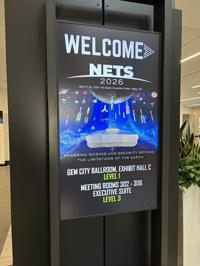
A sign at the American Nuclear Society’s Nuclear and Emerging Technologies for Space (NETS) 2026 conference at the Dayton Convention Center Tuesday, April 28, 2026. THOMAS GNAU/STAFF
“I would say by far, you’ve got the world’s brain trust here in terms of technologies and government officials in space power, nuclear space power,” he added.
The more than 400 attendees hail from NASA, the Air Force Research Laboratory at Wright-Patterson Air Force Base, General Atomics, L3 Harris, Sandia National Laboratories, Westinghouse and others.
Next year, the NETS conference will be held in Cleveland, a conference official said.