
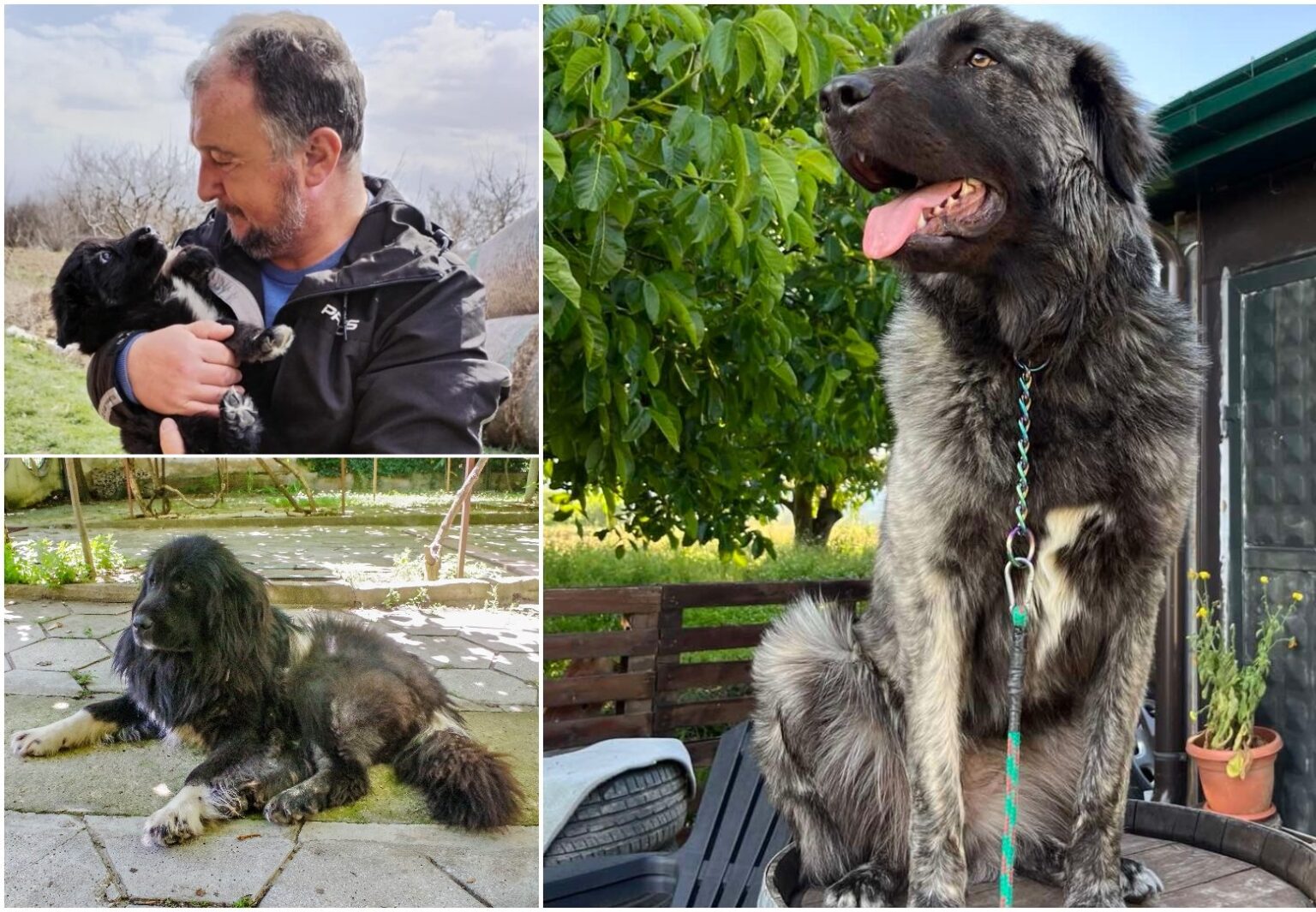
The Karaman shepherd of the country’s mountains is now officially recognized as a unique breed.
OHRID and SKOPJE, North Macedonia | Eleonora and Risto Novakoski bought their Karaman dog in 2022 and named her Bela.
“We moved to a property on the outskirts of Ohrid with a large yard and a fairly isolated setting. We needed a large, purebred dog that would be both a guard and a companion,” Eleonora and Risto told Transitions.
“We got Bela from a breeder in Ohrid. The Karaman is a beautiful dog, just like the name of our dog.”
The sturdy Macedonian Karaman, a black or black-and-tan dog originally bred centuries ago as a sheepdog, has earned renown among dog lovers for its diligence as a guard dog and deep attachment to its human family. This February, North Macedonia’s dog lovers attained a goal many years in the making when the Karaman earned a place on the World Canine Federation (FCI) list of recognized breeds.
The Karaman Macedonian Shepherd is now one of almost 380 breeds listed on the global canine map, and the first officially recognized sheepdog with a distinct national origin in North Macedonia.
The Novakoskis say this achievement is a major success for everyone who contributed to making it happen.
“To preserve this breed, all dog lovers who have the proper conditions for raising a Karaman should contribute,” they add.
- The World Canine Federation lists the Karaman Macedonian Shepherd in a subsection for mountain dogs of the “Molossian” type.
- Nearby breeds of similar origin are the Tornjak of Bosnia and Herzegovina and the Sharplaninec, a herding dog native to North Macedonia and Serbia.
- Karamans are muscular and robust: Males weigh from 40 to 45 kilograms, females around 3 kg less.
- The Karaman’s origin “is connected with stockbreeding settlements in Macedonia and the nomadic migrations of the stockbreeders,” the FCI notes.
- The breed is officially “stable and fearless,” “independent and very intelligent” and “proud and dignified” as well as “affectionate and loyal to its owner.”
New Breed With a Long Pedigree
The project to recognize the Karaman began when Panche Dameski was president of the Kennel Union of North Macedonia. Back then, in 2008, he explains, the first pedigrees for the breed were drawn up, measurements made of the dog’s characteristic features, and Karaman owners began exhibiting them in shows.
“In this demanding work, involving many enthusiasts of the breed, efforts were made to locate the population of these dogs, begin organized selection and breeding, and gradually standardize their characteristics. During that period, we managed to create an original breed standard,” says Dameski, who is now dean of the faculty of veterinary medicine at St. Kliment Ohridski University in Bitola.
The process of proving to the FCI that the Karaman is an autochthonous dog that has existed for centuries as part of mountain life in the country was not simple.
As part of the standardization process, the physical traits of a large portion of the Karaman population in North Macedonia were measured, and genetic analyses made.
Blood tests were carried out at the veterinary school in Bitola to determine the Karaman’s hematological and biochemical profile. The faculty of veterinary medicine in Skopje also contributed scientific expertise. The results of these studies are expected to be published in the scientific community soon, Dameski says, observing that the breed is unique not only in appearance, but also in its constitution, temperament, and genetics.
“The process of recognizing a breed typically takes two to three decades, which is how long it took us, but not every process ends with the creation of a new breed. We were fortunate to meet all the requirements set by the World Canine Federation and to have the Karaman officially recognized as a breed,” he adds.
Thanks to the work in popularizing the local dog by the Kennel Union and the Karaman Club, today North Macedonia has a large population of this dog, numbering more than 2,000 individuals, an uncommon example globally for a newly recognized breed. Its average lifespan is around 12 to 13 years, which is excellent for medium-sized dogs.
Most of the population is still found in the Macedonian mountains as companions to sheep flocks, but a significant number can also be found in urban areas.
Bela’s owners praise both her work ethic and personality.
“Bela always alerts us by barking when strangers approach, and in our absence she never leaves the yard,” they say. “She is strong, fast, skillful, and obedient.”
Miki Trajkovski is a journalist with more than 20 years’ experience covering North Macedonia and the Balkans at large. His work has been published by Radio Free Europe, BBC, Voice of America, and setimes.com. Trajkovski’s writing focuses on economics, energy, politics, and social issues.