
The recent election in Slovenia has created as many questions as answers to the future of the country’s politics. While a close race will mean a coalition government is necessary, a foreign interference scandal suggests relevancy beyond the small country’s borders.
April 14, 2026 –
Nikodem Szczygłowski
– 
Analysis
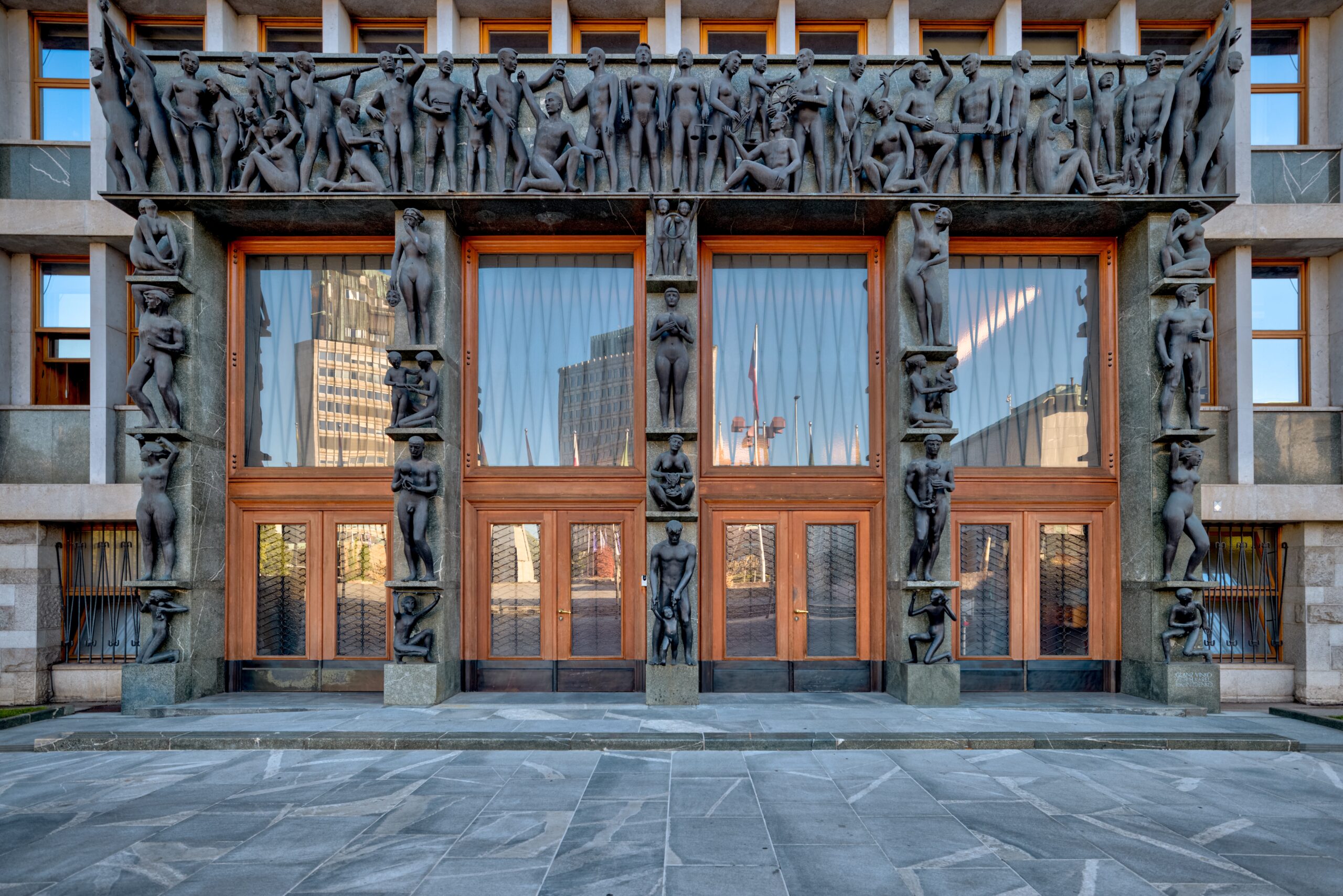
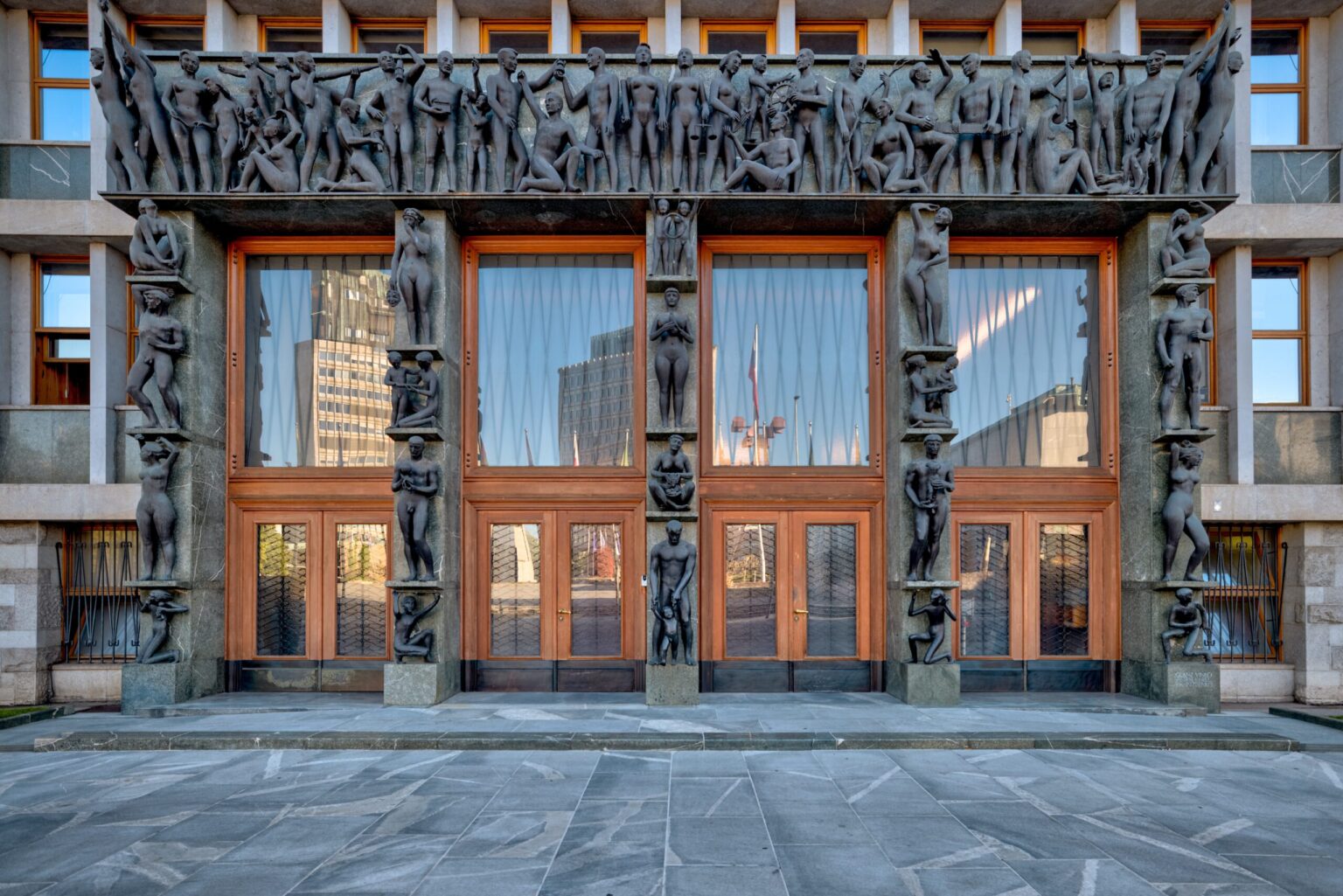
Entrance to the Slovenian parliament building in Ljubljana. Photo: Shutterstock
The parliamentary election in Slovenia, described by many observers as “landmark”, was preceded by an exceptionally brutal campaign marked by major scandals. These involved not only internal corruption but foreign influence. Against this backdrop, political and social polarization is deepening, and the results of the March 22nd vote did not produce a clear winner.
Voter turnout was 69.32 per cent. The ruling Freedom Movement (Svoboda) and opposition SDS achieved remarkably similar results: the first received 28.62 per cent of the vote, while the second received 27.95 per cent. The bloc of Christian democratic parties – NSi, SLS and Fokus – received 9.29 per cent, while smaller parties from various parts of the political spectrum received between 6.7 and 5.5 per cent of the vote. The likely distribution of seats in the new parliament is as follows: 29 seats for Svoboda, and 28 for SDS. The coalition of Christian democratic parties will receive nine MPs, while the SD (Social Democrats) and Anže Logar’s Democrats (moderate centre right) will each receive six seats. There are also five seats each for Resni.ca (Zoran Stevanović’s far-right populist party) and the joint left-wing list, which brings together the two left-wing groups of Levica and Vesna. As a result, the current Prime Minister Robert Golob from Svoboda leads Janez Janša’s opposition SDS by just one seat.
It is also noteworthy that many well-known politicians, running at the top of their party’s lists, failed to win a seat in parliament at all.
The parties are in, but their leaders out
The Svoboda movement failed, among other things, to get one of the party’s most prominent female politicians, the incumbent Speaker of Parliament Urška Klakočar Zupančič, into parliament. Shortly after the election results were announced, she declared that she was resigning not only from the party but from politics altogether.
The current Foreign Minister Tanja Fajon, who served in this role as a coalition partner representing the SD, also failed to secure a parliamentary seat. Meanwhile, Simon Maljevac, a minister from the Levica party – another coalition partner of Svoboda – also failed to secure a seat. The most unexpected turn of events occurred within the Democrats, as party Chairman Anže Logar and the second person on the party list – Vice Chairwoman Eva Irgl – were left without seats.
At the same time, the exceptionally unpopular Aleš Hojs managed to win a seat. This politician served as interior minister in Janez Janša’s government during the pandemic.
Ali Žerdin, editor-in-chief of Sobotna priloga, the Saturday supplement of Slovenia’s largest daily newspaper, Delo, attributes such examples to the complex electoral system in Slovenia. At the level of individual elected representatives the system sometimes turns elections into a lottery.
“Sooner or later, parliament will have to amend the electoral law, as this is also mandated by the result of the last referendum on the electoral system, but so far there is insufficient consensus on the direction of changes to the electoral system,” comments Žerdin.
A weak coalition or a government of national unity?
The leaders of the two largest parties – Robert Golob and Janez Janša – argue that it is necessary to form a “strong coalition government”. However, given the close race between the two parties, its composition remains rather unclear for now. After the results were announced, there were even calls for early elections. It is unlikely that a repeat vote would radically change the distribution of seats.
Over the past week, Golob has called for the formation of a government of national unity, while Janša (in his usual manner) has ambiguously suggested that the elections were allegedly rigged, for which he was reprimanded by President Nataša Pirc Musar. Left-wing parties have been preoccupied with finding those to blame for their lower-than-expected results. At the same time, the leader of Resni.ca announced that he would not support any “weak coalition” and declared the formation of a “third bloc” together with Christian democratic parties. In practice, however, this means that, as of writing, the chances of forming a governing coalition remain slim.
A campaign shrouded in scandals
The loss of support for leading Slovenian politicians is the result of an extremely brutal election campaign that preceded the March 22nd vote.
Public sentiment reached fever pitch when, a few weeks before the parliamentary elections, audio and video recordings of conversations between politicians, lawyers, and businessmen were leaked. These recordings suggest, among other things, that corruption is a widespread practice in Slovenia. Issues include the payment of ten per cent of a contract’s value to politicians in exchange for building permits, the privatization of energy companies, and cooperation with private medical firms. An investigation is currently underway, and the recordings have been sent to a foreign forensic laboratory to verify their authenticity.
Ten per cent for the mayor
The recordings reveal, among other things, details of potential contracts – mostly with developers – that stipulate that there must be “ten per cent for the mayor of Ljubljana” in exchange for issuing building permits. In several published excerpts, the speakers claim that to quickly obtain permits in prestigious districts of Ljubljana, “you have to know the right person” and “give ten per cent”. The recordings also feature Ljubljana Mayor Zoran Janković, who allegedly had influence over the permit-issuing procedures.
Janković has held the position of mayor of the Slovenian capital for years and is known, among other things, for various shady friendships with people in the inner circle of Serbian President Aleksandar Vučić. He categorically denied the allegations and announced that he would file a lawsuit, which he has not yet done.
The recordings specifically refer to the construction history of the InterContinental Hotel in the centre of Ljubljana – a project long linked to rumours of shady deals in Slovenia. The recording includes statements such as “everyone knows how it works” and that “without the right people”, such projects have no chance of being realized.
Other recordings point to the trading of medical licences. Former Health Minister Danijel Bešič Loredan stated that the recording in which he allegedly discusses “licence agreements” is inauthentic. The materials mention a possible secret collusion between private clinics and officials, the influence of certain political circles on the distribution of medical services, and allegations of a “fast track” in processing under specific conditions.
Loredan called the recordings “fabricated” and stated that they were “created to discredit opponents”.
Who needs to be bribed?
Former Justice Minister Dominika Švarc Pipan said that during meetings with some people claiming to be investors, “attempts were made to discuss influential figures.” According to her, the people she spoke with asked directly about “Who needs to be bribed properly for the investment to go through?” She stated that she already knew at the time that this was “an attempt to set a trap for her”, and that the recordings themselves were “edited”.
Some parts of the record mention potential influence over state-owned enterprises, particularly the energy company GEN-I. Its management officially stated that Švarc Pipan “never had the authority to act on behalf of the company”.
However, that was not the end of the revelations. There is much to suggest that all this information was leaked deliberately at the same time – in the final stretch before the elections. In this context, there is open talk of an attempt to influence the elections from outside. This has caused even greater outrage among Slovenians than the tape scandal itself.
The masks are slipping
Journalists identified two main channels for disseminating information about the recordings: the website “Maske padajo” (“The masks are slipping”) and the account/platform “Antikorupcija2026” (“Anti-Corruption 2026”).
“Maske padajo” was one of the first sites to feature video and audio materials attributed to Slovenian politicians and lawyers. Slovenian media reported that the website was registered abroad and its domain had a hidden owner. After the media began investigating the account’s history, it ceased to function. Journalists from the weekly Mladina and daily Delo, among others, emphasize that the website bore the hallmarks of a coordinated influence operation.
The second key distribution channel were accounts named “Antikorupcija2026” on X and Telegram. These were launched shortly before the recordings were published and linked to servers outside Slovenia. Some domains and servers were registered or hosted in North Macedonia – this applies to both the “Maske padajo” website and the “Antikorupcija2026” resources. After being published on these channels, the recordings quickly began to spread via anonymous accounts on X, Telegram channels, and YouTube profiles that had previously been inactive. At the time of publication, all these accounts were operating in sync. The anonymous profiles that disseminated the recordings used IP addresses linked to North Macedonia. This became one of the arguments that supported the theory of a coordinated operation rather than a random leak.
The shadow of Black Cube
At the time, the country was further rocked by another scandal – an intelligence scandal, likely the most significant of them all. The journalist Borut Mekina and Nika Kovač, director of the March 8 Institute, published data pointing to possible interference in the election campaign by Black Cube, a private Israeli intelligence company. The data shows that on December 22nd 2025, a private Hawker 800XP jet landed at Brnik Airport near Ljubljana. Among the passengers were Black Cube co-founder Dan Zorella and former head of the Israeli National Security Council Giora Eiland.
The delegation allegedly visited the headquarters of Janez Janša’s opposition party, the SDS. SOVA (Slovenska obveščevalno-varnostna agencija – Slovenian Intelligence and Security Agency) confirmed the presence of four Black Cube representatives in the country but did not confirm any meetings with politicians. The Israeli journalist Omer Benjakob described Black Cube as an organization that conducts “dirty business” and “works for anyone who pays”.
Prime Minister Robert Golob called the scandal “the biggest in Slovenian history” and stated that “The opposition is clearly deeply involved in the scandal.” The Foreign Minister Tanja Fajon stated that this was “an attack on the sovereignty of the state”. At the same time, President Nataša Pirc Musar warned against possible foreign interference in the election campaign and the spread of disinformation in the run-up to the elections. In her view, Slovenia “has joined the list of countries where such things happen”.
The recording scandal also sparked a sharp reaction from opposition forces, primarily the SDS. Its leader, Janez Janša, issued the harshest statements, accusing the current government of systemic corruption and manipulation.
Janša called the current government an “organized criminal group” that “openly boasts of its capabilities to foreigners”, all without specifying exactly who he was referring to. During the campaign, Janša claimed that the published recordings reveal the scale of corruption within the government, and not the opposition. In his view, the country has a network of political connections and interest groups that operate above the law, with “ten per cent” kickback schemes now the norm.
Party representatives announced they would file lawsuits against journalists who disseminated information about the SDS’s possible involvement in coordinating the operation.
Vojko Volk, State Secretary for National and International Security at the Office of the Prime Minister of Slovenia, stated after a meeting of the National Security Council (SNAV) that the revealed facts point to organized foreign interference in the electoral process in Slovenia. The recordings were one of the key components of this operation. Volk described these events as a “classic example of a hybrid attack”. He explained that the operation is carried out according to a pattern in which edited or artificially generated materials are published on servers in third countries – he again mentioned the “Macedonian route” (North Macedonia) – to circumvent Slovenian jurisdiction and media regulations.
“We are observing coordinated activities in which deepfake technologies are used to manipulate public opinion a few days before the vote,” emphasized the Slovenian state secretary.
Robert Golob, who was in Brussels at the EU leaders’ summit when the scandal broke, said he had already conveyed the facts regarding the Slovenian elections to European partners and the leadership of the European Commission. Golob emphasized that Slovenia had become a “testing ground” for new methods of hybrid warfare ahead of the upcoming European elections. According to him, the European Commission has already implemented tools under the Digital Services Act (DSA) to identify sources of disinformation and prevent their spread on major online platforms.
“This is not just a problem for Slovenia; it is also an attack on the democratic standards of the entire European Union,” the prime minister said during a visit to Brussels.
While the source of the leak and the origin of the tapes themselves were previously unknown, speculation began regarding a connection between the two cases following another leak linked to Black Cube’s activities in Slovenia. A theory emerged that Israelis were behind the recordings, acting on behalf of a Slovenian political party. Suspicions fell on the SDS. The party’s leader Janez Janša initially stated that he had learned of Black Cube’s existence from the media but later confirmed that a meeting had taken place last December at the party’s headquarters in Ljubljana with individuals who were later found to be connected to the Israeli intelligence firm Black Cube. Janša denies, however, that he commissioned Black Cube’s services or that he has any financial ties to the company. According to him, these individuals approached them in person, introducing themselves as “foreign investigative journalists” who possessed information about Robert Golob’s secret bank accounts in the Balkans (in Serbia, Bosnia and Herzegovina, and Montenegro).
“We listened to them just like any other source. Golob’s government is now trying to spin its actual corruption scandals, which were recorded on tape, into a spy story to distract voters,” claims Janša.
The Slovenian intelligence agency SOVA filed a report with the prosecutor’s office just before the elections. SOVA Director Joško Kaleb confirmed that the agency had recorded the entry and movements of foreign private intelligence agents within Slovenian territory.
At a meeting of the National Security Council, it was agreed to intensify monitoring of the information space ahead of the elections, which took place on March 22nd. The police and the National Investigation Bureau (NPU) are conducting a preliminary investigation into illegal wiretapping and document forgery.
🎙️ Listen to the latest Talk Eastern Europe podcast episode:
What happens next?
“What are the chances of forming a stable governing coalition?” I asked my interlocutors, who have been professionally observing the Slovenian political scene for years.
According to Boris Jaušovec, a journalist for the Maribor daily Večer, Golob himself realizes that it will be difficult for him to form any governing coalition, let alone a stable one. This is precisely why he is making public assurances that in these pivotal times, when wars are raging around us, when we face an energy crisis that will cause massive economic upheaval – not to mention security issues – a “government of national unity” must be formed. At the very least there must be a “government of development”, or one that will fight corruption and tackle the crisis.
“The question is to what extent Golob is capable of overcoming the sharp polarization – which would be necessary to form a government – and attracting a party from the right wing of the political spectrum,” says Boris. “The current governing coalition did everything in the election campaign to smear the parties on the right. In the context of the Black Cube scandal, the SDS has been, in a sense, branded by them as traitors.”
As Jaušovec emphasizes, the Slovenian public is particularly outraged by Israel’s involvement in this scandal and its alleged interest in the departure of Golob’s government, primarily due to his recognition of Palestinian statehood last year.
“However, the “left-wing” label has also been attached to the second-strongest opposition party, the Christian democratic NSi (New Slovenia),” notes the Večer journalist. This is
Ali Žerdin, the editor-in-chief of Sobotna priloga, agrees with this assessment and elaborates:
“Golob will have to demonstrate great political skill if he wants to form a new governing coalition. It is clear, however, that he cannot form a left-of-centre coalition, as such an arrangement would be too weak. Parties to the right of the political centre have so far been distrustful of Golob – but it is also true that Golob himself did not trust the centre-right parties. However, the fact that the vast majority of the parties do not want new elections works in Golob’s favour.”
What are the SDS’s chances of forming a coalition?
According to Boris Jaušovec, Janša’s chances are even slimmer than Golob’s, which is precisely why he is talking about alleged irregularities and election fraud and even suggesting the need for early elections, etc.
“The current situation does indeed look like a deadlock, but if Slovenians were to go to the polls again soon, many MPs would risk not being re-elected and thus would not secure the financial security for the next term that they currently enjoy. That is why it is better for them if a government is formed, even if it must go through the eye of a needle. And perhaps such a government could also be Janša’s government, if, say, the Social Democrats were to join him from the right.”
Ali Žerdin says that a coalition led by Janez Janša is possible if he is supported by the new populist party, Resni.ca, which for now rejects cooperation with the SDS. This possibility would require more serious analysis if Golob fails to form a governing coalition.
“It’s already a tradition for Janša to talk about election irregularities. However, with his theories about “vote theft”, he’s actually closing the door on forming alliances,” Žerdin points out.
What about the controversies and scandals that marked the final days of the election campaign?
Boris Jaušovec believes that, while they do remain in the background of the calculations regarding the composition of the new Slovenian government, they are merely a kind of “background noise.”
“The Black Cube recordings have been taken over by law enforcement, the parliamentary commission has already published a report on corruption within the NSi, and one of the confirmed cases – based on which a motion has been filed to indict four NSi MPs – is already being handled by the prosecutor’s office. The Commission for the Prevention of Corruption will continue to address all proven instances of corruption in Golob’s government following the change of government, while Golob himself is also demanding that the matter be resolved through the courts.”
According to others I spoke with, however, the secret recordings that are supposed to prove corruption in Slovenia are – if you listen to them carefully – of little significance. Every week, the Slovenian media feature reports on more in-depth journalistic investigations. In this case, it is primarily about the media impact, which – admittedly, at a deliberately chosen time – has been achieved.
What is new, however, is the external involvement in the creation of the recordings and likely their release to the media. It seems highly likely that the recordings were made with the intent to influence the election outcome. State institutions are also investigating an attempt by a foreign private intelligence firm to influence the vote.
It should be added that this attempt most likely failed, as the belief that an Israeli firm was interfering in the Slovenian electoral process primarily mobilized supporters of the left wing of the political spectrum – the very group against which the interference was supposedly intended.
“This is a multi-layered scandal, more serious than anything we have experienced in Slovenia so far. Unfortunately, we are not as calm and boring a country as some people think…” concludes Luka Lisjak Gabrijelčič, a historian, columnist, and editor of the magazine Razpotja published in Nova Gorica, in conversation with me.
Nikodem Szczygłowski is a reporter, writer and translator from Lithuanian and Slovenian. He is a frequent contributor with New Eastern Europe as well as other media outlets.
“Vsi proti vsem” (“Everyone Against Everyone”) is the title of a 2020 film by Slovenian director Andrej Košak, the creator of the famous 1997 film “The Outsider”, which depicts the Ljubljana punk scene of the 1980s.
In his latest film, Košak paints a uniquely specific portrait of Slovenia, where behind the idyllic scenery lies a harrowing depiction of exceptionally brutal political struggle, electoral fraud, and the collapse of moral values. It is set in the fictional town of Rovte at the foot of the idyllic Alps, where a corrupt mayor, on the verge of losing an election, sets off a spiral of dramatic events in an act of desperation that only amplifies the scale of the absurdity.
Recent events on the Slovenian political scene may indeed evoke certain associations with Košak’s film.
New Eastern Europe is reader-supported. If you value independent coverage of Central and Eastern Europe, please consider supporting our work.
👉 Click here to donate.

election interference, elections, Janez Janša, Robert Golob, Slovenia, Slovenian politics