
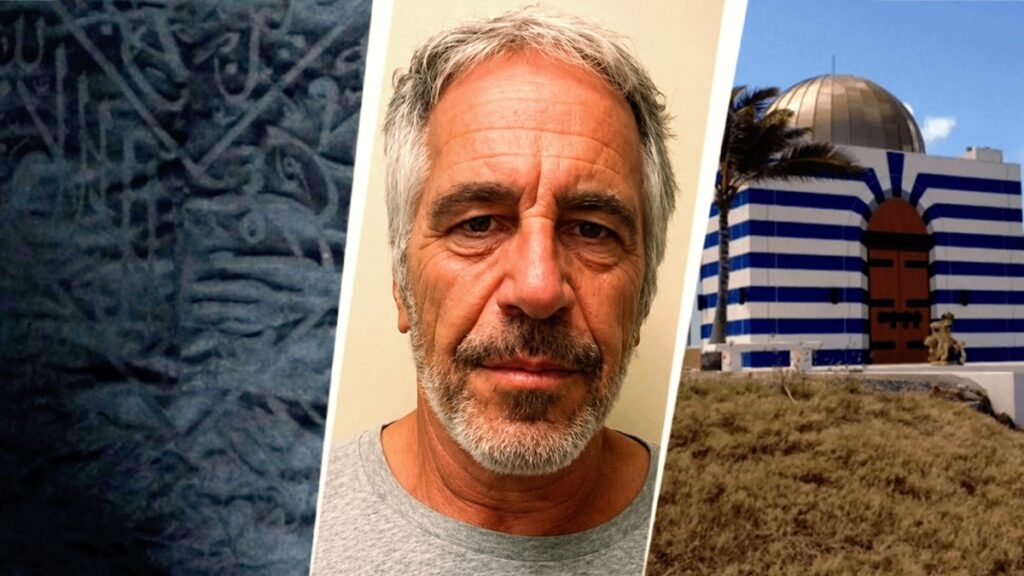
Convicted sex offender Jeffrey Epstein spent years cultivating connections across West Asia, leveraging them not only for business ambitions but also to acquire rare and religiously significant Islamic artefacts, many of which were used to adorn a controversial structure, which he called a ‘mosque’, on his private Caribbean island.
Tapestries embroidered with Quranic verses in gold, known as the Kiswa, were shipped from the Kaaba in Mecca. Handcrafted tiles were sourced from a mosque in Uzbekistan, and a golden metal dome was designed to echo architectural styles from ancient Syria, according to a report by The New York Times, which analysed millions of pages of records released in January by the US Justice Department.
The Kiswa holds deep religious significance. Produced annually by hundreds of artisans, it incorporates roughly 1,500 pounds of silk and 250 pounds of gold and silver thread, and is typically distributed in parts to institutions or dignitaries after it is replaced.
Emails cited in the records suggest Epstein’s associates coordinated shipments of these artefacts, describing them as intended “for the mosque”.
At the centre of the collection was a peculiar blue-and-white striped structure on Epstein’s private island, Little Saint James. Long speculated to be a temple or pavilion, newly released correspondence shows Epstein himself referred to it as a “mosque.” Although its design drew heavily from Islamic architecture, there is no evidence it was used for religious worship.
A blue-striped building on Epstein’s island, which he referred to as a ‘mosque’. (Photo: US Justice Department)
Romanian artist Ion Nicola, who worked on the project, confirmed that Epstein consistently described the building as a mosque. In one email, Epstein even suggested replacing Arabic inscriptions of “Allah” with his own initials. In a message marked by his characteristic spelling errors, he wrote: “Remember we saw the aribic writing in black and white, instead of allah, i thought j’s and e ‘s.”
The files indicate Epstein had long been fascinated by Islamic design. In 2003, he told Vanity Fair that he owned “the largest Persian rug you’ll ever see in a private home — so big, it must have come from a mosque.” His plans for an island shrine began while he was in a Palm Beach County jail after pleading guilty to soliciting prostitution. Before his release in 2009, he commissioned architects to design a hammam, or Turkish bathhouse, surrounded by Islamic-style gardens, according to correspondence.
Records show that in 2013, Epstein sent Nicola a photograph of the Yalbugah Hammam, a 15th-century bathhouse in Aleppo, featuring a golden dome, recessed arch and striped masonry, asking for sketches that would resemble it.
Tapestries from the Kaaba hold immense significance in the Islamic faith. (Photo: Reuters/File)
Epstein’s ability to acquire such artefacts and build networks was closely tied to influential contacts in the Gulf.
Through Norwegian diplomat Terje Rod-Larsen, Epstein gained introductions within Saudi Arabia’s elite circles, including Crown Prince Mohammed bin Salman, consultant Raafat Al-Sabbagh, and royal aide Aziza Al Ahmadi.
Epstein travelled to Saudi Arabia after receiving an invitation linked to the crown prince and later displayed photographs of the meeting in his New York residence. During this period, he sought to position himself as a financial adviser to Saudi leadership, even pitching what he described in one message as “radical ideas”, including a proposed currency called “the shariah” for use among Muslims, according to the Times.
Shipments linked to Al Ahmadi included artefacts from Mecca, with correspondence noting that “three pieces from the Kaaba” were being sent to Epstein. In one email, Al Ahmadi described the importance of one of the items sent to Epstein.
“The black piece was touched by minimum 10 million Muslims of different denominations, Sunni, Shia and others,” she wrote. “They walk around the Kaaba seven rounds then every one tries as much as they can to touch it and they kept their prayers, wishes, tears and hopes on this piece. Hoping after that all their prayers to be accepted.”
A page from the Epstein Files documents released by the US Justice Department.
Epstein’s high-profile meetings in West Asia often coincided with acquisitions, with the artefacts themselves seemingly functioning as symbols of access and influence. A 2014 photograph showed him with Emirati businessman Sultan Ahmed bin Sulayem examining a Kaaba tapestry in his New York townhouse.
However, his relationship with Saudi leadership appeared to cool after Mohammed bin Salman consolidated power.
By 2017, some artefacts housed in the island structure were reportedly damaged by Hurricane Maria.
Epstein was convicted in 2008 in Florida on sex-related charges and died in jail in August 2019.
– Ends