
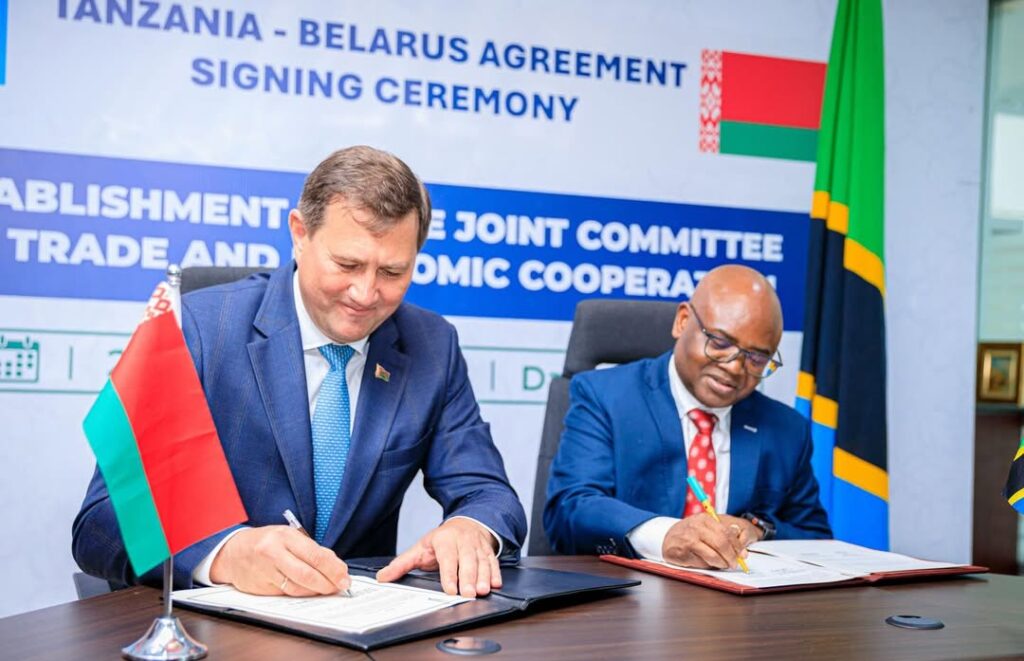
Tanzania and Belarus have established a Joint Trade and Economic Cooperation Commission, signaling a new chapter in bilateral relations aimed at fostering trade and investment opportunities across multiple sectors including industry, agriculture, technology, and infrastructure development.
Tanzania has strengthened its economic ties with Eastern Europe as officials from Tanzania and Belarus signed a significant agreement to establish a Joint Trade and Economic Cooperation Commission. The agreement, signed in Dar es Salaam on Wednesday, represents a strategic move to enhance bilateral economic relations between the two nations.
Minister of State in the President’s Office for Planning and Investment, Professor Kitila Mkumbo, signed on behalf of Tanzania, while Belarus was represented by its Foreign Affairs Minister, Maxim Ryzhenkov. The signing ceremony was witnessed by Tanzania’s Minister for Foreign Affairs and East African Cooperation, Ambassador Mahmoud Thabit Kombo, along with senior officials from both countries.
The newly established commission will focus on creating a foundation for a stable, fair, and mutually beneficial business environment, according to a statement from Tanzania’s Ministry for Foreign Affairs and East African Cooperation. This partnership aims to expand trade volumes and diversify economic engagement between the two countries.
For Tanzania, this agreement comes at a crucial time when the East African nation has been actively seeking to diversify its international partnerships and attract foreign investment to support President Samia Suluhu Hassan’s economic transformation agenda. The country has been working to position itself as an attractive investment destination in Africa through policy reforms and international cooperation agreements.
Belarus, a landlocked Eastern European nation with a strong industrial base, particularly in machinery, chemicals, and agricultural equipment, offers Tanzania potential access to technological expertise in sectors aligned with Tanzania’s industrialization goals. The European country has been expanding its diplomatic and economic presence in Africa as part of its own strategy to diversify international partnerships beyond its traditional allies.
The agreement identifies several key sectors for cooperation, including industry, agriculture, technology, and infrastructure—all critical areas in Tanzania’s development blueprint. Agricultural cooperation could be particularly significant, as both countries place high importance on this sector. Belarus is known for its agricultural machinery and fertilizer production, while Tanzania’s economy is heavily reliant on agriculture, which employs the majority of its workforce.
This partnership follows earlier discussions between the two countries regarding cooperation in ports management, suggesting a comprehensive approach to their economic relationship. Enhanced port efficiency could improve Tanzania’s position as a gateway to East and Central African markets, potentially benefiting regional trade.
The establishment of the Joint Commission provides an institutional framework for regular consultations and monitoring of bilateral economic initiatives, which could lead to increased trade volumes and investment flows. It also creates a platform for addressing any challenges that might arise in the implementation of joint projects or business ventures.
While specific financial commitments or investment targets were not disclosed in the initial announcement, the agreement establishes the groundwork for future economic collaborations that could involve technology transfer, joint ventures, and market access opportunities for businesses from both countries.
As global economic alignments continue to evolve, this partnership reflects the growing trend of cross-regional economic diplomacy, with countries increasingly looking beyond traditional partners to create diverse international relationships that can withstand global economic uncertainties.