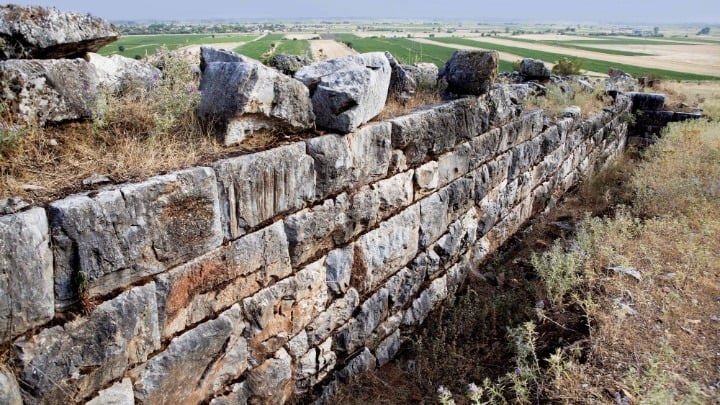
Greece’s Ministry of Culture is pressing ahead with the restoration of the acropolis of Ancient Pelinna, one of Thessaly’s most significant fortified sites and a city that once held a strategic role in the wars of antiquity.
The works, undertaken by the Ephorate of Antiquities of Trikala, are concentrated on the western section of the walls and the north-western towers, where centuries of moisture damage, structural fatigue and successive medieval interventions have left the stonework in a precarious state. Set on a naturally fortified hill in the Municipality of Farkadona, around 16 kilometres east of Trikala, the site has been inhabited in some form from late classical antiquity through to the early Ottoman period.
“The walls of Ancient Pelinna constitute one of the most important ancient fortifications of Thessaly,” Minister of Culture Lina Mendoni said. “Its acropolis constitutes a monumental complex of particular historical and archaeological value for the whole of Thessaly, with exceptional architectural remains, which date mainly to the Hellenistic period.”
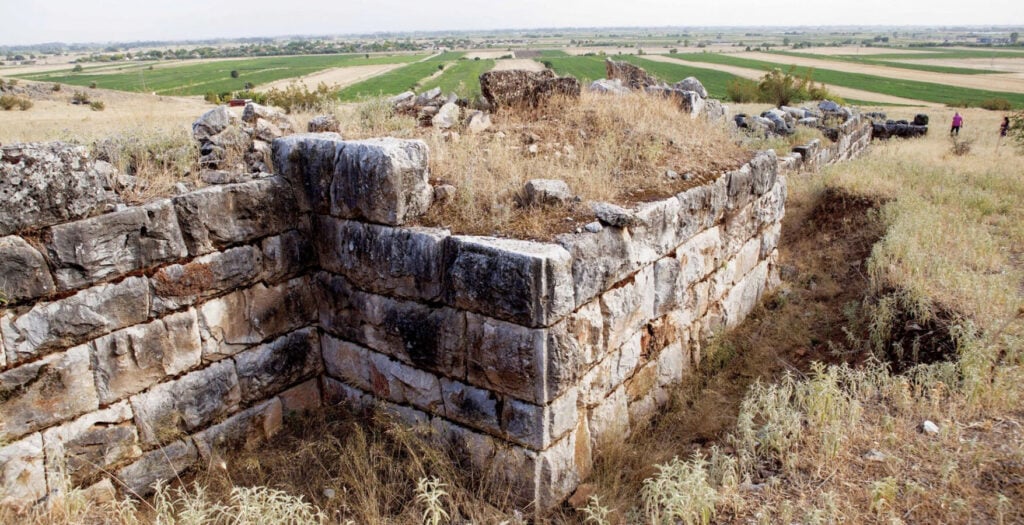
In its prime, Pelinna was a city of consequence. It rose to prominence in the fourth century BC under an alliance with Philip II of Macedon and was home to a celebrated temple of Zeus Pelinnaeus, with two Orphic gold tablets dating to the late fourth century BC unearthed at the site in 1985. Alexander the Great is recorded as having passed through on his march from Illyria to Boeotia. After the defeat of Philip V in 197 BC and a brief seizure by the Athamanes during the Antiochian War of 191 BC, Pelinna fell to Rome and slipped into obscurity. Its acropolis, however, retained strategic value into the Byzantine era, when the medieval settlement of Gardikion took root there and remained continuously inhabited until the early Ottoman years.
That layered history is now central to the restoration logic. The trapezoidal wall enclosing the acropolis on its western, southern and eastern sides preserves both ancient Hellenistic stonework and substantial medieval reworking, particularly along the central western section, requiring a multi-phase technical approach. Engineers and conservators are stabilising masonry, reinforcing cracks, partially rebuilding sections in collapse, improving drainage and reshaping the surrounding terrain. The most striking element of the western perimeter, a powerful bastion at the northern end with two towers and a connecting curtain wall, is being treated as the centrepiece of the works.
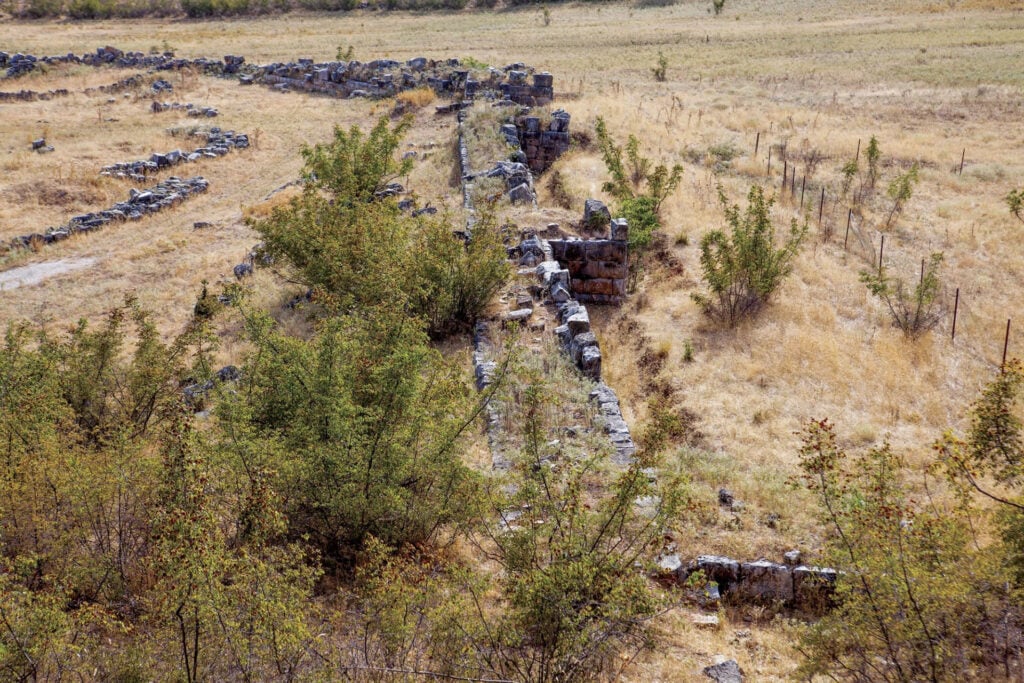
Mendoni framed the project in both heritage and economic terms. “With the interventions that are underway, by the Ephorate of Antiquities of Trikala, based on the approved studies, the protection and restoration of the monument is ensured, with absolute respect for its authenticity and timelessness,” she said. “With gentle and completely compatible interventions, a great archaeological site is being created, accessible and safe, which strengthens the cultural potential of Thessaly, while simultaneously creating new economic activities throughout the region.”
The works form part of the Ministry’s broader strategy for safeguarding Thessaly’s cultural heritage, with funding drawn from the Thessaly Regional Operational Programme under the ESPA 2014-2020 and 2021-2027 frameworks. Once completed, the site is set to reopen as a fully accessible archaeological park.
Read also The Ancient Greek Inscription that Names Jesus as God
acropolis restoration, ancient Greek fortifications, Ancient Pelinna, Ephorate of Antiquities of Trikala, Farkadona, Greek archaeology, Greek cultural heritage, Greek Ministry of Culture, Hellenistic period, Lina Mendoni, Natalie Martin, Thessaly, Trikala