
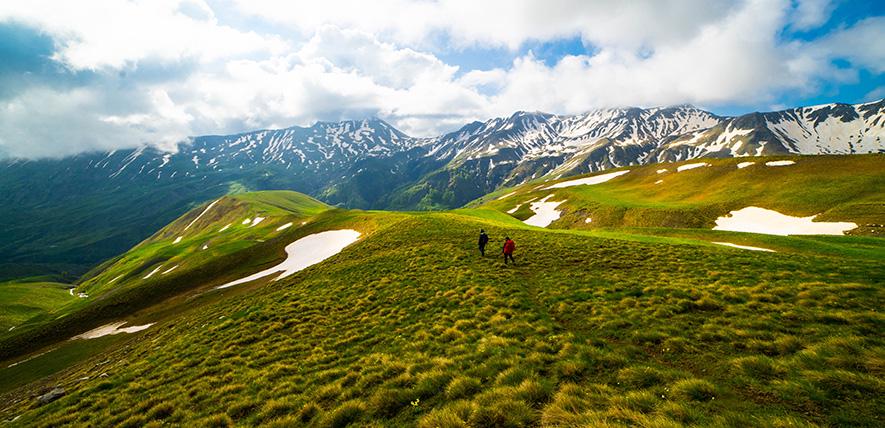
Snow cover on Greek mountains has more than halved in four decades. The scale of decline has accelerated since the turn of the century. In addition, the snow season is both starting later and ending sooner.
https://www.cam.ac.uk/research/news/snow-cover-on-greek-mountains-has-more-than-halved-in-four-decades-study-finds#:~:text=%E2%80%9CSnow%20is%20like%20a%20natural,more%20when%20you%20need%20it.
1 Comment
An international team of researchers, led by the University of Cambridge, used a combination of satellite imagery, climate data, terrain maps, and artificial intelligence to analyse how rising temperatures in the Mediterranean region have affected snow cover on the mountains of Greece – a region that is far less studied than other mountain ranges of Europe, such as the Alps or Pyrenees.
Using the tool they developed, called snowMapper, the researchers found that snow cover has declined by 58% in the past forty years, and that the scale of decline has accelerated since the turn of the century. In addition, the snow season is both starting later and ending sooner.
Their results, reported in the journal The Cryosphere, suggest that the loss of snow cover is driven by an increase in temperature, not a change in the amount of precipitation. Warmer air means that more precipitation falls as rain instead of snow at high altitudes, depriving downstream rivers of the ‘slow release’ water supply that snow provides.
“Snow is like a natural reservoir,” said first author Konstantis Alexopoulos from Cambridge’s Scott Polar Research Institute (SPRI). “It’s sort of like putting money in your savings account versus spending it right away. If you store that money away for a while, it collects interest and is worth more when you need it. And because snow slowly melts instead of washing away like rain, it’s very valuable – for irrigation, hydropower generation, and household water needs – during the hot and dry summer months, as it keeps rivers, lakes, and groundwater topped up.”
To quantify the degree of snow cover loss, the researchers used satellite imagery from NASA and ESA missions to show where snow was or wasn’t on clear days between 1984 and 2025. However, since cloud cover or shadows often obscure a clear view, the team used an AI technique called machine learning to help fill in the many gaps.
They used European climate and digital terrain datasets to help simulate what snow cover was likely to have been on a given cloudy day, based on temperature, precipitation data, elevation, and whether snow was previously present. Their machine learning algorithm was trained on thousands of ground-based snow observations collected from weather stations across the Alps and Pyrenees.
https://tc.copernicus.org/articles/20/2209/2026/