
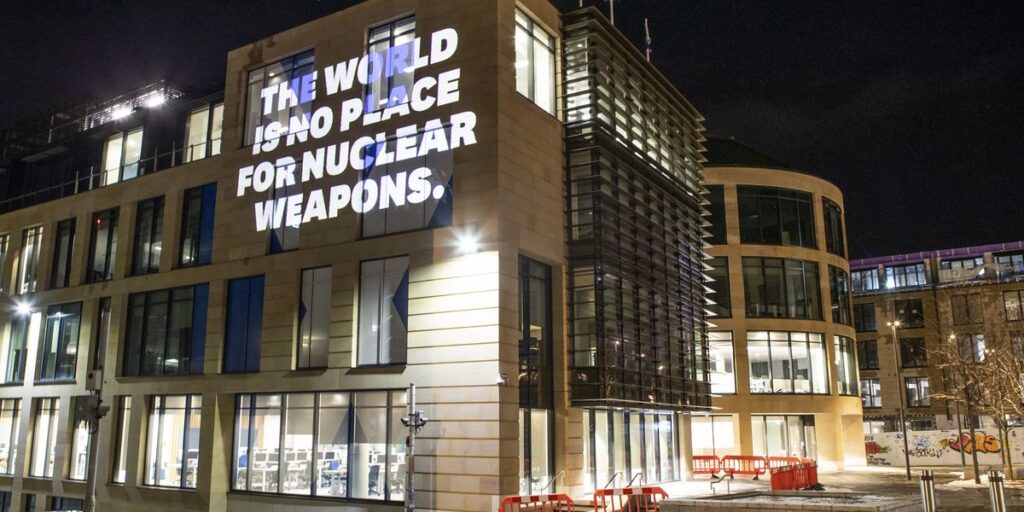
This speech was delivered to the 11th Review Conference of the Treaty on the Non-Proliferation of Nuclear Weapons on May 1, 2026.
Honorable President, Distinguished Delegates, Colleagues, and Friends,
We are living in a decisive moment. Humanity faces a choice, whether consciously or not, to continue down a path of conflict that leads toward ultimate destruction or to renounce its old ways and center peace at the heart of all its efforts.
International law, built painstakingly over decades and even centuries to prevent such an unfathomable catastrophe, is under brazen and relentless attack today. At the heart of this divergence lies a fundamental question: whether states may claim a right to wage war without restraint, and whether use and even possession of weapons with potential to end human civilization can ever be justified. These are precisely the issues at the core of the Treaty on the Non-Proliferation of Nuclear Weapons (NPT)—whose future we have gathered to discuss at this Review Conference.
Nuclear disarmament and nuclear non-proliferation are not separate tracks toward a safer world—they are intertwined and inseparable paths.
Our world is a time-ticking bomb. There are more than 12,000 nuclear warheads in existence—each capable of killing hundreds of thousands, some even millions of people, and any one of which could trigger a chain reaction leading to full-scale nuclear war in less time than this session will last.
More than 40 years ago, Presidents Ronald Reagan and Mikhail Gorbachev reminded us that “a nuclear war cannot be won and must never be fought.” And yet today, we hear renewed calls to use nuclear weapons in the name of “saving lives,” alongside threats that contemplate the destruction of entire societies.
The five nuclear-weapon states recognized under the NPT, the United States, the Russian Federation, the United Kingdom, France, and China, possess over 95% of the world’s nuclear arsenal. With that power comes not only a moral responsibility, but a clear legal obligation under Article VI of this Treaty: to pursue negotiations in good faith to achieve not only nuclear disarmament, but also total and complete general disarmament.
Nuclear disarmament and nuclear non-proliferation are not separate tracks toward a safer world—they are intertwined and inseparable paths. As Joseph Rotblat warned in his 1995 Nobel Peace Prize acceptance speech: “If the militarily most powerful and least threatened states need nuclear weapons for their security, how can one deny such security to countries that are truly insecure? The present nuclear policy is a recipe for proliferation. It is a policy for disaster.”
We join the voices of hibakusha and countless others who have come before us in urging all NPT States Parties to take immediate and meaningful action:
- Condemn and cease all military combat, including wars that risk escalation toward nuclear conflict, and reaffirm the primacy of international law and peaceful resolution of disputes.
- Unequivocally renounce the use or threat of use of nuclear weapons under any circumstances, and reject policies such as “launch on warning” and “first-use” that heighten, rather than reduce, the risk of nuclear war.
- Commit to a concrete, time-bound path toward a world free of nuclear weapons, including by joining the Treaty on the Prohibition of Nuclear Weapons. The first step in this journey must be clear to all: The United States and the Russian Federation, which together possess more than 85% of the world’s nuclear arsenals, must urgently restart bilateral negotiations to reduce and ultimately eliminate their stockpiles. The remaining nuclear-armed states must pause all modernization and arsenal increase programs, and commit to a transparent, verifiable, and irreversible process of disarmament.
- Recognize and assist all victims of the nuclear age, including survivors of the atomic bombings of Hiroshima and Nagasaki, those impacted by more than 2,000 nuclear explosions during the so-called nuclear testing period, and uranium mining workers and others harmed by the the development of nuclear weapons, ensuring justice, support, and environmental remediation.
This call is not just an abstract moral appeal; it is a prerequisite for human survival. The credibility of the NPT and the future of humanity depend on the actions we take over the next three weeks.
In the words of Joseph Rotblat: “The quest for a war-free world has a basic purpose: survival. But if in the process we learn how to achieve it by love rather than by fear, by kindness rather than by compulsion; if in the process we learn to combine the essential with the enjoyable, the expedient with the benevolent, the practical with the beautiful, that will be an extra incentive to embark on this great task.”
Thank you, Honorable President.