
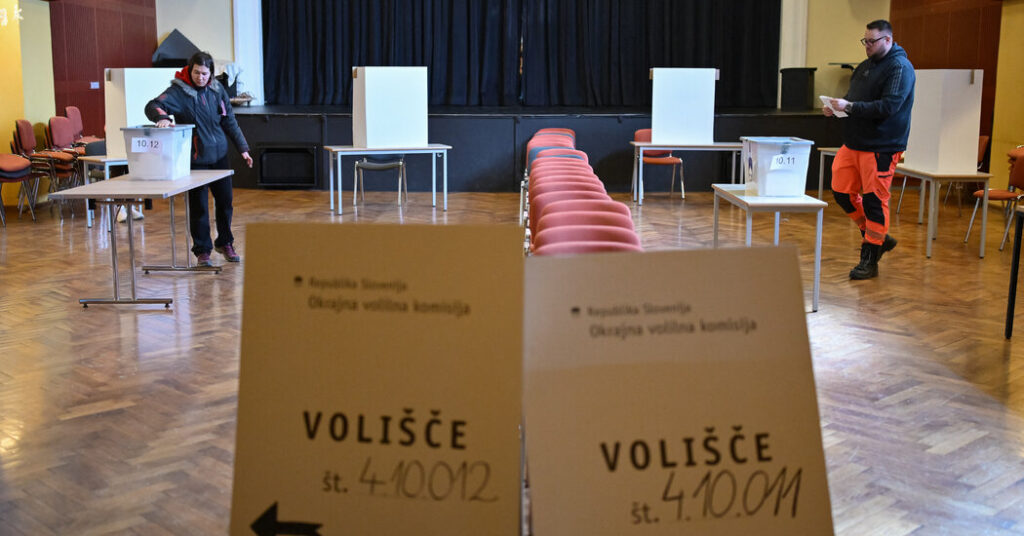
A face-off between Europe’s liberals and right-wing populists aligned with President Trump ended in a near draw on Sunday when voters in Slovenia split almost evenly between the two camps, according to official results of a general election.
With more than 99 percent of ballots counted, the center-left Freedom Movement of the incumbent prime minister, Robert Golob, had won 28.56 percent of the vote, compared with 28.12 percent for a nationalist party headed by Janez Jansa, an ardent admirer of Mr. Trump.
With neither of the two main parties garnering enough votes to secure a majority of seats in Slovenia’s 90-member Parliament, the shape of the next government will now depend on which camp can rally support from smaller parties, five of which, according to official results, also won seats.
Mr. Jansa, a former prime minister whose defeat in a 2022 election slowed what had been a surging populist tide across Europe, entered the race with what opinion polls considered a good chance of returning to power. But his Slovenian Democratic Party lost momentum in the final stage of the campaign amid accusations that it hired a private Israeli intelligence agency, Black Cube, to smear the prime minister’s governing party.
A Communist in his youth, Mr. Jansa, 67, morphed into a nationalist as Yugoslavia, which Slovenia used to be a part of, disintegrated in the early 1990s. He has for years taken a highly combative approach in politics and on Sunday asserted that the official vote count had been “unusual,” claiming that his party had won more votes than recorded by the electoral commission.
While in power, he cut off state funding for media outlets that he judged disloyal and railed against migrants as an existential menace. He insisted that Mr. Trump won the 2020 election, describing those who said he lost as “truth denying.”
Election posters for his Slovenian Democratic Party feature pictures of a young boy playing the accordion and ask voters to support the party “so your grandson will still sing Slovenian songs.”
Sunday’s vote took place just three weeks before Hungary holds a closely watched election that polls indicate could end the 16-year tenure of Prime Minister Viktor Orban, a close ally of Mr. Jansa’s and a standard-bearer for nationalist politicians across Europe.
Mr. Orban is hoping that opinion polls showing his Fidesz party trailing badly will prove out of line with how votes are actually cast on April 12, but Sunday’s results in Slovenia closely matched the outcome predicted by pollsters.
Slovenia, the homeland of Melania Trump, is the most stable and prosperous country to emerge from Yugoslavia’s breakup. But, still haunted by divisions dating to World War II, its two million people are polarized between liberals who see the European Union as a force for good and nationalists who worry that traditional values and culture are under threat from outsiders.
The final days of the election campaign were dominated by the release of 10 secretly recorded videos featuring a former minister, a lawyer and others connected to the government bragging about their political connections and how they could help a foreign businessman.
The revelations initially provided ammunition to Mr. Jansa’s party to attack the government as corrupt but became a liability after Slovenian journalists and a human rights group, 8th of March Institute, uncovered evidence indicating that the videos were part of a dirty tricks operation orchestrated by Black Cube at the opposition’s behest.
Run by former Israeli intelligence operatives, Black Cube has former clients who include the disgraced Hollywood producer Harvey Weinstein, and it has been entangled in a number of formerly Communist countries in Eastern Europe.
Three Israeli employees received suspended sentences in Romania in 2022 for trying to intimidate the anti-corruption prosecutor. The company has also been linked to smear operations in Hungary against critics of Mr. Orban.
Marko Milosavljevic, a journalism professor at Ljubljana University and an outspoken critic of Mr. Jansa, said the videos had increased the volatility of the election. “The tensions are extremely high,” he said.
Prime Minister Golob last week appealed for help from fellow European leaders against what he called a “a clear hybrid threat” to the European Union. He added: “Unfortunately, our far right exploits every opportunity to discredit Slovenia abroad. In this case, it has become clear that it is prepared to align itself with the most extreme para-intelligence agencies, with a single aim — to come to power, even if this means stopping at nothing.”
President Emmanuel Macron of France backed Mr. Golob’s account of events, saying Thursday that the Slovenian prime minister “has been the victim of a clear interference, disinformation and actions by third countries.”
Mr. Jansa initially denied any dealings with Black Cube, or even having heard of it, but later acknowledged meeting with one of its representatives, Giora Eiland, former head of Israel’s National Security Council. He said he had known Mr. Eiland for years and had discussed the Middle East, not Slovenian politics.
Mr. Jansa has long been an outspoken supporter of Israel. While prime minister for a third time from 2020 until 2022, he ordered that government buildings fly Israel’s flag as a gesture of solidarity. His successor, Mr. Golob, has been critical of Israel. His government recognized Palestine as a state in 2024 and last year banned all products originating in Israeli settlements in occupied territory.
Kristina Bozic contributed reporting from Ljubljana, Slovenia.