
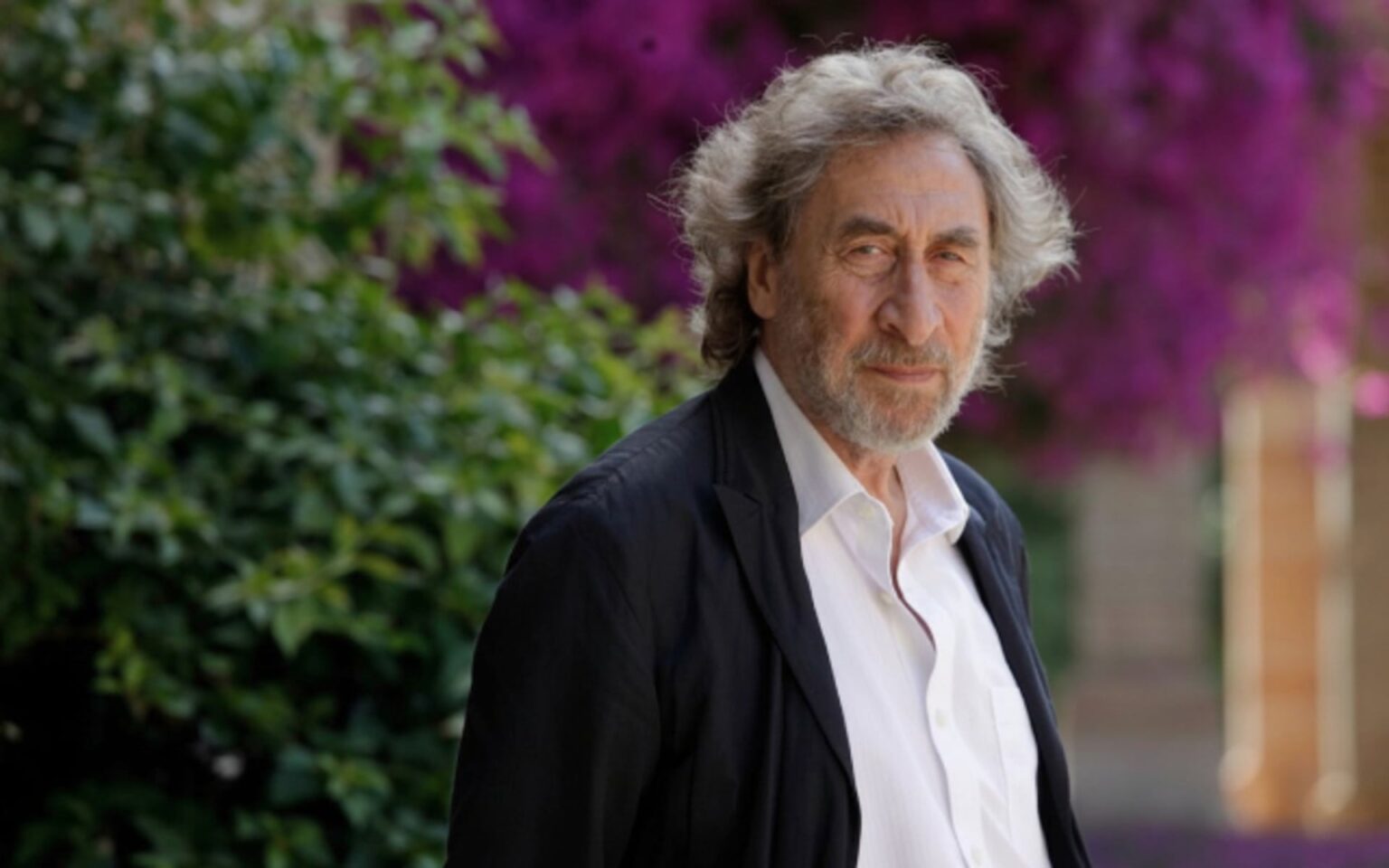
LONDON — Howard Jacobson knew the day after the October 7, 2023, massacre that he had to write a book.
But the acclaimed British novelist had a problem: the “absolutely white fury” that he felt in the aftermath of the attacks — not the right state, he says, in which to begin writing.
It was less the “awful” and “heartbreaking” violence visited on southern Israel that provoked his anger — some 1,200 people were slaughtered amid acts of horrific brutality in the October 7, 2023, Hamas-led terror onslaught, and 251 abducted to the Gaza Strip — but the unfolding scenes he was witnessing closer to home.
“The aftermath was rage that there were people out there, who one would normally have thought of as civilized and educated, who rejoiced in it,” recalls Jacobson. “It was bloodlust, and it seemed to me that it was bloodlust directed against the Jews.”
That bloodlust dominates his newly published novel, “Howl.” It’s the story of Ferdinand “Ferdie” Draxler, the Jewish headteacher of a south London primary school, who slowly unravels as he observes the world’s reaction to the barbarity of Hamas’s assault.
“I knew I had to make Ferdinand half mad because otherwise I would give him my anger,” Jacobson tells The Times of Israel. “You have to move from anger to something else — otherwise, it’s incoherent and more of a tract than a novel.”
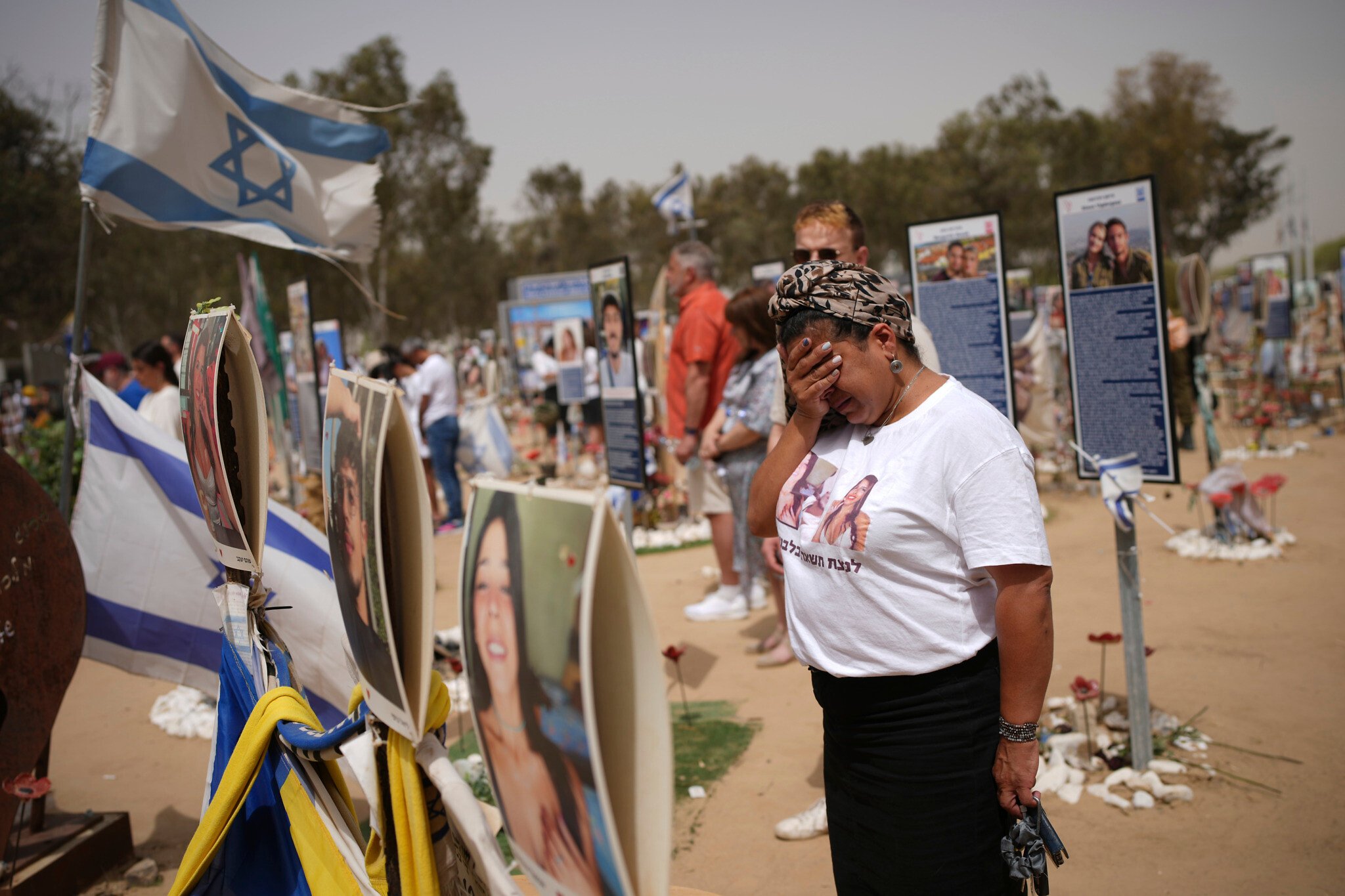
People stand still to observe two minutes of silence as sirens sound marking Israel’s annual Memorial Day at the site of Oct. 7, 2023, attack by Hamas terrorists at the Nova music festival near Kibbutz Re’im, southern Israel, April 30, 2025. (AP Photo/Ohad Zwigenberg)
Jacobson says he initially considered a work of nonfiction entitled “A History of the Jews in 100 Lies.”
“All I could hear was lies,” he says. “I’d sit in front of the television and scream at the television: ‘Lies. Those are lies. Those are lies.’ It was the lying, more than anything else, that I couldn’t stand. The lying about what Zionism was, the lying about how Israel came into existence … and [then] there were all the old libels coming back, including, of course, the oldest and most horrific and most absurd libel of all, the blood libel.”
Thankfully for fans of Jacobson’s prize-winning fiction, he decided to opt for a novel.
“I’m happiest when I’m writing a novel,” he says. “I like my own mind and voice more when I’m writing a novel.”
The decision to make Ferdie feel as if he’s going mad is a well-trod Jewish literary tradition, says Jacobson. Citing the protagonist of Saul Bellow’s 1964 novel “Herzog,” he continues: “I immediately thought of the words of Moses Herzog: ‘If I’m out of my mind, it’s all right with me.’”
‘I immediately thought of the words of Moses Herzog: ‘If I’m out of my mind, it’s all right with me’
Jacobson is well-known for his ability to find the comic and absurd in almost any topic. “Howl” is no exception; something which, he says, some early readers found surprising.
There is, of course, a darkness to the humor. On the evening of the attacks, Ferdie hears neighbors dancing, celebrating and shouting, “Gas the Jews,” in the street. He decides to confront them — albeit in a very English manner.
“Could you tone it down a bit?” Ferdie asks. “My wife’s not feeling well and is trying to sleep.”
The response is equally English. “Sorry,” one says, signaling to the others for quiet. “‘Gas the Jews,’ they whispered.”
Equally, when he spots graffiti saying “Death to Jews: Jenoside,” Ferdie can’t decide what offends him more, the vandal’s “not knowing what the word meant or not being able to spell it.”
“That has always been my way of dealing with anything,” says Jacobson. “Find the comic and then make sure you don’t find only the comic. I didn’t have any difficulty finding the tragic.”
Ferdie is not a comic figure but, Jacobson believes, “quite ordinary.” His pleasures are simple — visiting art exhibitions at the National Gallery and buying chocolates in London’s Fortnum and Mason department store — and so is the philosophy which underpins his teaching. As Jacobson has previously said: “Central to his teaching and example has been moral imagination — the faculty of entering into the suffering of others.”
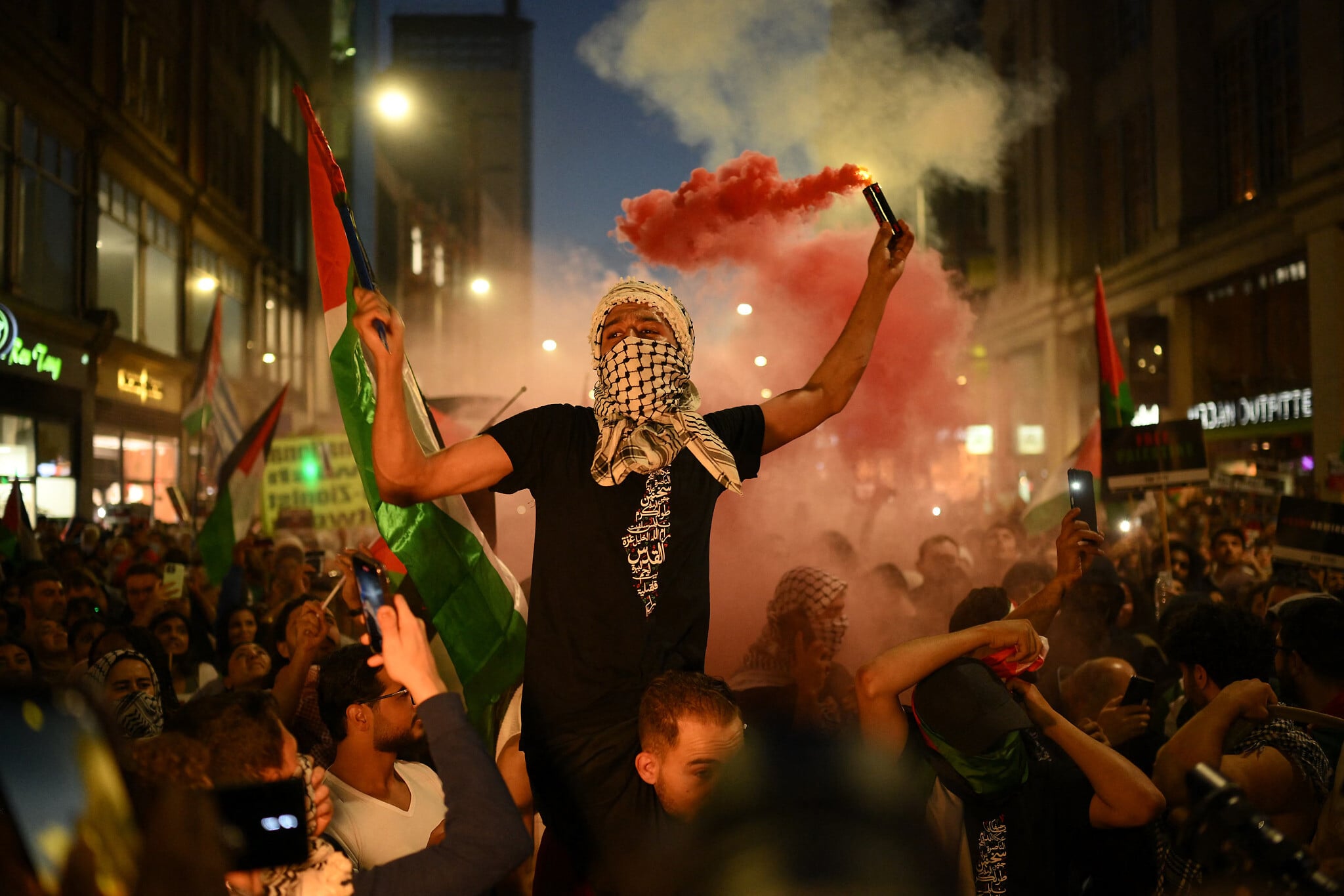
Anti-Israel demonstrators take part in a ‘Stand with Palestine’ protest close to the Embassy of Israel in west London on October 9, 2023. (Daniel LEAL / AFP)
Ferdie’s tragedy, Jacobson agrees, is that the faculty he teaches his children to extend to others is, in the days, weeks and months after October 7, denied to Israelis and Jews. The principle he has inculcated into his school, the author says, is “kindness and understanding” — so much so that he changes the school motto from “know thyself” to “know thyself, but know others better.”
“It is not intellectually sophisticated, but no less important for that,” says Jacobson. Ferdie may not be “a student of Jewish theology or Jewish intellectual life,” but he knows that, after centuries of “maltreatment and misunderstanding … an obligation of the Jewish moral life [is] that you do not do to others what’s been done unto you.”
‘An obligation of the Jewish moral life [is] that you do not do to others what’s been done unto you’
After October 7, Ferdie is discombobulated by the “speed at which morality went into reverse” as the “clerks and scholars [rush to]… embrace savagery.” The world, he sees, has gone from “Never Again” to “Please Repeat.” Listening to a student on the radio openly proclaiming the pogrom “the best day of her life,” Ferdie dryly observes: “Since dead Jews did it for her, I was only sorry she hadn’t been alive to see the crematoria of Belsen at full bore.” The choice of words is apt: Ferdie’s elderly mother, Agata, survived the Bergen-Belsen concentration camp.
From ‘Never Again’ to ‘Please Repeat’
From his home in Soho, in the heart of London’s West End, Jacobson could hear the “violent … full of hate” anti-Israel marches, which commenced even before the IDF had started its operations in Gaza.
But, he agrees, Ferdie is driven to the edge of sanity less by the outpouring of hate which he witnesses all around him, than by the manner in which this is cloaked in a twisted, manipulated language. “The language I’d been reading and speaking all my life assumed a common enterprise of imagination and compassion,” Ferdie observes. “Words were there to help us navigate our way to truth.”
Now the world feels topsy-turvy. “The Jews,” he says of those who both celebrated and denied Hamas’s atrocities, “had asked for whatever hadn’t happened to them.” Overburdened by the sense that “humanity had lost its mind,” Ferdie makes his choice: “If madness is the price of telling the truth, I would choose madness.”
Ferdie’s horror is exacerbated by the fact that his beloved daughter, Zoe, joins the marches. Not recognizing her father, who has become accidentally entangled in a protest, she screams “Colonialist Zio pig” in his face and later appears grinning on TV, ripping down the picture of a hostage. Ferdie is hurt and appalled, sardonically speaking of Zoe having gone to university “for a brain transplant” and emerging “in a world where doubt was frowned upon and irony outlawed.”
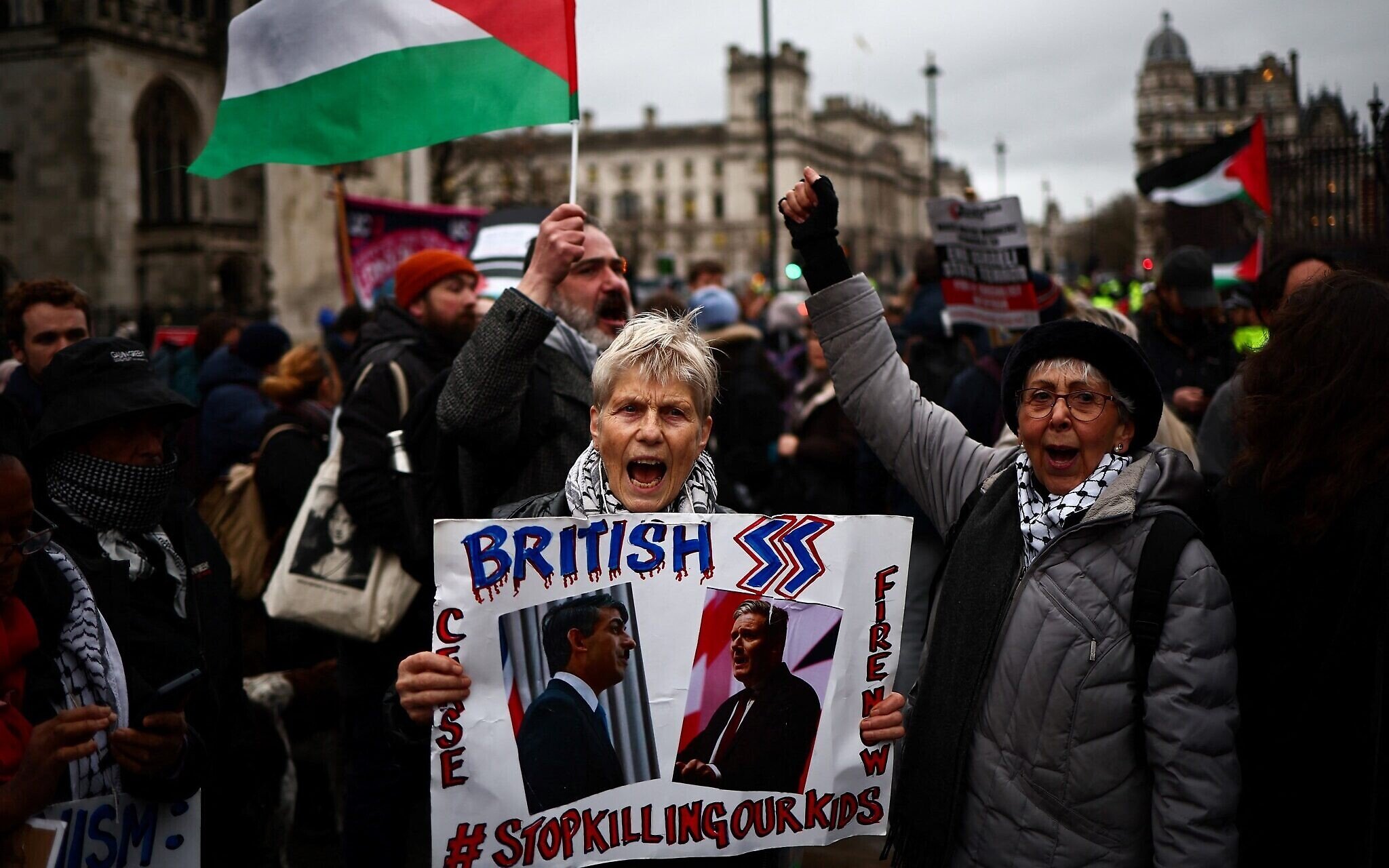
Pro-Palestinian, anti-Israel demonstrators wave Palestinian flags and hold placards as they protest in Parliament Square in London on February 21, 2024, during an Opposition Day motion in the House of Commons calling for an immediate ceasefire in Gaza. (Henry Nicholls/AFP)
A former academic, Jacobson believes that universities are the place where “we see reason extolled and people are taught by their teachers to think for themselves.”
He despairs at what the reaction to October 7 revealed: young people who “all apparently thought the same,” mouthing “that language of total agreement and the language of nonsense.” He cites “that settler colonial rubbish … unquestioned by hundreds and thousands of young people with degrees or about to get degrees and the people at the front of the marchers who will award them those degrees.”
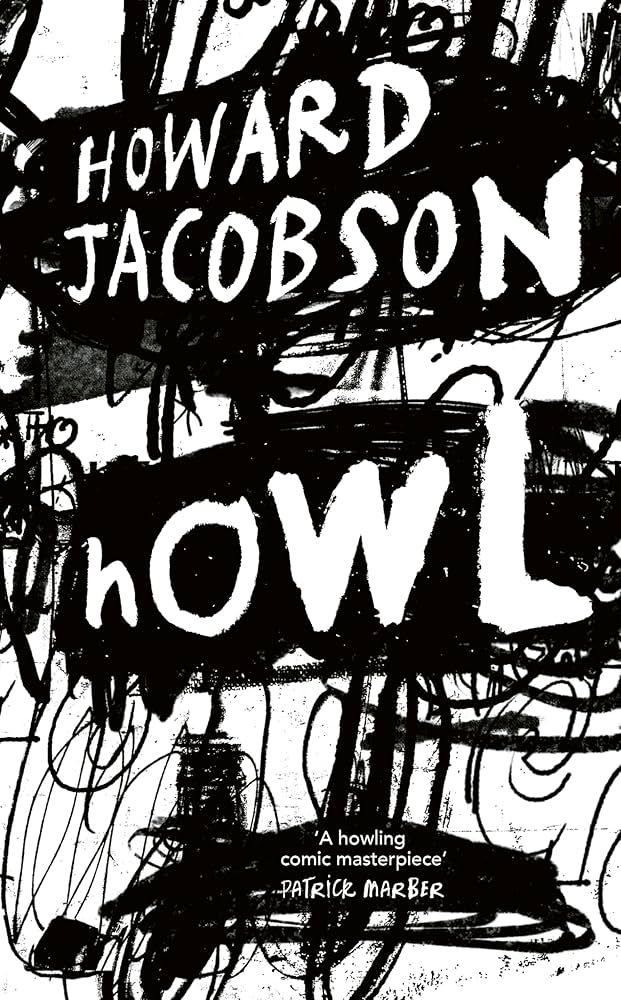
‘Howl’ by Howard Jacobson (courtesy)
Jacobson says he felt anger at the “sheer gibberish” being mouthed, while also wanting to laugh at it. It was necessary to constantly remind himself that “a thing doesn’t become any less absurd because it’s destructive and tragic.”
Jacobson says he was keen, through Ferdie’s wife, Charmian, who hails from a staunchly “pro-Jewish socialist” family, to remind people that Zionism wasn’t always anathema to large sections of the left. Quite the opposite. Ferdie himself offers a simple, eloquent defense, telling his wife: “A Zionist, my mother once told me, was a Jew with somewhere to live. Which meant an interior place of self-respect as well as a homeland.”
Can you be an anti-Zionist without being an antisemite, Charmian asks? “Zionism was the only hope European Jews had of getting out of Eastern Europe alive,” Ferdie responds. “Whoever denies them that is an antisemite.”
The chilling rise of anti-Zionist Jews
Jacobson can’t disguise his disdain towards far-left politicians such as the former Labour leader Jeremy Corbyn and the new leader of the Green party, Zack Polanski, a self-proclaimed anti-Zionist Jew. He labels Polanski “a despicable clone of Jeremy Corbyn,” while saying Corbyn at least has the excuse of ignorance. “He really is an ignorant man and doesn’t know what Zionism was and really does think it was a colonial enterprise from the start,” Jacobson says. “Zach Polanski doesn’t have that excuse.”
Jacobson recognizes that “the Zionist heart has hardened,” but believes this was inevitable both because “no grand ideal … can ever stay loyal to its first principles” and because “there’s been so much pressure put on it [by] the enmity it faced once the world decided to turn against Zionism.”
But he maintains his staunch belief in the nobility of the founding Zionist dream, which he terms “the liberation of the Jewish mind, as well as the liberation of the Jewish body.”
If Charmian desperately tries to help her husband cling on to sanity — “it can’t all be catastrophe, Ferdie,” she tells him — his mother has a view of the world shaped by history’s darkest hour. “She never did think humanity had learnt its lesson or ever would,” Ferdie recounts, quoting Agata’s dismal words: “I will not waste my time saying Never Again.”
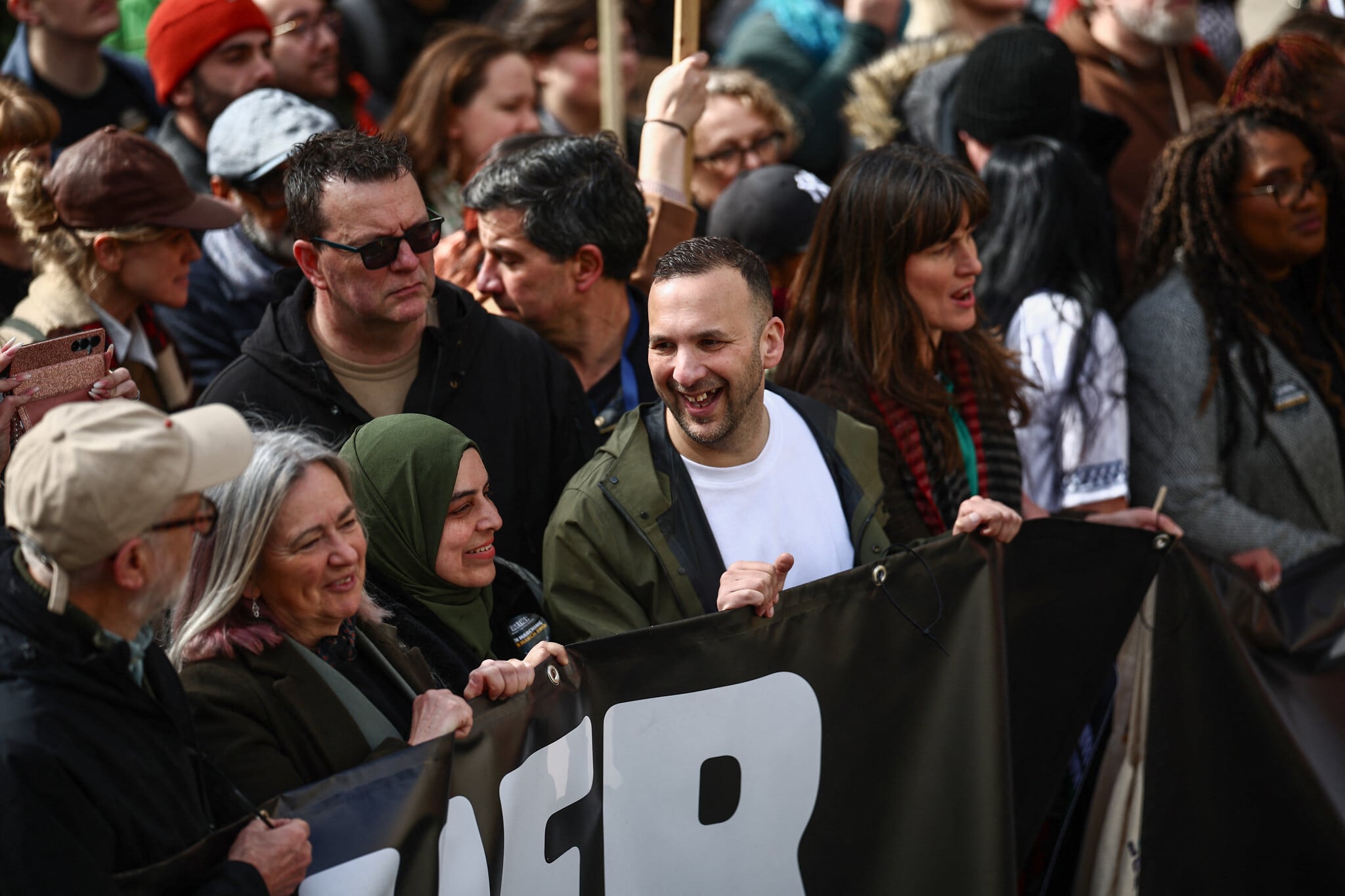
Green Party leader Zack Polanski, center, and former Labour party leader Jeremy Corbyn (far left) join protesters holding placards and waving flags as they take part in a march against the far right in central London on March 28, 2026. (Henry Nicholls/AFP)
Do the last two years validate that assessment? In the days after October 7, Jacobson recalls sensing an “exuberance … in some academic circles, on campuses throughout the Western world, [and] on the streets of our great cities.”
After eight decades of supposed restraint in the wake of the Holocaust, he says, “permission” had finally been given to “do to the Jews, and then say about the Jews, all the things we’d been brought up not to.”
Jacobson believes the results are horrifying. “The moral walls erected around Belsen and Auschwitz [are] finally coming down, and that’s terrifying,” he says.
‘The moral walls erected around Belsen and Auschwitz [are] finally coming down, and that’s terrifying’
The “raucousness” of the demonstrations in Britain, the manner in which people would “shout and scream” if they were denied their weekly “right” to protest exactly as they wished, didn’t just offend Jacobson’s Jewish sensibilities. “It bothered me as an Englishman too,” he says, adding it felt alien to the “free and easy way that life in London … and England has always been.”
But, Jacobson was recently reminded, the sympathies of England’s silent majority may not be with the strident minority.
As he traveled by cab to do a promotional interview, a London taxi driver asked Jacobson what he was going to be talking about on the radio. The author told him about “Howl.”
The driver asked to pull over for a minute, turned to face Jacobson, and said: “I just want you to know that out there in this country, we’re with you, you know.”
A perplexed Jacobson asked him what he meant.
“We’re not buying it,” the driver replied. “We’re not all buying that horrible [antisemitic] Jewish stuff, we’re not. We’re with you.”