
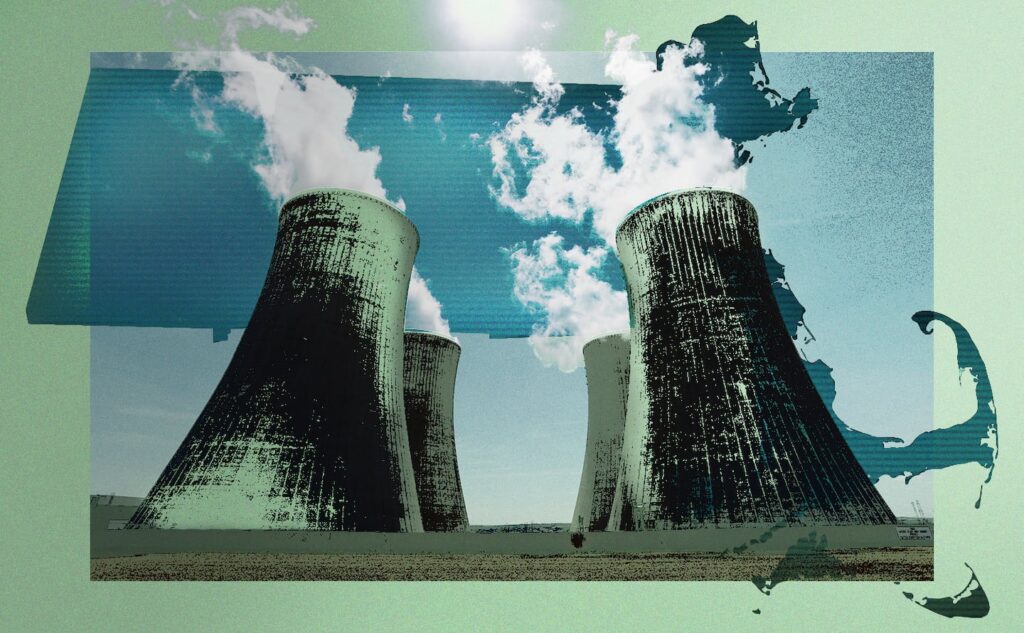
The Legislature is exploring procurement of wind and solar energy equal to our needs, increased solar panel installation by cities and towns, and ways to support these developments. Massachusetts residents should express their support for these options, which are possible, climate friendly, and produce no nuclear waste.
Donna Trainor
Sherborn
Small modular reactors merit a closer look
Kate Selig’s front-page article on a possible “nuclear renaissance” in New England points to a vital shift in our regional energy strategy. While the debate often centers on historical safety fears vs. climate goals, the engineering requirements for grid reliability are often overlooked.
According to the ISO-NE 2024 Economic Study, achieving a fully decarbonized New England grid by 2050 is not just a matter of building more wind and solar. Relying solely on renewables would require a massive, arguably unfeasible overbuild of capacity to ensure reliability during the extended overcast and windless periods in winter. The study found that incorporating small modular reactors is a more cost-effective way to meet these reliability needs than relying solely on long-duration battery storage.
By providing carbon-free, dispatchable power that doesn’t depend on the weather, SMRs would act as a necessary kind of insurance policy. They would reduce the total amount of infrastructure needed across the region, lowering both the land-use footprint and the overall system cost.
As Governor Maura Healey notes, nuclear must be part of the solution, not just for emissions but also for the fundamental stability of the grid in a zero-carbon future.
Frederick Hewett
Cambridge
Healey headstrong on nuclear despite health risks and costs
As attorney general in 2015 Maura Healey commissioned a special report of energy needs in Massachusetts that concluded that “under business-as-usual circumstances, the region can maintain electric reliability through 2030, even without additional new natural gas pipelines.” This was a welcome message, because new gas pipelines only increase our dependence on polluting fossil fuels that accelerate climate change.
Now governor, Healey expresses support for nuclear energy. This is in spite of a recent study in Massachusetts demonstrating increased numbers of cancer cases near nuclear reactors. An international study of workers in nuclear power plants shows that prolonged exposure to low-dose radioactivity results in elevated rates of cancer.
Nuclear power is considered the most costly way to generate energy. Solar and wind are much less expensive and don’t cause cancer. Battery technology is advancing rapidly. Network geothermal is an extremely energy efficient way to heat and cool buildings.
Healey’s energy and affordability bill includes a clause to repeal a state law that mandates voter approval before new nuclear power plants are introduced in Massachusetts. This repeal would not improve affordability, and it would divert taxpayer resources from safe, proven, more affordable technology.
Dr. Susan Racine
West Roxbury
The writer is cochair of the board of Greater Boston Physicians for Social Responsibility.
Keep the reporting on electrical generation coming
I hope this is just the first of multiple articles about New England’s options for electrical generation. While Kate Selig has beautifully researched the history of anti-nuclear protest and policy in the region, there is so much more happening that needs to be brought into public discussion.
The plummeting cost of solar, concerns about how concentrating power generation into a few hands contributes to income inequality and the rise of authoritarianism, and the attraction that nuclear plants have as targets for terrorism are not secrets. They are among reasons that investors balk at nuclear construction, and why ratepayers are wary of being committed to decades of nuclear debt when decentralized, low-cost solar is so affordable.
With Governor Maura Healey making a high-profile commitment to her new nuclear “road map,” as she calls it, we, the electorate, are depending upon the Globe to do a deep dive into all aspects of the question: What kind of electrical generation is in the long-term best interest not only of New Englanders but of the planet?
I’m not the only one who cares deeply about the subject and who is more likely to agree with Bill McKibben’s well-documented answer to the pro-nuclear movement with his book “Here Comes the Sun” than with Healey’s dubious alliance with the nuclear industrialists.
Lance Hidy
Merrimac
Chorus of approval for nuclear power
I agree with Governor Healey. We need nuclear power.
A low blow by the Globe to make the specter of Chernobyl part of the lead paragraph (the entire Soviet Union was dysfunctional at the time). It’s not 1986 anymore, and many advances have been made in safety and efficiency.
Let’s go!
DPierre508
BostonGlobe.com
Should it happen, yes.
Will it happen, no.
The most expensive part of nuclear power is the litigation before building ever begins.
GadflyS
BostonGlobe.com
Nuclear power is working just fine all over the world.
Critthink
BostonGlobe.com
Very easy for the six N.E. governors to say they support nuclear, since not a single additional watt of electricity will be generated by nuclear power while they are in office. They all want to pretend they are doing something about cost, even though they can’t. As the experts in this article say, next-gen nuclear “could also be cheaper,” which means it won’t be.
6thGenNHGal
BostonGlobe.com
Location, location, location
When those people pushing for, lobbying for, voting for, financing, supplying, building, or running nuclear power stations are willing to live next door to them, we can begin to discuss building new ones.
CatX
BostonGlobe.com