
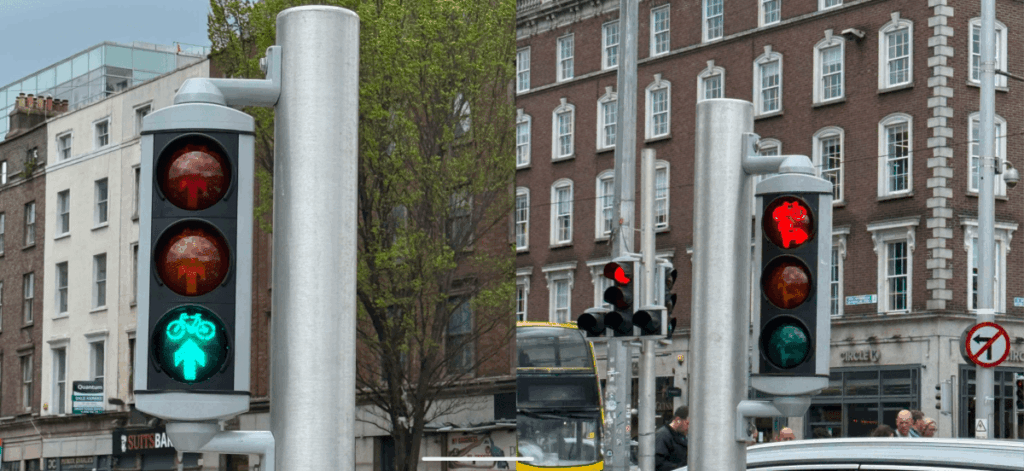
After directional bicycle lights were allowed by law last year, one of the first installed in Ireland is now in place on O’Connell Bridge in Dublin. The lights, as installed, replace the standard bicycle logo on cycle traffic lights and include a smaller version of the logo, with the direction of travel indicated by an arrow.
As this website reported last year, the latest change comes as part of a raft of legal changes to back new cycling infrastructure, and, as reported in 2020, the changes had been in the works since 2016. Other counties use a variety of approaches, including the one now taken in Ireland, and the main alternative: mini-road-sign arrows above or below the bicycle traffic light signals.
The above photos — thanks to a reader who sent them in — show the traffic lights that have been added to part of the end of the Liffey Cycle Route path from the Docklands to the south-east corner of O’Connell Bridge. It’s unclear whether others have been installed elsewhere, but the retrofitted logos on the traffic lights pictured are in one of the country’s most high-profile locations.
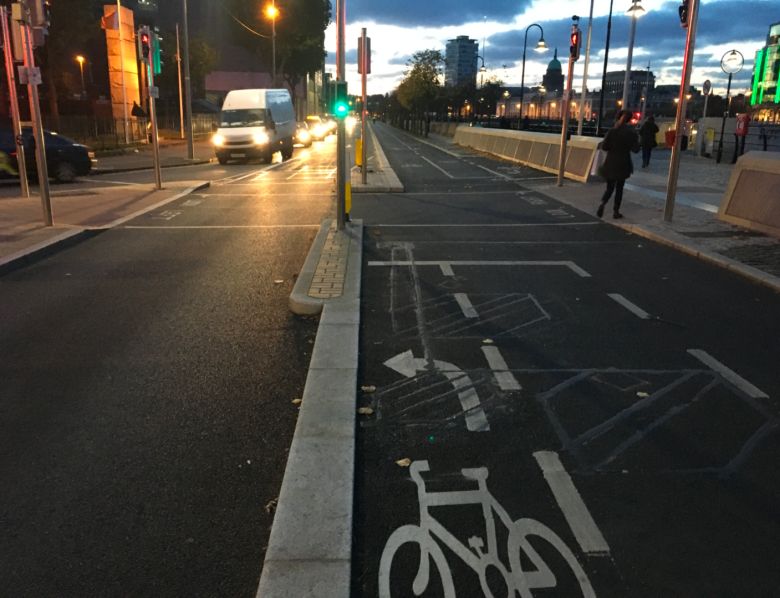 IMAGE: An older setup with a directional lane facing a green light just for straight-ahead travel.
The directional signals are important for clarity and safety, and without them, there have been some confusing and potentially dangerous situations, for example, where a green light only shows straight ahead movements when there is a left turn for people cycling.
Not having directional signals has also meant that in some situations, traffic light poles for cycle paths have had to be placed in different locations depending on direction, adding to clutter, cost, and complexity.
While it seems relatively straightforward, directional bicycle lights were not provided for in national legislation until now.
All mandatory traffic signs, signals, and markings must be included in law. This is usually done through secondary legislation published by the Minister for Transport, without the full parliamentary approval that accompanies primary legislation.
The legal changes are supported by amendments to the signals section of the current edition of the Traffic Signs Manual, which outlines how and where signals can be used.


IMAGES: The new traffic light symbols at the southeast corner of O’Connell Bridge (Photos: Thanks to a reader).
Related