
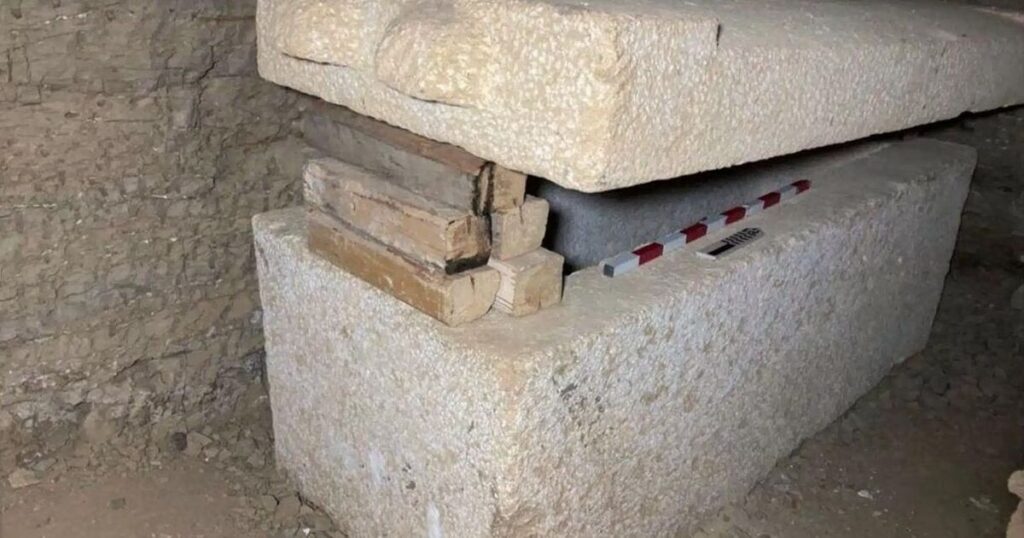
Archaeologists in Egypt uncovered a major discovery at the ancient necropolis of Saqqara, just outside Cairo, including a well-preserved mummy believed to be more than 4,000 years old and covered in layers of gold.
The finds come from a year-long excavation beneath an ancient stone enclosure near the Saqqara pyramids, dating to Egypt’s Old Kingdom period, roughly 2500 to 2100 BC.
Among the most striking discoveries is the mummy of a man found inside a sarcophagus, described by lead archaeologist Zahi Hawass as being “completely covered in layers of gold.”
Mr Hawass said: “I put my head inside to see what was inside the sarcophagus: a beautiful mummy of a man completely covered in layers of gold.”
Alongside the mummy, researchers also uncovered two tombs. One belonged to a fifth-dynasty priest named Khnumdjedef, while the other belonged to a palace official, Meri, who held the title “keeper of the secrets.”
The excavation also revealed statues, amulets, and other burial artefacts preserved within the site.
The discovery inevitably draws comparisons with Tutankhamun, the boy king whose intact tomb was famously uncovered in 1922 in the Valley of the Kings.
His burial chamber, filled with gold funerary masks, jewellery and treasures, remains one of the most significant archaeological finds in history and set the global benchmark for what a royal Egyptian burial could contain.
While the Saqqara discovery is from a different period and context, the presence of gold-covered remains underscores how wealth and ritual were central to elite burials across ancient Egyptian civilisation.
The finds were made within the Gisr al-Mudir enclosure, part of the wider Saqqara complex, which forms part of the ancient necropolis of Memphis.
The area includes some of Egypt’s most famous pyramid fields and has long been a focal point for archaeological research.
The latest find – unveiled in 2023 – adds to a series of recent discoveries across Egypt’s ancient sites, reinforcing the country’s ongoing efforts to uncover and promote its Pharaonic heritage.