
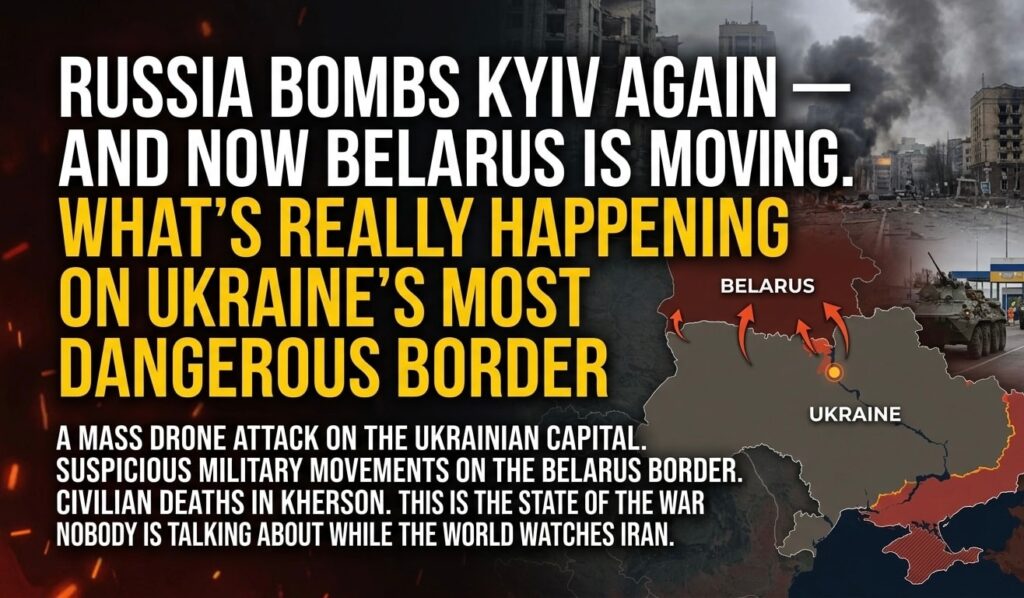
Russia Bombs Kyiv Again — And Now Belarus Is Moving. What’s Really Happening on Ukraine’s Most Dangerous Border
A mass drone attack on the Ukrainian capital. Suspicious military movements on the Belarus border. Civilian deaths in Kherson. This is the state of the war nobody is talking about while the world watches Iran.
While global attention has been locked on the Iran ceasefire negotiations, Russia’s war in Ukraine has entered a new and alarming phase — and the world is barely noticing.
On the night of May 2, Russia launched a mass drone strike on Kyiv. Kyiv Mayor Vitali Klitschko confirmed explosions across the capital and urged residents to take immediate shelter. The attack came just hours after Ukraine’s military reported that Russian forces had carried out 857 separate strikes on 45 settlements in the Zaporizhzhia region in a single day — a level of bombardment that signals not a war winding down, but one intensifying.
“We are closely documenting everything and keeping the situation under control.” — President Volodymyr Zelensky, addressing unusual Belarus border activity, May 2, 2026
But the drone attack on Kyiv is not the most alarming development. That comes from the north. On Saturday, President Zelensky issued a pointed warning about unusual military activity detected along the Ukraine–Belarus border. He offered no specific details about the nature of the movements but made clear that Ukraine is monitoring the situation and is prepared to respond to any escalation. The significance is hard to overstate: Belarus was the launchpad for Russia’s initial assault on Kyiv in February 2022. If Moscow is again moving forces through Belarusian territory, it could signal a new northern offensive — and a dramatic widening of the war’s front lines.
On the ground, the human toll continues to climb. A Russian drone struck a civilian minibus in Kherson on May 2, killing two people — including a municipal utility worker. In Kharkiv, four more people were wounded in separate drone attacks targeting residential areas. An energy facility in Mykolaiv was struck by Shahed drones, triggering citywide power outages. In the Sumy region, Russia is claiming it has taken control of the village of Myropillia.
Over the past week alone, Russia deployed approximately 1,600 attack drones, nearly 1,100 guided bombs, and three ballistic missiles against Ukraine — numbers that reflect a systematic campaign of infrastructure destruction designed to break civilian morale before winter.
There is also a geopolitical dimension that is getting lost in the noise. Poland’s prime minister has publicly condemned what he called NATO’s “disintegration,” after President Trump announced that the U.S. will further reduce its troop presence in Europe — a move that sent alarm signals through NATO’s eastern flank just as Russia shows new signs of aggression. Trump’s response: “We’re going to cut way down, and we’re cutting a lot further than 5,000.”
Ukraine has now recorded 1,332,950 Russian military casualties since the start of the full-scale invasion in February 2022, according to its General Staff. Russia continues to absorb those losses and press forward. The war is not ending. It is evolving — and right now, it may be entering one of its most dangerous chapters yet.
The world’s attention is in the Gulf. But the front line that could reshape Europe runs through Kyiv. Do not look away.
Russia Bombs Kyiv Again — And Now Belarus Is Moving. What’s Really Happening on Ukraine’s Most Dangerous Border
A mass drone attack on the Ukrainian capital. Suspicious military movements on the Belarus border. Civilian deaths in Kherson. This is the state of the war nobody is talking about while the world watches Iran.
Found this important? Share this article and leave a tip to support independent news coverage of an overlooked war.