
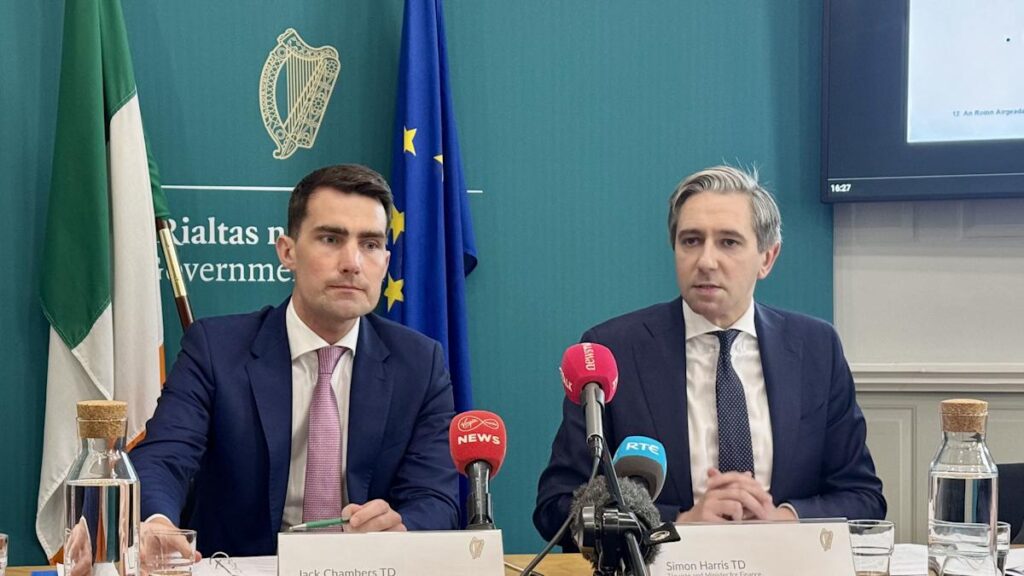
Economic growth is expected to continue across the island of Ireland this year but at a slower pace because of a fuel crisis triggered by the war in Iran.
The EY Economic Eye forecast, published on Tuesday, analysed the economies in Ireland and Northern Ireland amid turbulence prompted by the attack from US President Donald Trump’s administration and Israel on Iran.
Consultancy firm EY is forecasting Ireland’s inflation rate at 3.1% and Northern Ireland’s at 0.7% for 2026; while in 2027 it is expected to be at 2.4% for Ireland and 1.3% for Northern Ireland.
Inflation in Ireland is to increase because of the conflict in the Middle East and the shutdown of the vital trading route, the Strait of Hormuz, through which a fifth of oil supplies travel.
EY has said events in the Middle East had “adversely affected” Ireland’s inflation outlook.
“While some price pain is already being felt by households and businesses, the inflationary shock to date is less severe than that experienced following the invasion of Ukraine,” it said.
“However, energy prices remain a key downside risk to growth, with the duration of the conflict likely to strongly influence the impact on both the Irish and global economy.”
Meanwhile, the Irish jobs jobs market is expected to grow and consumer spending is expected to continue.
EY said employment growth would ease in 2026 and 2027, reflecting “more cautious hiring intentions” but unemployment would remain low by historical standards at 5% in 2027.
The EY also forecast expects Irish GDP to grow 1.8% in 2026 and 4.2% in 2027, with modified domestic demand – a better measure of the domestic economy – to rise by 2.7% in 2026 and 2.5% in 2027.
The Northern Ireland economy is also forecast to grow this year and next, at a slower rate than south of the border, with jobs expected to grow at 0.6% for 2026 and 2027.
“Northern Ireland’s economy continues to show resilience, but growth is increasingly constrained by global volatility, impacting costs, confidence and investment decisions,” said Rob Heron, managing partner at EY Northern Ireland.
“Understanding how global tensions, trade arrangements and policy choices affect local businesses is becoming more important for business leaders and policymakers in Northern Ireland as they plan for the future.”
Dr Loretta O’Sullivan, chief economist at EY Ireland said: “If 2025 was the year of US tariff uncertainty, then 2026 is the year of global energy volatility.
“Having navigated the former well, the Irish economy is now being challenged by the latter.
“Last year saw a very strong performance by the Irish economy, beating all forecasts, and it is only to be expected that this would unwind somewhat in 2026.