
El Niño happens when surface waters in the equatorial Pacific stay about 1 degree Fahrenheit warmer than average for at least three months. Its opposite, La Niña, occurs when those waters turn cooler than normal.This year, NOAA scientists say a particularly strong El Niño may be developing — possibly even a “super El Niño.” That would mean Pacific waters warming more than about 3.5 degrees above average. Forecast models show a wide range of outcomes, from near-record warmth to weaker conditions. But taken together, NOAA’s most likely scenario points to about 3.2 degrees of warming, just shy of super El Niño status.Even if it falls short of that threshold, it still looks likely to be a strong event — one capable of reshaping weather patterns around the world.The biggest effects are usually felt in winter, when El Niño tends to peak. In the United States, strong El Niño winters are known for raising the risk of excessive flooding in the Southwest and Southeast, while some parts of the Midwest can face drought. In some areas, the winter impact is less dramatic, but the odds of warmer-than-average temperatures still increase.There may also be one important benefit during hurricane season: strong El Niño patterns often help reduce the number of Atlantic hurricanes in the fall. Still, it only takes one storm to cause major damage.As El Niño develops through the summer, some local trends may begin to show. Historical patterns suggest a tendency toward slightly cooler summers in some areas. In fact, average summer temperatures were near or below normal in the lead-up to all three super El Niño events since 1950, and in half of the six strong El Niño events. There is also a clear tendency for wetter-than-average summers.Globally, the stakes are even higher. Strong El Niño events can sharply increase the chances of drought in some regions and excessive rainfall in others. They also tend to give global warming an added push. Climate scientists have observed notable jumps in global temperatures immediately after especially strong El Niño events.In the past, the cooler La Niña phase that often followed helped offset some of that heat. But with greenhouse gas levels having risen dramatically over the last century, that natural cooling effect is no longer enough to reverse the broader warming trend. Even after El Niño fades, long-term global temperatures are still expected to keep climbing.
El Niño happens when surface waters in the equatorial Pacific stay about 1 degree Fahrenheit warmer than average for at least three months. Its opposite, La Niña, occurs when those waters turn cooler than normal.
This year, NOAA scientists say a particularly strong El Niño may be developing — possibly even a “super El Niño.” That would mean Pacific waters warming more than about 3.5 degrees above average. Forecast models show a wide range of outcomes, from near-record warmth to weaker conditions. But taken together, NOAA’s most likely scenario points to about 3.2 degrees of warming, just shy of super El Niño status.
Even if it falls short of that threshold, it still looks likely to be a strong event — one capable of reshaping weather patterns around the world.
The biggest effects are usually felt in winter, when El Niño tends to peak. In the United States, strong El Niño winters are known for raising the risk of excessive flooding in the Southwest and Southeast, while some parts of the Midwest can face drought. In some areas, the winter impact is less dramatic, but the odds of warmer-than-average temperatures still increase.
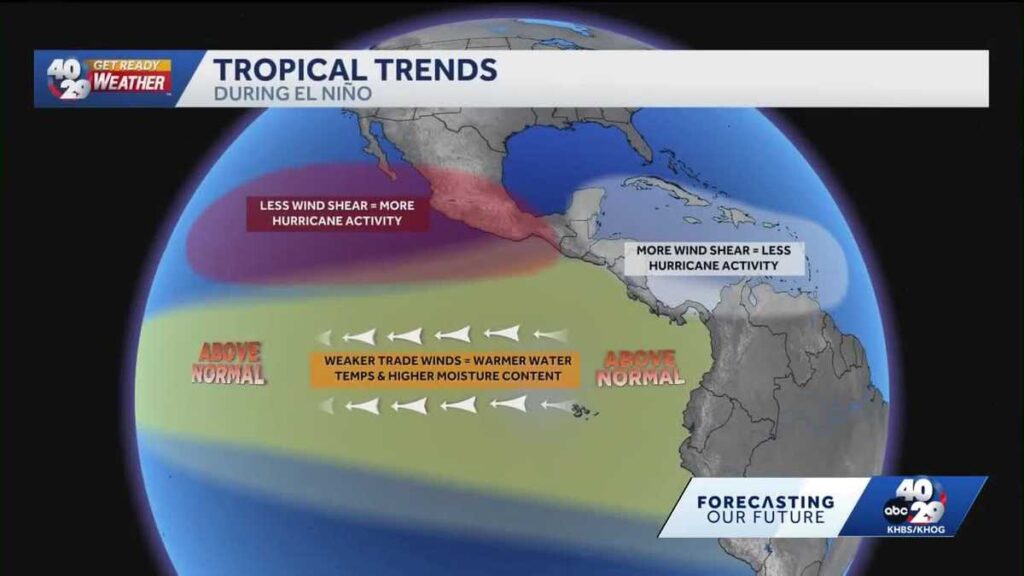
There may also be one important benefit during hurricane season: strong El Niño patterns often help reduce the number of Atlantic hurricanes in the fall. Still, it only takes one storm to cause major damage.
As El Niño develops through the summer, some local trends may begin to show. Historical patterns suggest a tendency toward slightly cooler summers in some areas. In fact, average summer temperatures were near or below normal in the lead-up to all three super El Niño events since 1950, and in half of the six strong El Niño events. There is also a clear tendency for wetter-than-average summers.
Globally, the stakes are even higher. Strong El Niño events can sharply increase the chances of drought in some regions and excessive rainfall in others. They also tend to give global warming an added push. Climate scientists have observed notable jumps in global temperatures immediately after especially strong El Niño events.
In the past, the cooler La Niña phase that often followed helped offset some of that heat. But with greenhouse gas levels having risen dramatically over the last century, that natural cooling effect is no longer enough to reverse the broader warming trend. Even after El Niño fades, long-term global temperatures are still expected to keep climbing.