
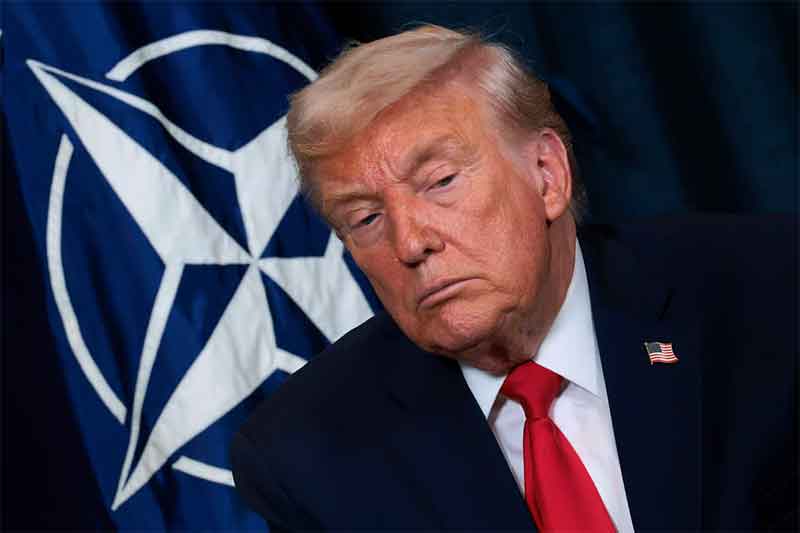
Is a fault line emerging across the Atlantic within the imperialist camp—one that carries serious implications? If this fault line cannot be repaired, does it reflect deeper contradictions within the camp itself? If it persists, will it widen further and reshape the global military map? What impact might this have on the Global South?
These questions arise from reports at the beginning of May 2026. The U.S. Department of Defense (DoD) ordered, on May 1, 2026, the withdrawal of about 5,000 U.S. troops from Germany, to be completed within six to twelve months.
U.S. President Donald Trump warned European allies that this withdrawal could be only the beginning. According to a DoD spokesperson, the move follows a comprehensive review of U.S. force positioning in Europe, military requirements, and disputes between the U.S. and its European allies—particularly over Greenland.
This reflects several developments:
- Europe’s current security needs differ from those of the Cold War era.
- The U.S. faces limits in sustaining Europe’s security burden, especially with Russia as an emerging military power.
- U.S. and European NATO interests are increasingly misaligned, as seen in disagreements over resource-rich Greenland.
A further point of contention is the Empire’s Iran war. The U.S. and its European allies differ on how to engage with Iran and the Gulf region, including how to benefit economically. U.S. policies have already strained European economies, following earlier shocks such as the Nord Stream explosions and sanctions on Russia. Capitalist economies prioritize profit over alliances, and sustained losses are rarely tolerated.
These developments suggest that the fault line is both deep and widening.
Within the U.S. itself, a key question has emerged: how long should the country bear the burden of defending Europe in the absence of the now-defunct Warsaw Pact and the Soviet Union? This question has intensified amid domestic challenges, including economic strain from monopoly finance capital, social divisions, and the rise of extremist groups.
The troop withdrawal is unlikely to be the last move affecting NATO. President Trump has indicated further reductions: “We’re going to cut way down, and we’re cutting a lot further than 5,000.”
He also suggested possible withdrawals from Spain and Italy, criticizing both countries for not supporting the U.S. Iran policy.
Additionally, plans to deploy a Tomahawk missile battalion in Germany—initiated under the Biden administration—have reportedly been scrapped.
Reports from AP and Reuters point to growing incoherence within the U.S. ruling system:
- Military leadership was reportedly not informed in advance of the troop withdrawal decision.
- Lawmakers from both parties expressed concern. Republican leaders of congressional armed services committees warned the decision could undermine deterrence and send the wrong signal to Russian President Vladimir Putin.
A Reuters source described the situation as “increasingly unpredictable,” noting a disconnect between political decisions in Washington and military messaging in Europe.
This raises broader questions: what does it indicate when major military decisions are taken without coordination with field commanders? What does it reveal about planning and strategic coherence?
The withdrawal decision extends beyond Germany. When asked about Spain and Italy, President Trump stated: “Yeah, probably. Look, why shouldn’t I? Italy has not been of any help to us. And Spain has been horrible, absolutely horrible.”
Is this a strategic recalibration, or a response to overstretched capacity? The answer may emerge over the coming years.
The President also reportedly described NATO as a “paper tiger,” echoing, though in a different context, Mao’s characterization of imperialism. This followed European reluctance to support U.S. actions against Iran.
Tensions also extend to Ukraine. Trump criticized NATO allies, saying they mishandled the situation: “They made a mess out of Ukraine, a total mess.”
The Ukraine conflict remains central to Europe’s security landscape, with far-reaching implications—from military alignment to economic stress and political instability within European states.
At the same time, the U.S. appears to be shifting its strategic focus toward the Indo-Pacific. Plans to reduce troop presence in countries like Romania reflect this pivot, though it has unsettled Eastern European allies who remain wary of Russia.
These countries, having abandoned neutrality to join NATO, now face uncertainty as the U.S. recalibrates its commitments.
Russia, meanwhile, is pursuing long-term geopolitical strategies that are not contingent on marginal troop changes. Its calculations are rooted in broader economic, political, and strategic considerations.
While it may be premature to predict NATO’s future, one conclusion is clear: significant changes are underway within the alliance, and more are likely to follow.