
About a month ago, a friend sent me the poster for The Sheep Detectives and asked, “Are we sure this is a real movie?” The image, to be fair, does look like something an A.I. might spit out on a particularly lazy day, a chaotic grouping of midlevel movie stars arrayed in a grassy meadow with the grace of a stack of cardboard standees, surrounded by a motley flock of clearly digitized sheep. But having sat through all 109 minutes, I can verify that not only is The Sheep Detectives real; it’s spectacular.
OK, perhaps that’s taking it a bit far. (I can’t resist the pull of a Seinfeld reference.) But the movie, directed by Kyle Balda and adapted by Craig Mazin from Leonie Swann’s novel Three Bags Full, is endlessly charming and pleasingly clever, as well as surprisingly moving in spots. And, oh yes, it’s about death.
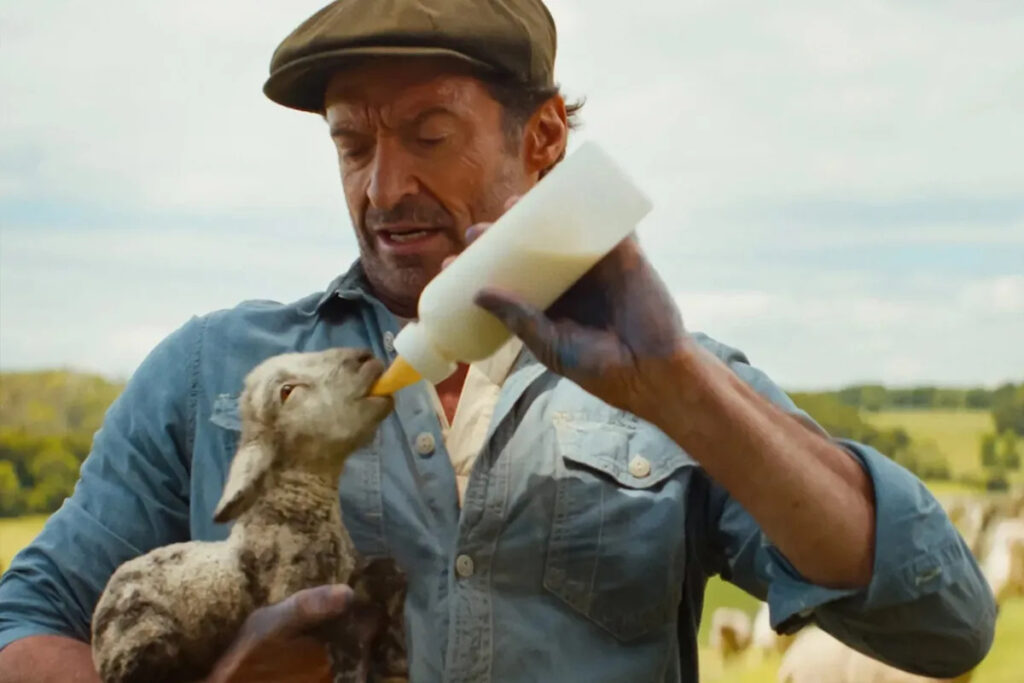
The sheep, who do indeed turn out to be detectives, know what humans think of them: Thanks to their long-standing relationship with the kindly shepherd George (Hugh Jackman), they understand English perfectly, certainly well enough to know that when a person is compared to a sheep, it’s never a compliment. But though they’re as timid as anyone might be whose life has been confined to a few square miles of turf, they’re not simply mindless followers. The movie’s strangest conceit isn’t that the sheep understand English, or even that they’ve so internalized the tropes of the mystery novels that George reads them every night that they can use them to solve a real-life crime. It’s that the flock has the power to wipe their own memories clean, to willfully and seamlessly forget anything unpleasant that might cross their path. It’s not that they don’t understand the world; it’s that they’ve decided it’s best not to.
In the sheep’s scrubbed-clean minds, no one ever dies; they just turn into clouds, as a glance at the fluffy white sky will instantly confirm. So it’s a shock on multiple levels when George suddenly turns up dead—not least to the audience, who’ve been up to that point watching a nice little movie about a handsomely rugged loner and his woolly little pals. It’s a bloodless death, and not just because the murder weapon turns out to be poison. This is, at least nominally, a movie for children, as Balda’s history as the director of several installments in the Despicable Me franchise might make you think. But it’s one seasoned with a dash of adult wisdom, easing its naive protagonists into the understanding that the world is a rougher and meaner place than they’ve been led to expect, and that greed and treachery aren’t only things you read about in books.
George’s favorite sheep are Lily (voiced by Julia Louis-Dreyfus), a boundlessly chipper, russet-haired ewe, and Sebastian (Bryan Cranston), a gruff, forbidding ram. While the residents of the picturesque village of Denbrook, including police officer Nicholas Braun and innkeeper Hong Chau, are compelled to affect some variety of English accent, the sheep are blessedly free to speak in their native dialects—since they are, of course, not speaking at all. Patrick Stewart, as a wise old sheep called Sir Ritchfield, gets to keep his sonorous Royal Shakespeare Company purr, just as Rhys Darby’s brassy New Zealand bleat underlines the anxiety of the perpetually confused Wool-Eyes. But the movie wisely concludes that simply because sheep share a meadow doesn’t mean they all need to speak the same way, especially if it’s making the point that they’re not as alike as shortsighted humans tend to think.
Instead, it’s the humans who blur together. Led by Lily, who has always been the best at guessing the murderer in George’s “nighttime stories,” the sheep try to sort their suspects into familiar categories. Could it have been the neighboring shepherd (Tosin Cole), looking to get his hands on George’s land and his flock? What about the butcher (Conleth Hill), who cast a disapproving eye on George’s decision to raise sheep only for their wool, and a positively scornful one on the fact that George was a vegetarian? Or the long-lost daughter (Molly Gordon), who turns up just as George’s will is about to be read? (As one mystery-novel-informed sheep observes, “There’s always a will.”) Or even the lawyer (Emma Thompson) in charge of reading it? In an ideal mystery, the killer could be any of them. But that’s also true of a lackluster mystery, in which none of the suspects are drawn sharply enough to make either guilt or innocence seem like a stretch. Some actors, like Thompson, burst onto the screen with such ferocity that their characters are established in a matter of seconds; others are allowed to linger around in the background without making much of an impression at all. (The distinguishing feature of Cole’s shepherd is that he’s fond of sweaters.) Perhaps they’re merely being given the sheep treatment, smooshed into one undifferentiated mass because they’re all vaguely the same shape. But the mystery would be more fun to solve if the potential killers didn’t have all the depth of Clue cards.
Fortunately, the sheep are more engrossing than the crime they’re solving, because what they’re really trying to understand isn’t who killed George but what it means that he’s dead. We’re watching not a jaded detective who comes upon a bloody corpse and starts dispassionately scouring it for telltale clues, but characters who’ve willfully convinced themselves that no one ever ends up that way finally coming to an understanding that it’s better to reckon with heartbreaking truths than embrace a life of cozy ignorance. It’s a hard lesson wrapped in a soft warm blanket, one that cushions the blow and might even mop up the occasional tear.