
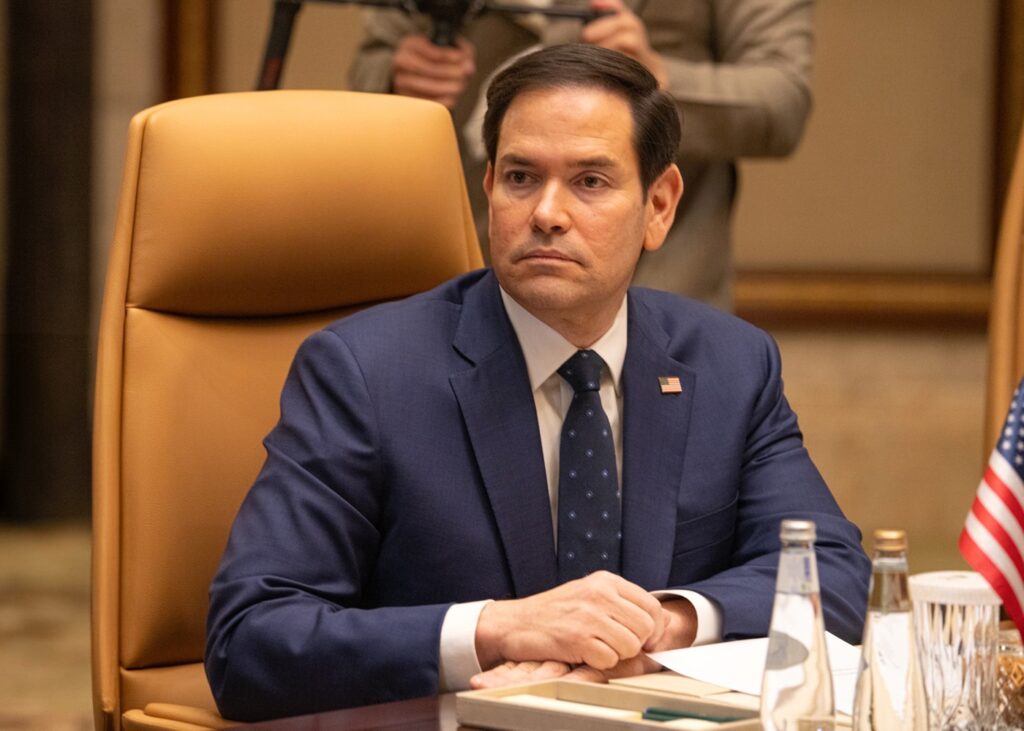
As global affairs expert Ian Lesser argues, Marco Rubio’s visit to Rome is unlikely to fully repair recent tensions between Washington, Italy and the Vatican, but it could still help ease the political climate. According to Lesser, Rubio embodies a more diplomatic and moderate Republican voice, yet remains constrained by the broader posture of the Trump administration and by growing European skepticism toward both the United States and the war.
The move: US Secretary of State Marco Rubio arrived in Rome amid tensions triggered by recent controversial remarks from President Donald Trump directed at Prime Minister Giorgia Meloni and Pope Leo XIV.
The visit is widely seen as an attempt to stabilize relations with two actors that remain strategically important for Washington: Italy as a key Mediterranean ally and the Vatican as an influential diplomatic and moral voice.
In a conversation with Decode39, Ian Lesser, distinguished fellow and advisor to the president of the German Marshall Fund, argued that Rubio’s presence alone “will already be useful,” although he noted that the secretary of state cannot fully distance himself from Trump’s rhetoric or policy line.
A Diplomatic Mission to Contain the Damage. “The very fact that Rubio is coming will already be helpful,” Lesser said, suggesting that the Secretary of State’s presence alone carries political significance.
- At the same time, he warned against expecting a complete reset. “I’m not entirely sure that he will be able to fully repair the damage,” he noted, because Rubio still speaks “with a different voice from that of the President.”
- Much will depend on the broader international context, particularly the trajectory of the Iran crisis and the wider debate surrounding US foreign policy.
The European Factor. “If there are positive developments on the Iran crisis in the coming hours, his message will be easier,” Lesser explained. “If the crisis remains open, the conversation will inevitably be more difficult,” especially given “the broader European context.”
- Rubio’s mission reflects a deeper problem affecting transatlantic relations: the growing skepticism within European public opinion toward both the war and the United States itself.
- “There is an obvious reality,” he argued, “which is that public opinion in Europe, including in Italy, is becoming increasingly critical both toward the war and toward the United States and the current administration.”
- That dynamic, he added, creates a complicated political environment for Washington. Communication and symbolism therefore matter. Some controversies can still be defused, particularly those involving the Pope and the Vatican.
- The remarks targeting the Pontiff also carry domestic political implications inside the United States, “especially ahead of the midterm elections.”
Rubio’s Political Balancing Act. Rubio’s trip also has a strong domestic American political dimension. Widely perceived as a more “traditional” Republican figure than some of the administration’s other leading voices, Rubio is increasingly viewed as one of the possible figures in a future post-Trump landscape.
- Even as Washington approaches the midterms, attention within Republican circles is already shifting toward the question of succession and long-term leadership. Lesser said Rubio is likely trying “to strengthen his image as a more diplomatic and moderate voice,” particularly on issues with direct electoral relevance inside the United States, including relations with the Vatican and Italian-American voters.
- “At that level, it is natural that he also thinks about his future prospects,” he observed, describing such calculations as part of the normal political dynamic in Washington.
- At the same time, Rubio must navigate carefully within an administration where several figures harbor similar ambitions. His diplomatic style may help distinguish him from both Trump and, at times, Vice President JD Vance. Yet that same positioning also constrains him.
- As Lesser put it, Rubio’s more diplomatic style “can be an advantage, but it also creates limits on what he can say and do.”
The Vatican Dimension. The Vatican represents another crucial dimension of the trip. Rubio’s openly Catholic identity makes him a particularly suitable interlocutor for the Holy See at a moment of significant geopolitical and moral tension.
- Still, Lesser sees clear limits to what diplomacy can realistically achieve with Pope Leo XIV.
- “The Pope has a very defined position on the war, which he considers a wrong choice, and this is unlikely to change,” he said.
- Rubio’s role, therefore, is less about changing strategic positions and more about easing tensions. “What Rubio can do is improve the atmosphere more than change the underlying positions.”
Rome, Security and Strategic Clarification. Where Rubio may have greater room for maneuver, according to Lesser, is with the Italian government itself. Rome has also faced criticism from Washington in recent weeks, particularly over sensitive security and military issues.
- “As Secretary of State, Rubio has room to address concrete issues,” he explained, mentioning “the use of Italian bases, the Sigonella case and other sensitive dossiers.”
- According to the GMF’s expert, the visit could at least help produce greater clarity — and potentially “some form of understanding, or at least clarification” — even if deeper disagreements remain unresolved.
- Ultimately, Rubio’s trip highlights a broader reality confronting the transatlantic relationship under the current administration: strategic ties between Washington and Rome remain deeply important, but political trust and public perception are becoming increasingly fragile on both sides of the Atlantic.