
Patria has signed three memoranda of understanding (MoU) with Czech companies as it positions itself for the Pandur II replacement. This is not Patria’s first approach to Czechia, and it faces stiff competition.
By Sam Cranny-Evans, editor of Calibre Defence, published on May 7, 2026.
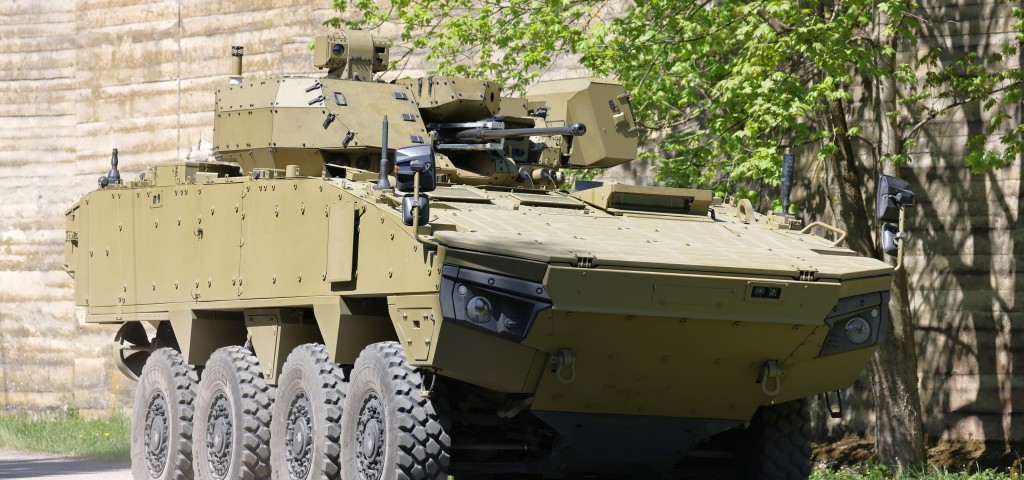
Patria has signed MoUs with several state enterprises in Czechia as the country works towards a new 8×8 fleet. According to a May 6 press release, Patria is offering its AMV XP to Czechia as a replacement for the fleet of Pandur IIs.
The MoUs were signed with:
- Vojenský technický ústav: Focuses on testing, evaluation and certification of military equipment and weapons systems for the Czech Armed Forces.
- VOP CZ: the Military Repair Plant, best known for modernisation and upgrade programmes for armoured vehicles, including work on the Czech BVP-2.
- and Vojenský výzkumný ústav: the Military Research Institute. The R&D arm, focused on applied defence research — developing new capabilities, technologies and concepts for the Czech military.
The memorandums with these entities, which are owned by the Czech MoD, build upon an earlier agreement with the STV Group. That company is privately owned and produces various types of ammunition and explosive.
“If the project is implemented, [these MoUs] would ensure significant domestic industry participation,” Patria states. Adding that it would support technology transfer and capability development within the Czech industry.
The press release also states that if successful, Patria envisions adding the Czech enterprises into the global AMV supply chain.
The competition

A Czech Pandur II in 2013. The troubled vehicle is set to be replaced by a new 8×8. Credit: CS92, CC BY-SA 3.0 , via Wikimedia Commons
The Czech MoD reached out to several other companies in 2025, according to local reporting. This includes:
- Tatra Defence Vehicle and Czechoslovak Group with the Pandur EVO from General Dynamics European Land Systems (GDELS).
- The Piranha 5 from GDELS, which has also been procured by Romania and Denmark.
- General Dynamics Land Systems and its Stryker as used by the US, the Philippines, and Colombia.
- And the Artec Boxer, used by many nations throughout Europe.
These companies and platforms all offer a mixture of benefits including extensive domestic production. However, the costs are likely to be a key differentiator.
Notably, Boxer lost out in Slovakia on a value for money consideration, leading to that country’s selection of the AMV XP instead. However, Artec also proposed a production partnership with Czech industry in March this year, indicating an attempt to build a stronger offer for the programme.
GDELS is increasing its footprint in Europe with a new facility in Germany supporting various procurements there. And it has established local production in Romania for Piranha 5. Local production, or participation at least, is likely a core requirement for Czechia. Given that most of the bidding companies offer some form of localisation, it seems likely that the selection will come down to a variety of factors.
Calibre comment: Czechia’s Pandur fleet
Czechia chose not to fund a maintenance programme for the 107 Pandur IIs that it received from 2010. As a result, availability had collapsed by 2019, with just 21 out of the 72 combat variants ready for use. The lack of spare parts and maintenance meant that the vehicles were no longer useable. Other concerns like survivability are also driving the Czech decision to seek out a replacement.
The Czech Army conducted a market survey to up-armour the Pandur II fleet and modernise it. However, the costs were estimated to be up to 75% of the cost of a new vehicle. It was instead decided to procure up to 250 new vehicles with funding expected to be made available in 2026. Delivery will follow from 2028, assuming that the successful production line can support that timeframe.
The lead image shows a Patria AMV XP with a turret and add-on armour. Credit: Patria.