
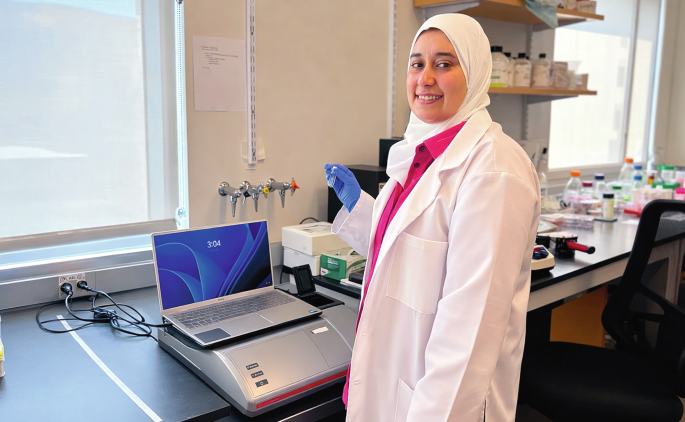
The shift to sustainable energy technologies requires advanced materials, such as polymer electrolytes in batteries and nanoparticle additives in high-performance dielectric capacitors. The synthesis of these materials takes place in liquids, where nanoscale particles or polymer chains are present — and the behaviour of these particles or chains during synthesis can have important impacts on the properties of the final material. Determining the size of these structures and whether they agglomerate in solution remains a major challenge. Electron microscopy can let researchers look at nanostructures but requires sample drying, which might alter the structure of soft materials. As a result, there is a need for a technique that enables direct examination of nanoscale structure directly in liquids, under conditions closer to their operational environment.
DLS is becoming an essential tool for the characterization of nanocomposites for clean energy materials. In polymer nanocomposites designed for energy storage applications, DLS can show whether nanoparticles remain well dispersed or begin to form aggregates that could degrade performance. In our research on polymer-grafted nanoparticles for dielectric capacitor systems, DLS helps to determine the hydrodynamic size of particles in solution and track changes in dispersion stability before film fabrication. This information helps us to make materials that are more flexible and last longer. As new materials are developed for batteries, capacitors and other devices, DLS will remain an important technique to understand and improve how they work at the nanoscale. This will help us to make better energy storage devices and ways to produce them on a large scale.