
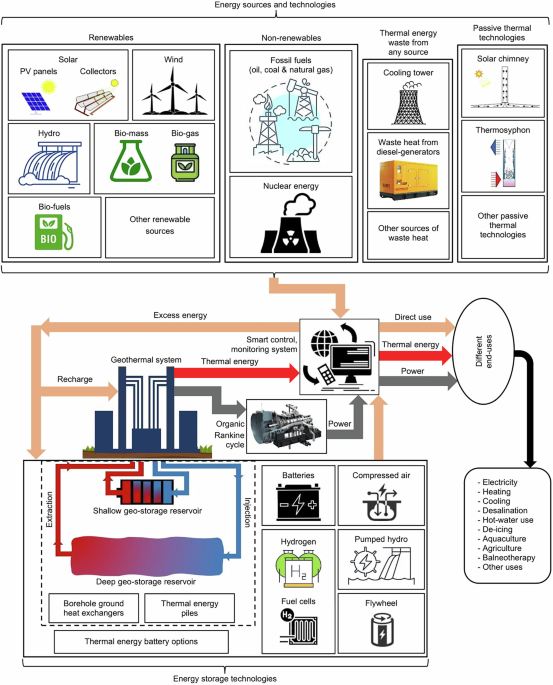
In SHIEG systems, the term ‘smart’ refers to the continuous monitoring and coordinated control of system components using flexible energy management strategies to optimize the operation of multiple energy sources and storage technologies over time and under varying demand. This approach can be enhanced by artificial intelligence and advanced control algorithms for operational optimization, predictive maintenance, and fault or emergency detection. By collecting and integrating data from distributed sensors and control devices (e.g., anemometers, thermometers, hygrometers, thermostats for thermal regulation, and light controllers for demand-side management), the system dynamically adjusts generation, storage, and load. As a result, SHIEG systems achieve improved energy efficiency, higher operational reliability, extended system lifetime, and reduced life cycle costs.
The term ‘hybrid’ refers to energy storage, potentially utilizing batteries, compressed air, pumped hydro, hydrogen, flywheels, and heat storage technologies. Hybridization makes energy systems more robust, secure, reliable, flexible, and useful in situations of demand variations.
The term ‘integrated’ means various energy sources and systems are combined to provide high-quality energy for different end-uses. The sources can be wind, solar and hydro; nuclear energy and legacy fossil fuels; low-grade thermal energy (e.g., waste heat from cooling towers and diesel/gas generators); and even passive thermal technologies such as thermosyphons and solar chimneys—whatever can provide the best outcomes under local needs and conditions. In SHIEG systems, key factors are geothermal configurations—deep, shallow, or combinations thereof—with potential for recharge and storage. Geothermal-based integrated, hybrid systems have commonly received less attention than other integrated, hybrid systems.
The term ‘engineered’ implies that appropriate technologies are applied to enhance the system’s productivity and effectiveness. For instance, hydraulic stimulation of low-permeability/low-porosity hot dry rock reservoirs enhances rock mass flow capacity, whereas longer horizontal wells can access larger hot rock volumes.
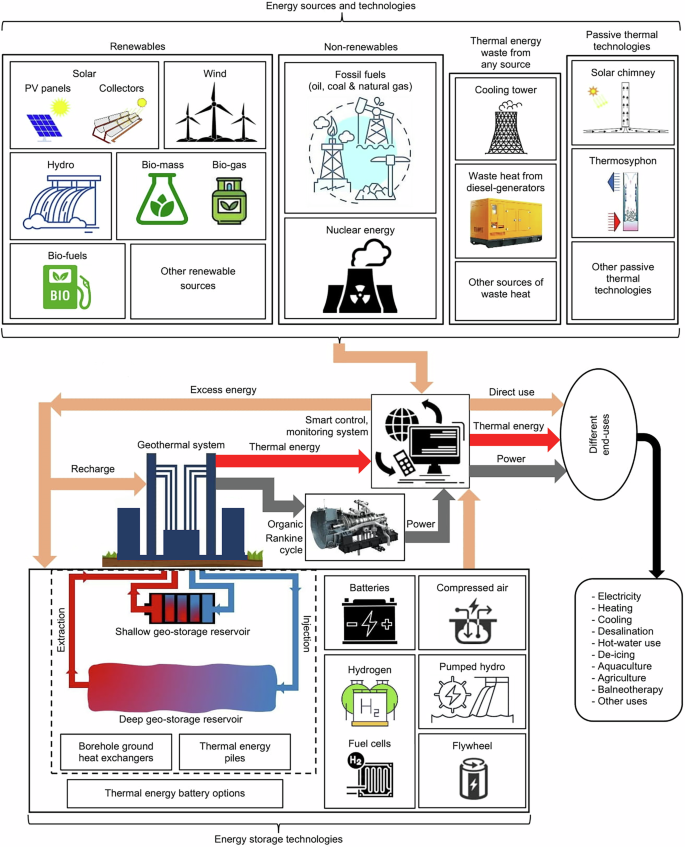
The SHIEG systems’ concept and configuration are schematically shown in Fig. 1. The systems can be developed in any climate for combined electrical and thermal energy (heating or cooling) applications. However, both shallow and deep geothermal reservoirs can suffer thermal energy extraction rate degradation over time because of cooling and declining heat flux. Unless managed and recharged, their effectiveness diminishes, unless they are exploiting hot (or warm) pore fluids from vast subsurface volumes, a rare but desirable condition.
 The alternative text for this image may have been generated using AI.
These systems are applicable to both distribution and non-distribution (more favourable) grid-connected sites. One of the main benefits of SHIEG systems is that they localize energy production. In this figure, arrows of different colours show the direct and indirect uses of various energy sources and storage solutions for diverse applications.
Reservoir temperature, geo-fluid circulation rate, conductive and advective heat flux partitioning, re-injected fluid temperature, and thermal properties (thermal diffusivity and heat capacity) govern heat flux, proportional to a system’s production rate and a reservoir’s thermal energy capacity. During a typical geothermal system’s operational life, at constant fluid flux, the fluid exiting from a single subsurface loop will eventually exhibit a diminishing temperature, driving a reduction in useful energy flux. To sustain heat flux, new subsurface circuits may be added, or the geothermal reservoir can be recharged—naturally or deliberately. With few exceptions (e.g., regions located in the Ring of Fire), natural heat recharge rates from conductive rock mass heat flux are very low; hence, particularly in impermeable low-porosity systems, only deliberate heat recharge is feasible—using thermal energy from other processes. Sources may comprise waste heat (e.g., hot water from a power plant), surplus energy (e.g., excess solar or wind energy), or deliberately produced heat (e.g., solar heating of a recharge fluid).
Energy sources and technologies not only can produce energy for their desired purposes—either for a limited time (e.g., several days or months) or continuously—but can also recharge shallow/deep geo-reservoirs or other forms of storage systems through any energy they generate over demand (Fig. 1). For example, when solar photovoltaic (PV) panels and wind turbines produce electricity for direct use, surplus electricity can be used to support the system’s operations, charge batteries, produce hydrogen, store compressed air/hydrogen for later power generation, and can even be stored as heat in shallow or deep geo-reservoirs via primary loop geo-fluid circulation and conductive ground heat exchangers. Alternatively, solar thermal collectors or parabolic troughs can provide direct heat to habitats when needed, and excess heat can be utilized to increase the working fluid temperature before power production or be stored monthly/seasonally in the geo-reservoir. Waste heat from diesel and natural gas generators, industrial processes, waste incineration, and other sources can heat or partially heat the primary loop geo-fluid re-injected into the geo-reservoir. Essentially, a thermal battery is created. Several real engineering cases worldwide have implemented thermal battery strategies, such as using underground water and metro space as the heat source to build a geothermal-based system in Dublin, Ireland22, and utilizing waste heat from a concentrated solar thermal power plant integrated with ultra-high-temperature underground thermal energy storage as a geothermal battery system23.
In Fig. 1, shallow and deep geo-storage reservoirs, in various forms and scales, play pivotal roles in SHIEG systems by storing thermal energy. Storage capacity and secure heat flux help balance energy generation and demand, especially during peak consumption periods (diurnal to seasonal demand fluctuations). Important factors include temperature differences (input, output, and ambient), the system’s design and configuration, the existing energy infrastructure, and available sources of low-, intermediate-, or high-grade heat. Smart control systems based on sensor inputs and machine learning monitor, assess and manage the energy sources, storage allocations, and end-use needs, reducing waste heat loss, providing seasonal heat reserves, and enhancing system resilience.
The smart monitoring and control of SHIEG systems will allow more sustainable use of energy production and storage technologies based on time and energy demands. The smart system must offer the flexibility to adapt to changes in energy needs while improving the long-term operation and efficiency of those systems and technologies, with the capability to predict maintenance needs, faults, or emergencies. SHIEG systems will thus enhance energy provision and services and diminish wastage and pollution.
SHIEG systems focused on energy management are local in nature rather than power grid system-based—although they can be connected to a grid—so they are more suitable to support community energy planning initiatives. These focused systems are also largely self-energized and self-contained in terms of year-round energy supply. A SHIEG system can output both electricity—if thermodynamic cycles (for instance, Organic Rankine or Kalina cycles) are incorporated—and thermal energy for various purposes, as local combined heat and power systems. Important factors for producing electricity via Organic Rankine or Kalina cycles in the proposed systems are the temperature differences between the ambient air and subsurface reservoir, plus the temperature difference between injection and production wells. Overall, SHIEG systems may turn out to be the most eco-friendly, sustainable, and efficient local energy systems in terms of having the lowest environmental footprint and highest efficacy.
Designing, implementing, and developing SHIEG systems in various places relies on factors such as local weather conditions, geographical characteristics, and geological settings (particularly local geothermal gradients); a reservoir’s properties (heat flux, thickness, volume, and thermal capacity); the availability of diverse energy sources; energy needs (daily, weekly, or seasonal cycles); community or user awareness levels; and the degree of socio-economic development involved.
SHIEG systems can generally serve as a novel pathway for advancing geothermal energy within net-zero strategies and enhancing community energy resilience.