
**Submission Statement**
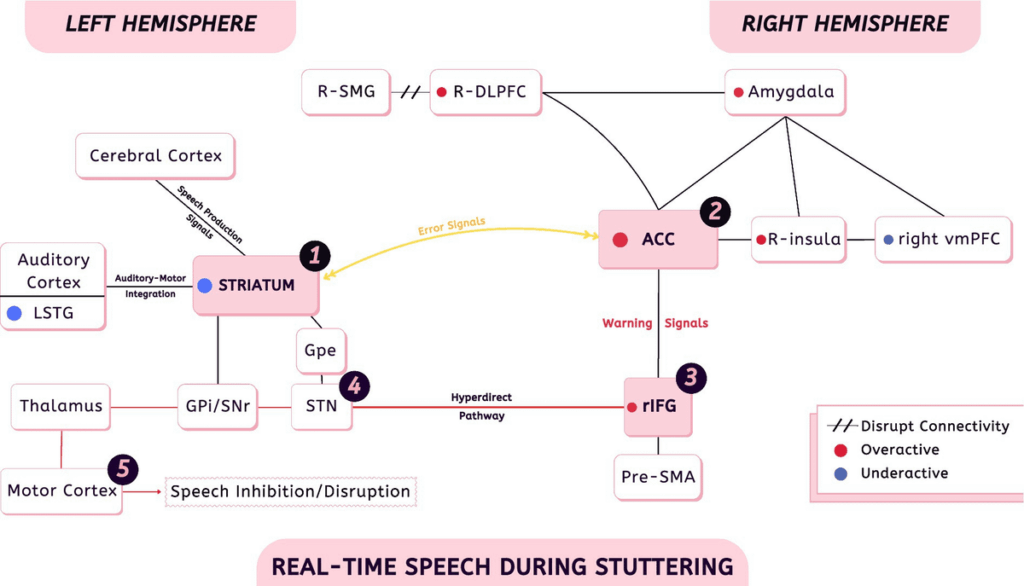
This 2026-research presents stuttering as a complex neurodevelopmental disorder that cannot be explained adequately by a single isolated mechanism. Instead, it proposes an integrative framework linking situational variability in speech to neurobiological dysfunction, with particular attention to the right inferior frontal gyrus (rIFG), dopaminergic regulation, and presynaptic D2 autoreceptor dysfunction.
Future-oriented contribution is attempting to unify clinical variability, developmental change, and brain-based mechanisms within one coherent hypothesis. By framing stuttering as potentially rooted in disrupted dopamine feedback control, it opens a path toward future research that may completely change the current field, identify biomarkers, and guide new client-centered interventions.
Future studies piece: The most essential future perspective is to replicate the Wu et al. study in a larger cohort, using PET or another method with comparable or better reliability. Map where dopamine is elevated in the brain specifically the spatial distribution of elevated dopamine to see which regions are most affected. Test presynaptic D2 autoreceptor dysfunction directly including reduced activity, decreased sensitivity, or abnormal receptor function, and DAT. Measure dopamine in children for the first time. Subgroup children by dopamine level and track them into adulthood to test whether lower elevations predict recovery and higher elevations predict persistent stuttering. Measure rIFG activity in real time during stuttering moments across the rIFG–HDP–STN pathway, looking for a transient spike. Investigate whether dopamine affects rIFG development/connectivity as it's still unclear whether rIFG abnormalities are caused by dopamine or are separate. Test the conscious error-monitoring / SMS idea experimentally to see whether disrupting conscious monitoring helps explain fluency changes and the emergence of stuttering.
https://doi.org/10.3389/fnhum.2026.1700499
1 Comment
**Submission Statement**
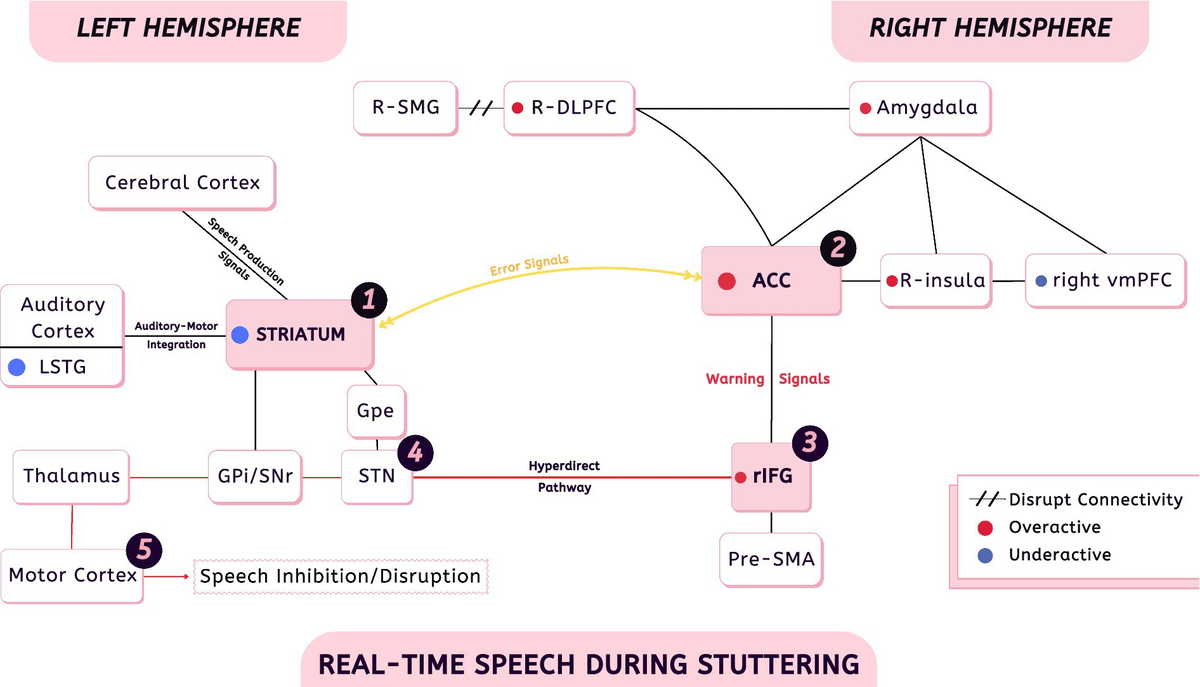
This 2026-research presents stuttering as a complex neurodevelopmental disorder that cannot be explained adequately by a single isolated mechanism. Instead, it proposes an integrative framework linking situational variability in speech to neurobiological dysfunction, with particular attention to the right inferior frontal gyrus (rIFG), dopaminergic regulation, and presynaptic D2 autoreceptor dysfunction.
Future-oriented contribution is attempting to unify clinical variability, developmental change, and brain-based mechanisms within one coherent hypothesis. By framing stuttering as potentially rooted in disrupted dopamine feedback control, it opens a path toward future research that may completely change the current field, identify biomarkers, and guide new client-centered interventions.
Future studies piece: The most essential future perspective is to replicate the Wu et al. study in a larger cohort, using PET or another method with comparable or better reliability. Map where dopamine is elevated in the brain specifically the spatial distribution of elevated dopamine to see which regions are most affected. Test presynaptic D2 autoreceptor dysfunction directly including reduced activity, decreased sensitivity, or abnormal receptor function, and DAT. Measure dopamine in children for the first time. Subgroup children by dopamine level and track them into adulthood to test whether lower elevations predict recovery and higher elevations predict persistent stuttering. Measure rIFG activity in real time during stuttering moments across the rIFG–HDP–STN pathway, looking for a transient spike. Investigate whether dopamine affects rIFG development/connectivity as it’s still unclear whether rIFG abnormalities are caused by dopamine or are separate. Test the conscious error-monitoring / SMS idea experimentally to see whether disrupting conscious monitoring helps explain fluency changes and the emergence of stuttering.