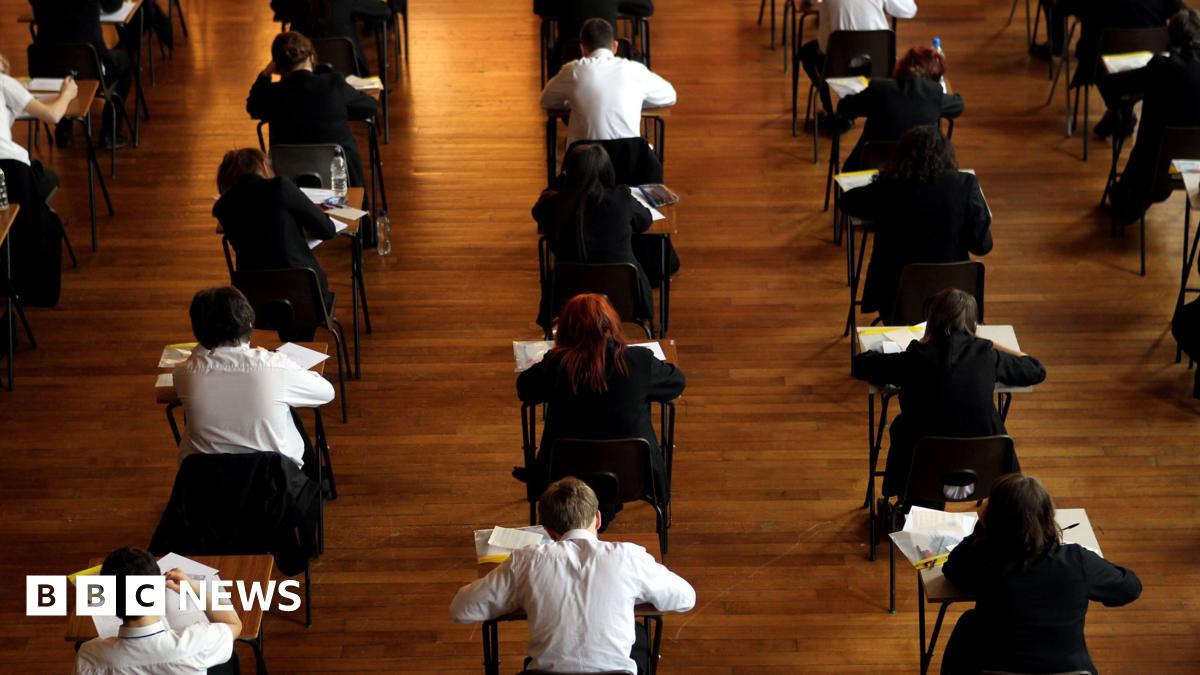
Pupils hopeless and crying after ‘poorly worded’ Higher Maths exam
https://www.bbc.co.uk/news/articles/cx21j20l9wlo
Posted by kiyomoris

Pupils hopeless and crying after ‘poorly worded’ Higher Maths exam
https://www.bbc.co.uk/news/articles/cx21j20l9wlo
Posted by kiyomoris
24 Comments
So what were the questions that were incomprehensible?
why would you not include an example in the article of what it actually was? All those interviews and post-Exam reactions, but I’m still not clear on what the bloody problem was
Readers hopeless and crying after ‘poorly written’ article
The same thing happened with me for my A level maths paper way back when. I did 10 years worth of practice papers and got A* in every single one. Then my year they decided that too many people were passing and completely flipped it on its head.
However I think the biggest issue is the teaching. For a lot of my subjects it seemed we rushed through all the material to then spend months focusing purely on practice papers and exam theory. All that does is teach you how to answer a specific question, not actual knowledge in the subject. Maths in particular often boiled down to identical questions being asked on papers, just with different numbers to plug into your memorised methods.
Funnily enough we all did much better in our physics exam because our teacher would focus more on raw knowledge, even on stuff that might be outside of what would be asked on the exam.
>One of the main complaints the BBC has heard is that some “command words” – the words that indicate how you should answer the question – were different to what pupils had been taught to expect, so they did not know what was being asked.
One way you could read that is that they’ve been trained to pass the exam rather than having been taught the subject.
So long as the nomenclature is standard for mathematics then the fault isn’t with the exam it lies with the teaching. We shouldn’t be teach to the exam questions we should be developing understanding of the subject.
Hard to judge as the question itself hasn’t been included in the article.
> after sitting a Higher Maths exam which they said was “totally unrecognisable” from what they had prepared for in class.
If you can only sit a paper you were pre-prepared on, you shouldn’t be sitting higher maths in the first place.
Pass marks for this particular exam are incredibly low (22% was a C when I was in school for higher maths) precisely because it’s the exam fort he handful of student who are expected to understand all the underlying concepts.
Only about 70% of the A set at my school sat higher – about 12 people in the entire school year – and prior papers were **not** available for study.
The intermediate maths exam had a C grade of 60% as an example.
*Edit*:
It’s my understanding (and I’m old, so I might be wrong), but all GCSE’s are now mostly coursework based to avoid exams being a blocker from getting a decent grade – when I was in school (decades ago now), that final exam was something like 80% of your final grade on top.
Considering how long the petition has been up for, the number of signatures is ridiculously high compared to the number of people who took the exam.
Maybe it’s just me, but I doubt every exam age kid has a communications network with over half of the teenagers who took the exam and as such the number of signatures even before the news started reporting on it is incredibly suspicious.
Also notable that there are no details of any actual issues with the exams, that the feedback from teachers is that the exam was fair and they couldn’t even name a single one that considered it unfair.
Maybe there’s a legitimate problem. Or maybe it’s students making a mountain out of a difficult exam and it getting on the news because it’s the first year since QS replaced the SQA. Not that much actually changed other than the name, IIRC.
This reminds me of my Standard Grade maths exam way back when. I can’t recall the exact question, but it mixed miles and kilometres. Converting between them wasn’t part of the syllabus, and the SQA admitted afterwards that it should have been a simple speed-distance-time calculation in one units or the other.
This situation doesn’t sound the same, though. From what’s in the article, it seems some pupils were taught to look out for certain expressions or words, and not taught to more generally identify the concepts.
So I am a maths tutor and I can see 2 issues straight away on the paper.
1. Asked to find “Linear factor”. This is usually called a root in the curriculum and the question is usually asked a different way in past examples.
2. There was lots of difficult graphs, when usually graphs show up less. One graph featured an asymptote, which is usually only taught in advanced higher maths.
Paper 2 was better, but a few oddly worded questions there too.
It was a hard paper, but grade boundaries should hopefully level things out.
There are two issues here
1) Schools teaching students to pass exams rather than actually understand the content to the extent a change in wording can throw thousands of students for a subject as unambiguous as maths.
2) Schools and parents and society leading children to believe that fucking up one paper aged 18 forever ruins your chances of being a doctor or engineer or whatever they aspire to be. Loads of people get into those careers by slightly scenic routes and absolutely thrive.
When I was doing my GCSEs (1990s), my mum asked me what I was learning.
I told her I was learning to pass the exams. She said I didn’t understand what learning was about. I told her she didn’t understand what British schooling was about.
She is not British.
The entire education system is an out of date joke.
I hate maths questions that are actually english riddles instead of being fucking maths.
Reminds me of the AQA biology paper from 2010 that had a huge section on bubble graphs. Those never came up in the AQA syllabus, our teachers had never heard of them and I have never seen them used in anything since then (and I have a degree in biomedical sciences and nearly a decade’s experience in the field). Schools in the UK definitely teach to the test too much, however sometimes kids sit an exam that throws far too much of a curveball too. I used to teach primary and the kids in Year Six when I was doing my PGCE had this with a SATs reading paper for example.
As a maths teacher I can say that there was no problem with the paper. It was a fair paper. There are always 1 or 2 questions which will be in an unfamiliar context. That is standard practice in Nat 5 and Higher exams.
This reminds me of when I did my higher maths. It was the first year of the new CfE in 2015 so there was 0 prior same level material to use.
The maths in our paper wasn’t necessarily hard, but the questions were worded awfully which caused a lot of confusion. In the end, they dropped the grade boundaries 10% so 60% was an A, 50% a B etc etc.
I was pretty good at maths and continued it through part of uni, but even struggled with the wording and based off what I’ve saw from these papers, I’d have really struggled with this years so I do feel for them
The kickback worked for our year, hopefully the students this year get a similar result
> “For many students, the problem was not knowing what the question was actually asking or which method was intended, despite understanding the mathematical content itself,” he added.
Sometimes, this kind of complaint is just students moaning about problem solving. Mathemayics is not about repeating methods you’ve memorised, it’s about applying that knowledge to solve unfamiliar problems.
Another nothingburger. This happens every year, and the people you expect to do well do well anyway despite crying on the bus home
I mean isn’t Higher Maths hard enough without this stupid shit?
Having a different style of exam to what you have revised is idiotic. Its not what doctors do in med school , why are they always fucking around? Its almost deliberate.
They always have the same grade proportions pass anyway.
Wording is so incredibly important, they often don’t tell you what they want to do and instead word it so you have to figure out what they actually want. Most of the time this is fine with practice but it can get out of hand be genuinely confusing and needlessly obtuse.
The only qualified, experienced professional quoted in the article says it was fine.
I would have assumed that the exams are moderated so surely this should have no significant effect? e.g. if absolutely no-one can answer it, everyone gets inflated, if some can, then it’s doing the job of seperating the wheat from the chaff, which is what exams are for?
The [paper](https://www.highermathematics.co.uk/wp-content/uploads/2026/05/2026-QS-Higher-Maths-P1-P2.pdf) in question.
The article alludes to question 11, (a) part ii: “Explain why (x + 2) is the only linear factor of x^(3) + 7x^(2) + 18x + 16.” The student can factorise the cubic to (x + 2)(x^(2) + 5x + 8). The discriminant of the quadratic factor is less than zero, therefore it has no real roots, therefore the cubic has one quadratic factor, and one linear factor only. Standard question, the writer of the article is misinforming the public.
The article also says “some “command words” – the words that indicate how you should answer the question – were different to what pupils had been taught to expect, so they did not know what was being asked.” The command words in the paper are: express, find, determine, state, solve, explain, and sketch. All seven of these command words are explicitly in the [SQA command word list](https://www.sqa.org.uk/files_ccc/NQMathematicsCommandWords.pdf). The author of the article is just lying about this.
You can tell there are a bunch of mathematicians in here with the outstanding lack of proof reading on show.