


Latvian Defense Minister Andris Spruds meets with NATO Secretary-General Mark Rutte at NATO headquarters in Brussels on May 20, 2025. Spruds resigned from his position Sunday after two wayward drones hit an oil depot in the country. (NATO)
The drone war raging over Russia and Ukraine triggered the resignation of a top NATO defense official after a recent incursion in Latvia, underscoring how the alliance’s eastern flank has become an exposed front line in a widening air defense battle.
Latvian Defense Minister Andris Spruds’ resignation Sunday came days after two wayward drones hit an oil depot in the country.
In a statement Sunday on X, Latvia’s prime minister, Evika Silina, said she had lost confidence in Spruds because the country’s anti-drone systems were not activated quickly enough.
“The drone incident that occurred this week clearly demonstrated that the political leadership of the defense sector has failed to fulfill its promise of safe skies over our country,” Silina said.
The situation poses a growing challenge to NATO front-line states, which have been grappling with how to deal with various incursions stretching from Finland in the north to Romania in the south.
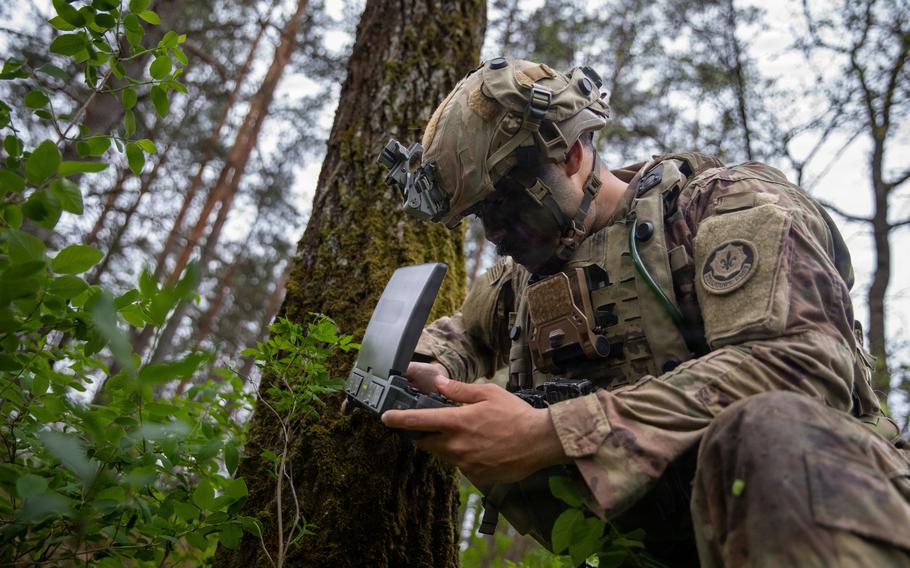
A U.S. Army infantryman assigned to 2nd Cavalry Regiment operates a drone overhead from a remote command and control device during an exercise at Pabrade Training Area, Lithuania, May 8, 2026. (Nicodemus Taylor/U.S. Army)
In the Latvian incursion, Ukrainian officials blamed Russia, saying that electronic warfare tactics were used by Russian forces to commandeer Ukrainian drones.
“The investigations proved that this was the result of Russian electronic warfare deliberately diverting Ukrainian drones from their targets in Russia,” Ukrainian Foreign Minister Andrii Sybiha said in a statement.
There also have been reports of similar instances in recent months in Estonia and Finland. Sybiha said Ukraine was prepared to coordinate more closely with those countries to prevent such incursions.
Meanwhile, countries on NATO’s eastern flank are taking steps to boost their air defenses. U.S. soldiers are also spread out across the region, which is serving as a testing ground for developing counter-drone tactics.
In Lithuania, U.S. troops this month have been testing reconnaissance drones, first-person view strike systems, electronic jammers and artificial intelligence-enabled command-and-control platforms as part of a broader, multinational effort focused on countering unmanned aerial systems.