
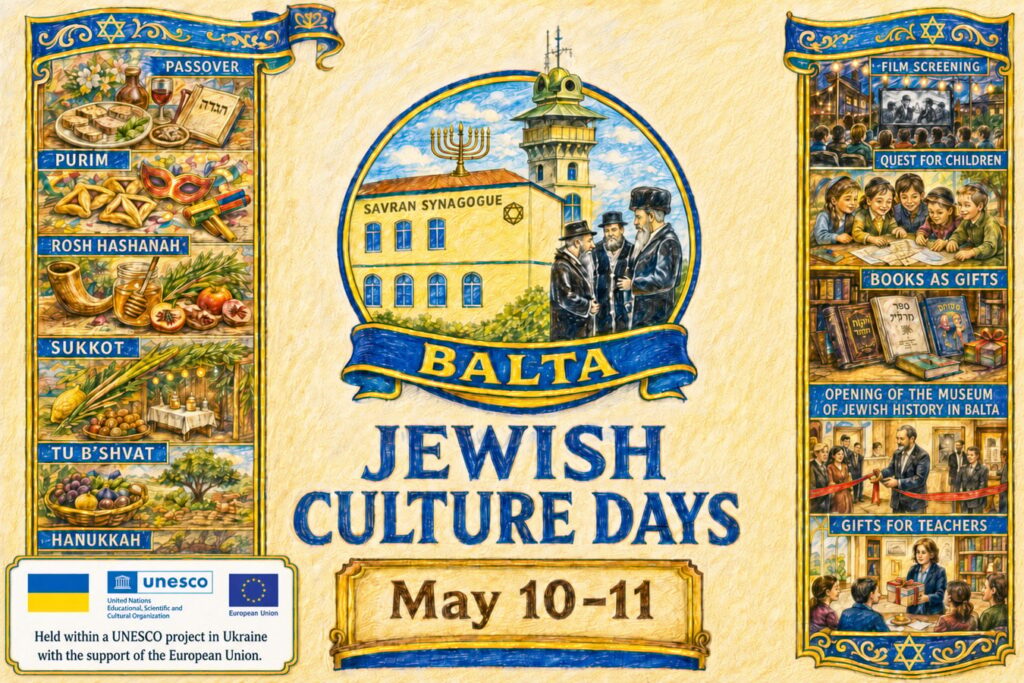
On May 10–11, 2026, the town of Balta in Ukraine’s Odesa region hosted Jewish Culture Days — a festival that showed something important and often overlooked: Jewish life in Ukraine today is not only about war, pain, rescue, and survival. It is also about growth, memory, education, culture, and the quiet determination of communities that continue to build even while the country is fighting Russian aggression.
For many readers outside Ukraine, Jewish life there is now seen mostly through the lens of war. Air raids. Destroyed cities. Volunteer aid. Soldiers at the front. Refugees. Families scattered across Europe and Israel.
All of this is real.
But it is not the whole story.
This is precisely the kind of story NAnews – Nikk.Agency Israel News tries to bring into the Israeli conversation: not only the headlines of war, diplomacy, and emergency, but also the quieter evidence that Jewish life in Ukraine continues to organize itself, educate children, preserve memory, and grow.
In Balta, people gathered not to escape history, but to bring it back into public life. They opened a museum, donated books to libraries, organized children’s activities, sang in Yiddish, visited a synagogue, watched a film, met with teachers, and honored the memory of the Balta ghetto.
That is what a living community looks like.
Not only a community that mourns. Not only a community that helps Ukraine resist an aggressor. But a community that also teaches, remembers, creates, and develops.
A Ukrainian Jewish Festival During Wartime
Jewish Culture Days in Balta were held within a UNESCO project in Ukraine with the support of the European Union. The event brought together members of the Jewish community, educators, museum workers, librarians, local residents, guests, and people who understand that Jewish history in southern Ukraine is not a closed chapter.
Balta is not just a small town on the map. It is one of those places where Jewish life was once woven into the city’s everyday rhythm. Synagogues, families, crafts, markets, holidays, languages, cemeteries, memories of prewar life — all of this formed the city’s identity.
And then came the catastrophes of the twentieth century.
That is why the festival had two layers. On the surface, it was a cultural event: music, books, food, film, workshops, meetings. But underneath, it was also a statement: Jewish history in Ukraine belongs not only to the past. It still has people who care for it, restore it, and pass it forward.
For Israel, this matters.
Many Israeli families have roots in Ukraine — in Odesa, Dnipro, Vinnytsia, Zhytomyr, Chernivtsi, Podolia, Bessarabia, and small towns whose names survive in family stories, old documents, photographs, or only in a vague sentence once heard from grandparents: “Our people came from there.”
Balta is one of those places where memory becomes concrete again.
Books, Yiddish Songs, Food, and Children
The first day of the festival began on May 10 with an official opening and the donation of books to the Balta community. According to local reporting, 22 libraries received 180 books by Jewish authors translated into Ukrainian.
This detail may seem simple, but it is one of the most meaningful parts of the story.
A book placed on a library shelf can do more than decorate a cultural program. It can reach a student, a teacher, a family, a reader who did not know that Jewish life was part of their own town’s history. It can make memory accessible without turning it into a lecture.
That is how culture survives.
After the opening ceremony, the festival continued with a Jewish food fair. Participants presented six Jewish holidays. There were hamantaschen, kosher wine, juice, nuts, songs in Yiddish, performances by local musical groups from Balta, and workshops for children about Jewish traditions.
This was not a dry historical event.
It had taste, sound, movement, and warmth. It showed Jewish culture not as a museum object behind glass, but as something that can still be shared with neighbors, children, teachers, and guests.
That is especially important in wartime Ukraine.
Because when a country is under attack, cultural life can look like a luxury from the outside. But in reality, culture is often one of the ways people prove that the aggressor has not succeeded in reducing life to fear and destruction.
In Balta, Jewish life was present not only in memorial language. It was present in children’s curiosity, in songs, in books, in food, in public space.
The Personal Memory Behind the Festival
One of the organizers, Pavlo Kozlenko, has a deeply personal connection to Balta. His mother was born there, and his great-grandfather and great-grandmother were murdered in the Balta ghetto.
That detail changes the meaning of the entire event.
This was not only a cultural project. It was an act of family memory. A way to return to a place marked by loss and say: the story did not end there.
For many Jewish families connected to Ukraine, this feeling is familiar. The geography of memory is often painful. A town can be both a place of roots and a place of destruction. A synagogue can be both a sign of continuity and a reminder of everything that was almost erased.
The work of rebuilding memory is never easy. But it begins with people who decide that silence is not enough.
A Museum Inside a Synagogue
One of the central events of Jewish Culture Days in Balta was the opening of the Museum of Jewish History of Balta. It is located on the third floor of the local synagogue.
The head of the Jewish religious community of Balta, Vadym Viniarskyi, said that the city once had 23, or even 25, synagogues, and that Jews made up a significant part of the local population. The synagogue building was purchased in 2015, and later the idea emerged to create a museum of the Jewish shtetl.
This is more than a symbolic detail.
A museum inside a synagogue connects prayer, memory, education, and community life. It tells visitors that Jewish history is not only something to be studied from a distance. It is connected to real walls, real streets, real families, real losses, and real attempts to continue.
The museum’s exhibition covers the period from the mid-eighteenth century to the mid-twentieth century. The earliest materials date back to 1768, while the final part of the exhibition includes objects from the Second World War.
That means the museum holds almost three centuries of local Jewish history.
For a town like Balta, this is not a side story. It is a core part of the city’s biography.
And for Ukraine today, it is also an answer to a larger question: can a country at war still preserve memory, support culture, and restore parts of its multiethnic past?
Balta’s answer is yes.
Not loudly. Not perfectly. Not without pain.
But yes.
Why This Matters for Israel
For Israeli readers, the story of Balta may feel both distant and intimate.
Distant, because it takes place in a Ukrainian town that many may never visit.
Intimate, because the names, landscapes, and historical wounds of such places are part of the wider Jewish story. So many families in Israel came from towns like this. So many stories were interrupted there. So many memories were carried away, translated, forgotten, rediscovered, or buried inside family silence.
That is why events like Jewish Culture Days in Balta should not be seen as small regional news.
They are part of a broader process: the return of Jewish memory to Ukrainian public space.
And in 2026, during Russia’s ongoing war against Ukraine, that process has an additional meaning. The Jewish community in Ukraine is not only responding to emergency. It is not only collecting aid, supporting refugees, or helping the country stand against aggression.
It is also building.
Opening museums.
Giving books to libraries.
Working with schools.
Teaching children.
Holding public cultural events.
Creating places where memory can live.
That is not a minor detail. That is continuity.
Shttl, the Ghetto Memorial, and the Education of Memory
The first day of the festival ended with a screening of Shttl, a Ukrainian-French war drama. The film was presented in Balta by Odesa-born actress Anisia Stasevych, who played the leading female role.
According to Stasevych, the film challenges stereotypes about confrontation between Ukrainians and Jews and instead shows mutual support. For the film, a set recreating a Jewish shtetl was built in the Kyiv region, and that set has been preserved. The film was created by an international team from Ukraine, France, and the United States.
Today, a film about a disappearing Jewish shtetl cannot be watched only as a historical drama.
Against the background of Russia’s war against Ukraine, it also becomes a conversation about the fragility of home, language, culture, family, and ordinary life. It reminds viewers how quickly a world can be threatened, and how important it is to record what existed before destruction.
The second day, May 11, focused more directly on memory and education.
Participants visited the memorial to the prisoners of the Balta ghetto and the Righteous Among the Nations. This was one of the most important parts of the program. Without the memory of the ghetto, the Jewish history of Balta would remain incomplete.
Culture gives memory warmth.
A memorial gives it gravity.
Both are necessary.
Later, schoolchildren took part in the quest “Jewish Balta,” followed by an award ceremony for the winners. This format matters because children do not always connect with history through formal speeches. Sometimes they connect through movement, searching, questions, streets, maps, and small discoveries.
A child who learns that Jewish history was part of their town may grow up with a different understanding of Ukraine itself.
The program also included a meeting between a representative of the authors’ group that worked on textbooks for schoolchildren and history teachers of the Balta territorial community. Gifts were also presented.
This is where memory becomes durable: in schools, lessons, textbooks, and conversations between generations.
A Community That Continues
Visitors to the festival spoke not only about history, but also about feeling. One guest, Frida, said such events help preserve historical memory because Jewish culture is directly connected to the history of Balta. Another resident, Larysa, an English teacher, noted that around 20,000 Jews once lived in the city and said the festival gave her a sense of calm and positive emotion.
Among the guests was also Felicity Spector, a foreign writer and volunteer with Bake for Ukraine. She said her grandparents came from Dnipro and probably left around 1905 during the pogroms.
Her presence added another layer to the story: the connection between Ukrainian Jewish history, emigration, family memory, and today’s renewed interest in roots.
That is also part of Jewish life in Ukraine now.
People come back physically, emotionally, culturally, or intellectually. Some return to family places. Some discover names. Some support projects. Some help Ukraine. Some write, volunteer, film, teach, or simply stand in front of a memorial and understand that the past is not abstract.
Balta showed that Jewish heritage cannot be preserved by one plaque or one ceremony.
It needs books. Museums. Songs. Language. Films. Teachers. Children. Synagogues. Archives. Public events. Honest conversations about the ghetto. And people ready to continue the work.
For the Odesa region, this is a reminder of its own multiethnic foundation.
For Ukraine, it is proof that even during war, the country is not only defending its present, but also restoring a complex and often painful memory of its past.
For Israel, it is a signal worth hearing clearly: Jewish life in Ukraine has not disappeared into wartime headlines. It is still alive. It is wounded, but active. It remembers, but it also develops.
And perhaps that is the most important message from Balta.
A community is alive not only when it survives.
It is alive when it builds something for the next generation.