
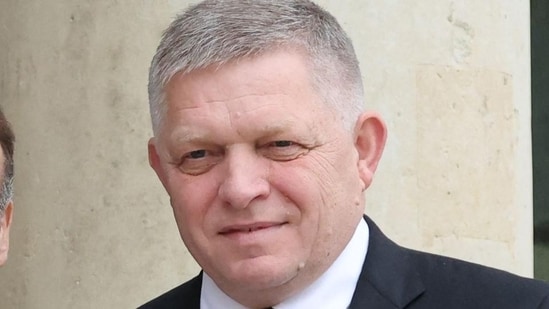
Slovak Prime Minister Robert Fico’s attendance at Russia’s Victory Day celebrations on May 9, 2026, and his meeting with Russian President Vladimir Putin, stand out as a provocative diplomatic choice. As the only EU leader present, Fico’s presence highlighted persistent fissures within the European Union rather than a sudden collapse of western unity. To note, this is not the first time that any European leader has been getting closer to Moscow; earlier, Hungary and, recently, Bulgaria have followed a similar course.
Slovakia’s Prime Minister Robert Fico (AFP)
Amid the fractured transatlantic ties, a few European countries have started diversifying their foreign relations, especially with China and Russia. Robert Fico visited China last year to participate in commemorations of the 80th anniversary of the Chinese People’s War of Resistance Against Japanese Aggression. This visit was in continuation of the China-Slovakia strategic partnership established during Fico’s major visit to Beijing in late 2024.
Putin welcomed Fico at the Kremlin, thanking him for attending the Victory Day celebrations despite difficulties and praising his unwavering stance on preserving the historical truth about the Red Army’s role in liberating Europe from Nazism and Slovakia’s care for Soviet military graves. Putin noted the previously strong bilateral relations, which had been disrupted by the situation in Ukraine and the confrontational policies of the EU and NATO, while welcoming Fico’s government’s independent and pragmatic approach toward Russia. He pledged that Russia would do everything possible to meet Slovakia’s energy needs and expand bilateral economic cooperation. Fico, in turn, expressed gratitude for the invitation, rejected any distortion of WWII history, emphasised Slovakia’s commitment to maintaining sovereign foreign policy and normal friendly relations with Russia, and voiced opposition to a new iron curtain dividing the two countries.
This tilt towards Moscow is neither a total rupture nor mere symbolism. It reflects longstanding structural realities. Energy dependencies, domestic political incentives, and differing threat assessments have shaped Central European policies since the full-scale war between Russia and Ukraine in 2022. A more nuanced view requires weighing legitimate national interests against collective security concerns, without reducing it to a simple narrative of alleged Russian divide-and-rule.
Slovakia’s position stems heavily from infrastructure and geography. The country’s Slovnaft refinery is configured primarily for Russian crude via the Druzhba pipeline. The 2026 disruptions, linked to damage in Ukrainian territory and ensuing disputes, triggered real supply pressures, strategic reserve drawdowns, and a national energy emergency. Fico’s government leveraged its veto power in EU sanctions discussions to press for pipeline resumption, a transactional tactic that frustrated partners but underscored real vulnerabilities. While the EU has diversified overall (dramatically reducing Russian energy dependence since 2022), exemptions and legacy infrastructure mean countries like Slovakia and Hungary remain more exposed than Baltic or Nordic States. Putin’s pledges during the meeting to support Slovakia’s needs reinforce this leverage, but they also highlight Bratislava’s limited short-term alternatives.
This is classic energy statecraft. Dependence creates influence, but over-reliance also exposes smaller economies to volatility. Slovakia’s push for diversification (e.g., Adria pipeline expansions) acknowledges this, yet transitions take time and investment. Fico’s approach aligns with his domestic base. Sceptical of expansive military aid to Ukraine and prioritising cost-of-living issues, he frames his policy as pragmatic realism rather than ideological alignment with Moscow. Honouring the Soviet WWII victory taps into shared historical memory across much of Central and Eastern Europe, even as interpretations of the current war diverge sharply.
This can be seen as undermining EU cohesion and providing influence value to the Kremlin. One can also argue that it keeps dialogue channels open and prioritises Slovak workers and households facing higher energy costs. Both perspectives contain partial truths. Unilateral gestures can erode trust in Brussels, yet forcing uniform policy on energy-vulnerable States risks alienating voters and fuelling populist backlash.
The Visegrad Four (also known as the V4 or Visegrad Group) which is a cultural and political alliance of four Central European countries: The Czech Republic, Hungary, Poland, and Slovakia, fosters cooperation on military, economic, and energy issues within the EU and NATO. This group operates as a flexible platform rather than a unified bloc. Poland and the Czech Republic adopt a harder stance on Russia, concerned about security threats and energy diversification, especially after the annexation of Crimea. Conversely, Slovakia and Hungary take a more accommodating approach, with Hungary maintaining close ties to Russia for energy security. This divergence reflects each country’s historical context and political considerations, posing ongoing challenges for collaboration within the group. However, there are uncertainties regarding Hungary’s relationship with Russia following Viktor Orbán’s electoral defeat and the transition to the new prime minister.
Fico’s visit to Russia does not signal imminent EU disintegration. Most member States remain committed to supporting Ukraine and the sanctions frameworks. However, it illustrates the limits of a one-size-fits-all approach in a heterogeneous union of 27 countries with asymmetric vulnerabilities. For the EU, sustaining unity requires addressing energy security gaps more effectively and allowing calibrated national flexibility where core principles (e.g., territorial integrity) are not compromised. For Russia, pockets of engagement provide diplomatic breathing room and media wins, but they have not led to the dismantling of sanctions or a reversal of battlefield realities. For Slovakia, balancing economic pragmatism with alliance commitments carries risks. Reputational isolation within the EU could offset short-term energy gains.
In 2026, Europe will confront a protracted conflict with no quick resolution. Fico’s foreign policy embodies a recurring debate over how to reconcile national sovereignty and immediate citizen welfare with long-term collective security on an interdependent continent. Oversimplifying it as mere populism or Russian success misses the deeper interplay of geography, history, economics, and democratic accountability. Therefore, an effective European strategy must navigate these tensions rather than wish them away.
(The views expressed are personal)
This article is authored by Pravesh Kumar Gupta, associate fellow (Eurasia), Vivekananda International Foundation, New Delhi.