
The world order is undergoing an upheaval at least as radical as the end of the Cold War. Back then, Estonia made crucial choices regarding the restoration of independence and return to the western world, which served the country well for more than three decades.
Today, small states in our region are facing big dilemmas. Many, if not all, key pillars of Estonia’s and Europe’s security are under enormous strain: the transatlantic relationship, European integration, and international law.
In hindsight, the path chosen by the Baltic states in the late 1980s and early 1990s, when the Soviet Union started to crumble and the window of opportunity to regain independence opened, may seem obvious and even inevitable. Yet at the time, it was far from obvious; there were principled disagreements between national leaders over whether to choose a reformist or radical path, evolution or revolution.
The choice of legal continuity, which meant re-establishment of the old Estonian republic after half a century of occupation, was unprecedented in world history and difficult to explain to foreigners. Nonetheless, it provided an anchor that later helped to keep the country on track during painful reforms. The pursuit of radical decoupling from Russia was equally hard for many external observers to understand. The Baltic states were seen as too dependent and too weak to disconnect from the (post-)Soviet economic structures.
Furthermore, their accession to the EU, let alone NATO, was regarded as unrealistic and undesirable among many western leaders in the 1990s. Despite the disagreements, what united Estonians and other Baltic nations was their desire for freedom, sovereignty, and democracy, as well as their sense of belonging to Europe. These core elements still underlie their foreign policies today.
In many ways, the Baltic states are in a stronger position now than in the early 1990s. They are deeply integrated into western and regional networks of cooperation and backed by strong Allies. However, the overall security situation in Europe is weaker than ever after the end of World War II, with a major war on the continent continuing for the fifth year, a collapse of transatlantic trust, and a revanchist Russia that Europe is not ready to deter on its own in case the US withdraws or considerably reduces its contribution.
Can Europe Defend Itself?
All European nations are facing similar dilemmas, but the Baltic states, being more exposed to the Russian threat and more dependent on the US for their security than other European countries, have found it particularly hard to adjust their security strategies to the new realities.
The Baltic states have found it particularly hard to adjust their security strategies to the new realities.
First, our defence relies on NATO, with the US playing an indispensable role in the Alliance in terms of both political leadership and military capability. Under the second Trump administration, however, the US has made clear that it expects Europe to take over responsibility for its conventional defence.
At best, this can happen gradually in the spirit of burden-shifting, but the possibility of a more abrupt abandonment cannot be excluded. The US no longer shares European threat perceptions regarding Russia and no longer endorses the core principles of European and international security, such as sovereignty and territorial integrity. Its demands on Greenland and Ukraine have made this plain. Even if the American positions on Russia, Ukraine, and Greenland may well change under the next president, the strategic shift away from Europe should be seen as a long-term trend, irrespective of who sits in the White House.
For the Baltic states, the dilemma of whether to make every effort to further deepen ties with the US to avoid abandonment or to actively seek ways to reduce dependence has been too sensitive to discuss publicly. Estonian officials have denied the dilemma, arguing that strengthening Estonia’s and Europe’s defence capabilities serves both goals: increasing the likelihood of continued US engagement and preparing for its possible withdrawal.
In this new way of war, Ukraine has more experience and expertise than any other country in the world.
In practice, however, the two are difficult to reconcile. If the priority is to maintain the US commitment, it is essential to buy American equipment and back US foreign policy positions that have increasingly contradicted European security interests. If the goal is to reduce dependence, it is necessary to invest more in the European defence industry and build up European capabilities in areas where NATO has so far relied heavily on the US, such as air defence and intelligence.
Moreover, Europe needs to adapt its defence to the rapidly changing nature of warfare that is playing out in Russia’s war against Ukraine. As the US–Israeli operation against Iran has revealed, even the US is ill-prepared to counter attacks of Iranian drones. In this new way of war, Ukraine has more experience and expertise than any other country in the world, but the US has blocked its accession to NATO.
The Baltic states are in danger of marginalising themselves from European debates by prioritising ties to the US.
NATO defence plans are currently based on the assumption of a strong and unwavering US contribution. Yet Europe also needs to prepare to defend itself without US support if need be. Many European leaders have been understandably cautious when discussing such plans in public—to avoid precipitating US withdrawal. But the discussions have gathered pace behind closed doors. The Baltic states are in danger of marginalising themselves from European debates by prioritising ties to the US.
The EU Under Pressure
The second major pillar of Estonia’s security and well-being is the EU. This has always entailed the dilemma between national sovereignty, on the one hand, and greater influence over external decisions and developments that affect us, on the other. The deeper the integration, the sharper the dilemma.
Estonia has consistently opposed extending the qualified majority vote in EU foreign policy, arguing that the veto right increases the country’s influence, since other member states are bound to take this possibility into account. Yet the EU’s decisions regarding the war in Ukraine have repeatedly been blocked, delayed, or watered down by the unanimity rule—in a manner that has worked against Estonia’s vital security interests.
Deeper integration is seen by many Europeans as a solution to the EU’s weak international influence and competitiveness. Many also look to the EU for a stronger European defence. However, strengthening the latter within NATO is seen as a more viable path in Estonia, as well as in many other member states. For the time being, this is Europe’s response to the dilemma of relying on a defence Alliance undermined by its strongest member. The EU’s increased support for the European defence industry and innovation complements the goal of Europeanising NATO. Building new defence structures under the EU framework—from command structures to defence plans—would take time and resources that Europe currently lacks.
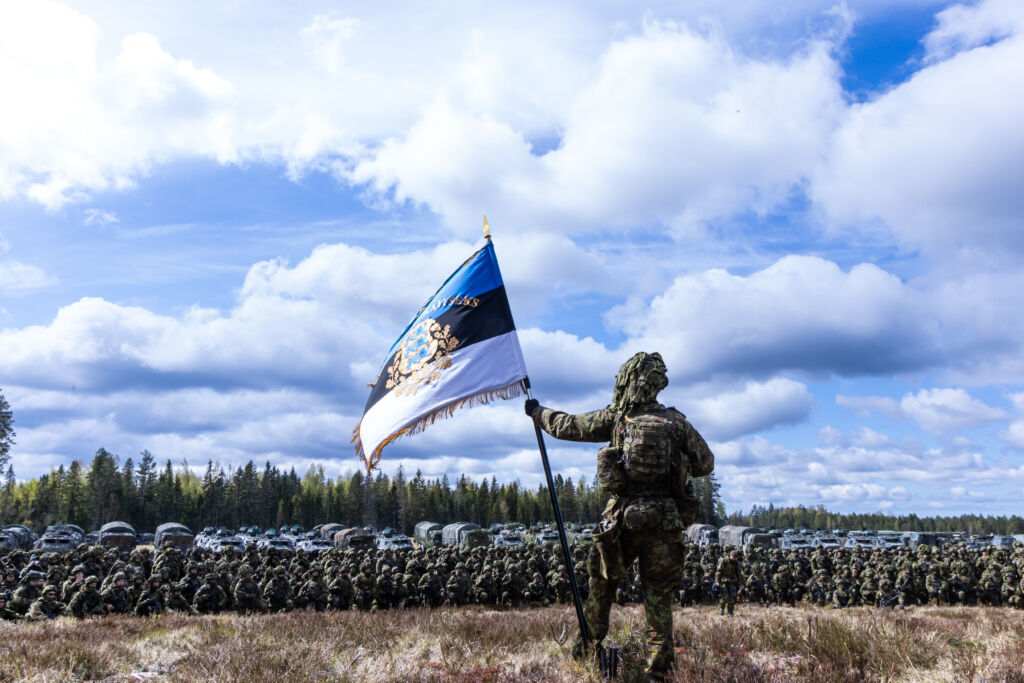
Troops from Kalev Infantry Battalion participating in the military training exercise Hedgehog 2025 in May 2025. Photo: Estonian Defence Forces
Another factor that adds pressure to deepen integration is enlargement, which the EU nowadays defines as a geopolitical necessity. Estonia is a strong supporter of enlargement but has been lukewarm about many aspects of deepening integration and internal reform, which are seen as preconditions, especially for Ukraine’s accession in some member states. The EU struggles to move forward with the accession processes of Ukraine, Moldova, and the Western Balkan countries. In the case of Ukraine, one condition for full membership is the end of the war, which is currently not in sight.
No matter when the war ends, Europe needs Ukraine to build up a credible European defence against Russia. It therefore needs to find a way to integrate Ukraine into the European security system. Estonia, together with other staunch allies of Ukraine, has to look for creative solutions that are not premised on the end of the war or on internal reforms in the EU—but rather on gradually integrating Ukraine into Europe while the conflict continues.
International Law in Small State Security
Third, Estonia continues to declare a value-based foreign policy, with international law and democratic values as pillars of its security. Yet the Baltic states are now finding it even harder than many other European countries to reconcile the sharpening tension between international law and security interests or, more broadly, between values and interests. This is, by no means, a new challenge, but its scope is unprecedented now that the disregard of the current US administration for international law and democratic values marks a radical break from the decades-long role of the US in upholding the rules-based order and leading the free world, however imperfectly.
The change required from Europe is not only to rearm and reduce dependencies, but also to reshape our narratives and mental maps.
As the Baltic states have struggled to adapt, their positions have not always aligned. In January this year, when tensions over Greenland peaked, Estonia was the only Baltic state to publicly affirm that Greenland was an integral part of the Kingdom of Denmark and to signal its readiness to contribute a small military contingent to the Allied exercise called by Denmark. Latvia and Lithuania chose a more restrained line to avoid angering the US.
A further challenge is that the transatlantic relationship increasingly involves not only choices between values and interests, but also divergent security interests between the US (as perceived by the current administration) and Europe. When the US lays claim to Greenland or puts pressure on Ukraine to cede territory to Russia, this violates the core European principles of territorial integrity and the inadmissibility of changing borders by force. These examples underscore that for small states, values and interests are closely intertwined, since they cannot impose their will on others as major powers often do.
However, international law does not, in itself, protect Estonia or other small neighbours of Russia—it never did. When the US still cared about defending the rules-based order and democratic values, these provided a foundation for the transatlantic Alliance and the US’s willingness to defend its European Allies. Now, the foundation is gone, and the Baltic states struggle to make themselves useful to their main Ally in the spirit of transactionalism. The dilemma between values and interests can hardly be resolved by endorsing US foreign policy adventures that run counter to our own values, principles, and interests. If the US no longer cares about territorial integrity or freedom of Russia’s neighbours, American security guarantees are at best volatile—and at worst, they lack credibility.
If the US Is Indispensable, Then Europe Is Doomed
All of this leaves us in a situation where the strategy of relying on the US has become increasingly unsustainable. Yet we lack a viable alternative in the short term. Estonia and other Nordic-Baltic countries have taken important steps to adapt to the deteriorating security environment by strengthening their national defence, enhancing regional cooperation, and leading the way in European support for Ukraine, especially since US assistance has all but ended.
The big question is whether we are doing the right things to prepare for a possible US withdrawal and to craft European deterrence against Russia that would not collapse without the Americans. Washington has been an indispensable Ally for decades; yet continuing to call it indispensable suggests that Europe is doomed without it. The change required from Europe is not only to rearm and reduce dependencies, but also to reshape our narratives and mental maps. The dilemma of whether we precipitate US withdrawal by preparing for it constrains us.
The Baltic states are now finding it even harder to reconcile the sharpening tension between values and interests.
Future generations will judge whether the choices Estonia and other European countries make today are sustainable. Are we clinging on for too long to an Alliance that has become dysfunctional and unreliable? Or are we turning into prudent realists who learn to be transactional and compromise our values and principles in order to survive in the new world of power politics? Are we refusing to forge a new strategy out of fear that it will weaken our security, even though the old one is falling apart?
As at other breaking points in Europe’s recent history, Estonia now faces difficult dilemmas— the decisions we make today are existential for our future. Fudging choices and maintaining ambiguity may be a good approach up to a point. However, this moment calls for a serious rethinking of the pillars of our security. While many things are uncertain, we can be sure that our fate will be intertwined with that of our European Allies and friends, including Ukraine. Estonia’s ambition should not only be to survive and overcome the current period of turbulence, but to shape the future European security order.
This article was written for the Lennart Meri Conference special issue of ICDS Diplomaatia magazine. Views expressed in ICDS publications are those of the author(s).