
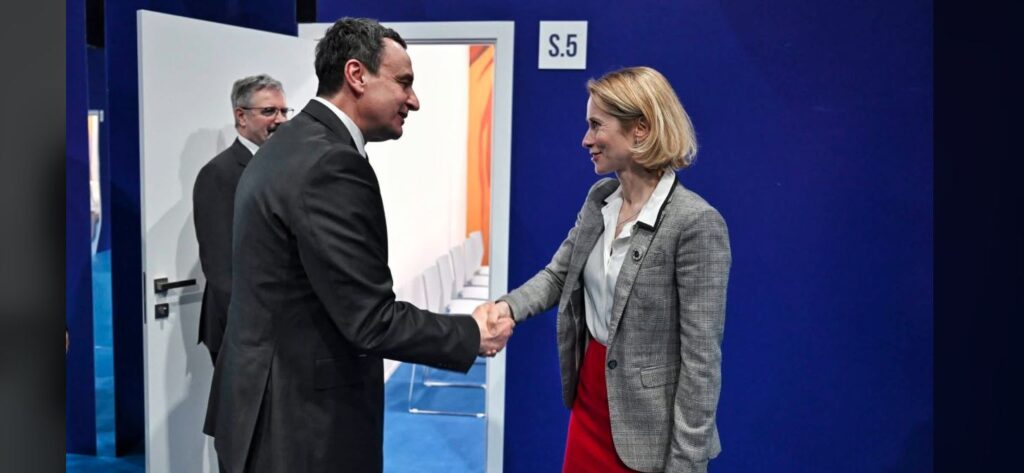
Kallas: We had Kurti and Vučić’s consent for a meeting within the framework of the dialogue, the elections in Kosovo are delaying the process

Express newspaper
11/05/2026 9:26
The European Union’s High Representative for Foreign Affairs and Security Policy, Kaja Kallas, confirmed that the frequent election cycles in Kosovo are the main reason why, for a long time, there has not been a new round of dialogue between Pristina and Belgrade, at the leadership level.
She told reporters that there is a willingness from both the President of Serbia, Aleksandar Vučić, and the Prime Minister of Kosovo, Albin Kurti, for a meeting within the framework of the dialogue, but that the announcement of new early elections in Kosovo has postponed the process again.
“We, in fact, had planned the dialogue between Belgrade and Pristina – high-level political dialogue. We had the consent of both leaders – from Kosovo and from Serbia – but now the elections in Kosovo are approaching again, which of course postpones the process,” Kallas said.
“I am, however, working separately with both parties so that we can continue to implement the agreements that are already in place,” she added.
The leaders of Kosovo and Serbia last met as part of the dialogue to normalize relations in September 2023.
Kallas took office as EU High Representative in December 2024 and has not yet had the opportunity to host any round of talks.
Today, it hosts a meeting of Foreign Ministers of European Union member states and their counterparts from the Western Balkans.
The talks between the 27 European heads of diplomacy and the six foreign ministers of the countries of the region are expected to serve as an introduction to a further debate on the situation in the region, which will take place today, but only at the level of EU ministers.
The meeting is expected to also discuss preparations for the EU-Western Balkans summit, which will be held in June in Tivat, Montenegro.
According to European diplomats, the main focus will be: strengthening cooperation between the EU and the region, increasing resilience to external influences, alignment with EU foreign policy, and improving relations between countries in the region.