
By Zach Hagadone
Reader Staff
When a lot of people talk about “the good old days,” more often than not they’re conjuring a hazy image of the 1950s — a vibe that will be prevalent throughout the Sandpoint area with the 39th annual Lost in the ’50s celebration from Friday, May 15-Saturday, May 16.
The middle decade of the 20th century was complex, for sure. On one level, the ’50s were deeply unenlightened — from racial segregation to culturally enforced misogyny to inquisitorial anti-communism. On another, it was a revolutionary period that saw the mainstreaming of rock music, television, car culture and timeless fashion styles. On yet another level, it was a time of explosive technological development that perhaps did more to determine how we live today than any preceding era — from the polio vaccine, transistor radios, velcro and three-point seat belts, to satellites, lasers, copy machines, pacemakers and super glue.
Below are a handful of ’50s inventions that changed our world in ways big and small:

The integrated circuit
Computers were in use throughout the 1940s, but by the end of the decade they’d grown enormous enough to be as unreliable as they were unwieldy. That was because vacuum tubes were needed to control the electrical flow through the machines, and the most advanced computers of the day needed tens of thousands of them — on top of thousands more other components.
That means computational technology hit a ceiling until transistors came along and enabled computer components to be more densely arranged and thus reduce both the size and power consumption of devices.
Still, computers remained almost more trouble than they were worth until a series of inventions in the early 1950s culminated with Texas Instruments engineer Jack Kilby’s breakthrough in 1958 that introduced a way to pack together and connect tiny transistors, resistors and capacitors on a small piece of material — a.k.a. an integrated “chip” — that could perform all the functions of those earlier behemoth computers at a fraction of the size and energy needs.
Kilby’s innovation paved the way for rapid improvements by other engineers that resulted in the microchip and serves as the foundation for practically every modern technology — from cars to smartphones to credit cards, the latter which was also invented in the 1950s. In fact, that technology went from the cardboard Diners Club card in 1950 to the smart cards we know today by 1959, when a silicon integrated chip was put on a plastic card and used to accomplish secure electronic bank transfers.
Video tape
Storing data on a magnetized strip of plastic dates back to the late 1920s in Germany (and was kept mostly a secret by the Nazis during World War II), but up until the 1950s that technology had only been used for audio recording and playback.
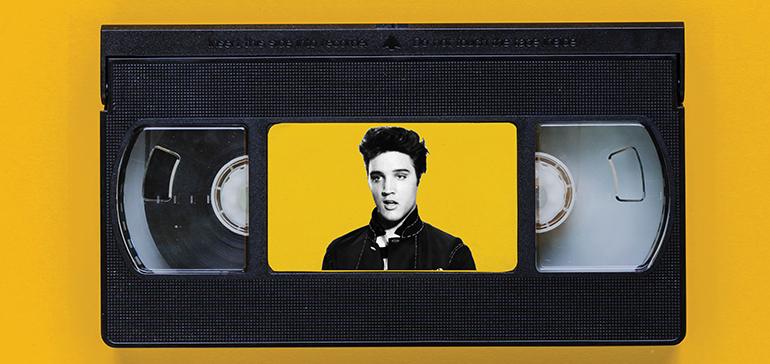
Video tape actually has its origins with iconic singer Bing Crosby (born in Tacoma and raised in Spokane), who wanted to know if magnetized tape could be used to record images, as well as sound. His engineer, Jack Mullin, said it could be done provided the tape ran at speeds high enough to achieve the wide bandwidth necessary to capture a picture (video needs a signal of six megahertz vs. audio, which requires just 20 kilohertz).
Crosby used his celebrity clout in 1951 to get electronics company Ampex to figure it out, and they started work on what would become the video tape recorder — a humongous open-reel device that almost immediately replaced old film stock and made TV recording much cheaper and faster. By 1955, CBS was using the VTR technology, but it was spendy: one Ampex VRX-1000 cost the equivalent of $592,000 in 1956, and that was on top of $300 for one 90-minute reel of tape — a cost of $3,600 today. Of course, now you can buy a whole box of VHS tapes for about a buck.
The microwave oven
While the patent for the first microwave oven was filed in 1945, it wasn’t until 1955 that folks could purchase one for their home. It all started with Raytheon Laboratories engineer Percy Spencer, who is credited with discovering that microwave signals could generate heat when he was working in proximity to a live radar set and noticed that a candy bar in his pocket had melted.
Spencer figured out that microwave signals being emitted from the radar’s cavity magnetron tube — a vacuum tube that creates microwaves when electrons interact with a field created by magnets — generated heat sufficient to liquify his snack, and started experimenting with how to focus and direct the waves using a metal box with a door affixed to its front.
Spencer’s prototype was wholly inaccessible to the average person. The “Radarange” weighed about 750 pounds, was six feet tall and cost almost $5,000 — the equivalent of about $91,500 in today’s money. When Raytheon licensed the original patent for retail sales in 1955, the Tappan appliance company came out with the RL-1 model, which was a 220-volt built-in wall unit design that weighed a slight 150 pounds and would have set a consumer back the equivalent of more than $10,500 in 2026 dollars.
Needless to say, sales were not initially robust. Only 34 units were manufactured that first year, but the technology was out there and would be refined by the mid-1960s into what we’d recognize today.
Stay curious, 7B, and look forward to Brenden Bobby’s return after he takes a break from column-writing duties.