
Australia CNC Grinding Machines Market Overview:
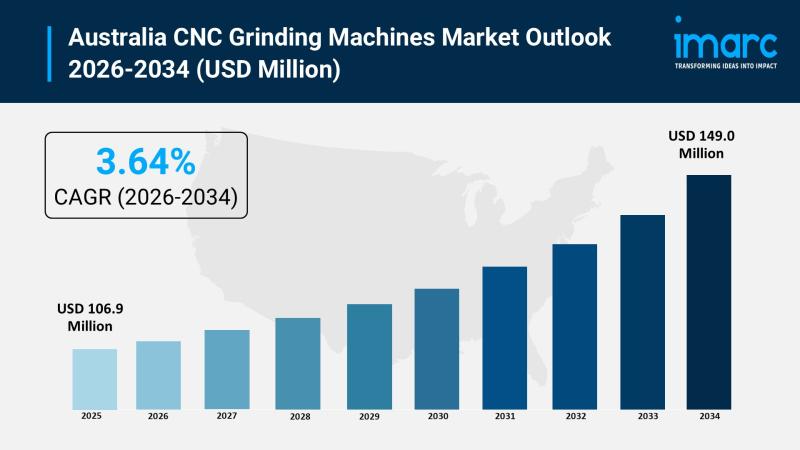
The Australia CNC grinding machines market size was valued at USD 106.9 Million in 2025 and is expected to reach USD 149.0 Million by 2034, growing at a CAGR of 3.64% during 2026-2034. The market is segmented by type (cylindrical, surface, others), by application (automotive, aerospace and defense, medical, electrical and electronics, others), and by distribution channel (online including company websites and e-commerce websites, offline including direct sales and indirect sales) across Australia Capital Territory & New South Wales, Victoria & Tasmania, Queensland, Northern Territory & Southern Australia, and Western Australia.
Request for a sample report PDF: https://www.imarcgroup.com/australia-cnc-grinding-machines-market/requestsample
Australia CNC Grinding Machines Market Summary:
• The Australian government’s AUD 330 billion defense investment program is channeling unprecedented capital into sovereign manufacturing capability, with CNC grinding machines forming the backbone of precision component production for naval shipbuilding, armored vehicle manufacturing, and guided munitions programs across multiple states.
• In January 2026, the Australian government awarded $17 million in defense manufacturing grants, including $998,568 to Rivierra for CNC machining equipment, $1 million to Catten Industries for automated laser cutting and welding systems, and $1 million to DVR Engineering for 5-axis CNC machining centers-directly expanding the installed base of precision grinding and machining infrastructure.
• Queensland hosts over 300 aerospace businesses and accounts for 31% of Australia’s maintenance, repair, and overhaul (MRO) activities, creating concentrated demand for cylindrical and surface CNC grinding machines used in turbine blade reconditioning, landing gear refurbishment, and structural component manufacturing.
• Persistent labor shortages across Australian manufacturing-with CNC machinists consistently ranking among the hardest roles to fill-are compelling shop owners and production managers to invest in automated CNC grinding systems that reduce operator dependency while maintaining tight tolerances on critical workpieces.
• The Medical Research Future Fund (MRFF) is supporting technology upgrades across health manufacturing facilities, driving demand for precision surface grinding machines used in orthopedic implant finishing, surgical instrument production, and medical device component manufacturing where sub-micron surface tolerances are mandatory.
• Industry 4.0 adoption is accelerating across Australian manufacturing facilities, with CNC grinding machine operators increasingly integrating IoT-enabled monitoring, real-time process feedback, and automated wheel dressing systems to improve throughput, reduce rates, and extend consumable life across high-mix production environments.
• Market segmentation covers three machine types (cylindrical, surface, others), five application verticals (automotive, aerospace and defense, medical, electrical and electronics, others), two distribution channels with sub-segments (online via company websites and e-commerce, offline via direct and indirect sales), and five regional markets.
Key Trends Shaping the Australia CNC Grinding Machines Market:
• Defense sovereign manufacturing reshaping precision machining demand: The AUD 330 billion defense investment program is building a domestic supply chain for naval vessels, armored vehicles, and weapons systems that requires Australian manufacturers to produce components previously sourced from overseas. The Advanced Manufacturing Research Facility (AMRF) is working alongside defense primes to qualify local suppliers, with CNC grinding machines central to achieving the dimensional accuracy and surface finish specifications demanded by military-grade components.
• Aerospace MRO concentration in Queensland driving regional equipment upgrades: With 300+ aerospace businesses and nearly a third of Australia’s MRO work concentrated in Queensland, the state has become a hotspot for CNC grinding machine investment. Boeing Australia’s expanded Brisbane manufacturing site, operational since April 2024, processes defense aircraft components that demand tight-tolerance cylindrical grinding for engine shafts, bearing surfaces, and hydraulic actuator housings.
• Workforce automation imperative accelerating CNC adoption cycles: CNC machinists remain among the hardest roles to fill in Australian manufacturing, and the gap is widening as experienced operators retire without sufficient apprentice pipelines to replace them. This structural shortage is compressing equipment replacement cycles as manufacturers upgrade from manual and semi-automatic grinders to fully automated CNC platforms equipped with robotic loading, in-process gauging, and unattended overnight production capability.
• Medical device precision requirements elevating surface grinding specifications: Growing domestic production of orthopedic implants, dental prosthetics, and surgical instruments is pushing surface grinding machine specifications toward sub-micron finishes and ultra-tight geometric tolerances. MRFF-funded technology upgrades are enabling smaller Australian medical manufacturers to acquire high-precision CNC surface grinders that were previously only economical for large-scale overseas producers.
• Industry 4.0 connectivity transforming grinding operations into data-driven processes: Manufacturers are retrofitting existing CNC grinders with IoT sensors and connecting new machines to centralized monitoring platforms that track spindle loads, thermal drift, wheel wear, and cycle times in real time. This data-driven approach enables predictive maintenance scheduling, automatic compensation for thermal expansion, and statistical process control that reduces rates and improves first-pass yield across both high-volume and job-shop environments.
Market Growth Drivers:
Defense Manufacturing Sovereignty and Strategic Procurement
Australia’s AUD 330 billion defense investment program represents the largest sustained commitment to domestic manufacturing capability in the nation’s history. Programs spanning nuclear-powered submarine construction, Hunter-class frigate production, and Infantry Fighting Vehicle manufacturing all require precision ground components that must meet stringent military specifications. The January 2026 allocation of $17 million in defense manufacturing grants-including direct funding for CNC machining equipment at firms like Rivierra and DVR Engineering-demonstrates the government’s intent to build a resilient domestic supply chain. The AMRF is further accelerating this transition by helping smaller manufacturers qualify their CNC grinding processes for defense-grade tolerances, opening procurement pathways that previously favored overseas suppliers exclusively.
Aerospace and MRO Expansion Across Eastern States
Queensland’s aerospace cluster-comprising over 300 businesses and handling 31% of national MRO activities-generates consistent, high-value demand for CNC grinding machines. Turbine blade reconditioning, landing gear refurbishment, and structural repair all require cylindrical and surface grinding to restore components to original equipment manufacturer specifications. Boeing Australia’s expanded Brisbane facility, now producing defense aircraft components, has added further demand for multi-axis CNC grinding capability in the region. New South Wales and Victoria also contribute significant aerospace manufacturing volume, particularly in avionics housings, sensor enclosures, and precision fasteners that rely on CNC grinding for final dimensional accuracy and surface finish quality.
Chronic Labor Shortages Compelling Automation Investment
The Australian manufacturing sector faces a deepening skilled labor crisis, with CNC machinists consistently listed among the most difficult positions to recruit. Retiring tradespeople are leaving the workforce faster than apprenticeship programs can produce replacements, and immigration pathways have not bridged the gap. This structural deficit is fundamentally changing purchasing behavior: manufacturers who once ran two-shift operations with experienced operators are now investing in CNC grinding machines with automated loading systems, adaptive control software, and lights-out production capability. The payback calculus has shifted decisively in favor of automation, as the total cost of ownership for a fully automated CNC grinder now compares favorably against the escalating wages, recruitment fees, and productivity losses associated with unfilled machinist positions.
Browse the full report with TOC and list of figures: https://www.imarcgroup.com/australia-cnc-grinding-machines-market
How AI is Reshaping the Australia CNC Grinding Machines Market:
• AI-driven adaptive grinding control for real-time process optimization: Machine learning algorithms analyze spindle power, acoustic emission signals, and vibration data during the grinding cycle to adjust feed rates, wheel speed, and depth of cut in real time. This eliminates the conservative parameter sets that operators traditionally use as safety margins, increasing material removal rates while simultaneously reducing thermal damage and maintaining dimensional tolerances on hardened steel, ceramics, and superalloy workpieces.
• Predictive wheel wear modeling extending consumable life and reducing downtime: AI systems track grinding wheel degradation patterns across thousands of cycles, predicting optimal dressing intervals and end-of-life timing with far greater accuracy than fixed-schedule maintenance. Australian manufacturers running mixed-batch production benefit substantially, as the AI adjusts predictions based on workpiece material, grinding mode, and coolant conditions-reducing unnecessary wheel changes by up to 25% while preventing the surface quality defects that occur when worn wheels are pushed beyond their effective life.
• Computer vision surface inspection replacing manual quality checks: Deep learning-based vision systems mounted on CNC grinders capture high-resolution images of finished surfaces and automatically classify burn marks, chatter patterns, feed lines, and micro-cracks that would traditionally require experienced inspectors using magnification equipment. For aerospace and medical device components where every surface must meet documented specifications, this AI inspection capability provides 100% part verification at production speed rather than statistical sampling.
• Digital twin simulation accelerating setup and reducing on new jobs: AI-powered digital twins simulate the entire grinding process before cutting begins, predicting thermal distortion, residual stress distribution, and final surface roughness for new workpiece geometries. Australian job shops that frequently change over between different parts use these simulations to establish near-optimal grinding parameters on the first attempt, dramatically reducing the trial-and-error that traditionally accompanies new job setups on cylindrical and surface grinders.
• AI-enabled production scheduling optimizing machine utilization across mixed workloads: Machine learning algorithms analyze order backlogs, material availability, tooling status, and operator schedules to sequence grinding jobs for maximum throughput and minimum changeover time. In facilities running multiple CNC grinders, the AI balances workloads across machines based on each unit’s strengths-routing tight-tolerance aerospace work to the newest equipment while directing roughing operations to older machines-increasing overall equipment effectiveness and reducing lead times for priority orders.
Australia CNC Grinding Machines Market Segmentation:
The Australia CNC grinding machines market is comprehensively segmented by type, application, distribution channel, and region to provide granular insight into demand patterns and growth opportunities across the precision machining landscape.
By Type:
• Cylindrical
• Surface
• Others
By Application:
• Automotive
• Aerospace and Defense
• Medical
• Electrical and Electronics
• Others
By Distribution Channel:
• Online (Company Websites, E-commerce Websites)
• Offline (Direct Sales, Indirect Sales)
By Region:
• Australia Capital Territory and New South Wales
• Victoria and Tasmania
• Queensland
• Northern Territory and Southern Australia
• Western Australia
Australia CNC Grinding Machines Market Key Players:
The competitive landscape of the Australia CNC grinding machines market includes a blend of established global manufacturers and specialized regional distributors. Key players include UNITED GRINDING Group, JTEKT Corporation (Toyoda), ANCA, Okuma, DMG MORI, Makino, Studer, Junker Group, Danobat, and Kellenberger, alongside Australian distributors such as Dimac Tooling, Hare & Forbes Machineryhouse, and other domestic and international participants competing on precision capability, automation features, service support, and total cost of ownership across the Australian manufacturing sector.
Key Aspects Required for the Australia CNC Grinding Machines Market:
• Demand segment analysis across machine types, application verticals, distribution channels, and regional markets to identify high-growth pockets and equipment specification trends driving purchasing decisions among Australian manufacturers.
• Defense procurement pipeline assessment including the AUD 330 billion investment program, AMRF supplier qualification pathways, and direct grant allocations that are creating new demand corridors for precision CNC grinding equipment in sovereign manufacturing.
• Aerospace MRO capacity and equipment modernization tracking across Queensland, New South Wales, and Victoria to quantify replacement and expansion demand for cylindrical and surface CNC grinders serving turbine, landing gear, and structural component reconditioning.
• Workforce availability and automation adoption metrics that link skilled labor shortages to capital equipment purchasing patterns, including the shift toward lights-out production, robotic loading systems, and automated in-process gauging on CNC grinders.
• Medical device manufacturing expansion analysis covering MRFF-funded technology upgrades, domestic implant production growth, and the surface finish specifications driving demand for high-precision CNC surface grinding machines in healthcare applications.
• Competitive landscape dynamics including global OEM positioning, distributor network strategies, aftermarket service capabilities, and the growing influence of Industry 4.0 connectivity features in equipment selection across the Australian CNC grinding market.
Recent News and Developments:
March 2026 – ANCA showcased productivity-focused CNC grinding solutions at GrindingHub 2026
Australia-based ANCA announced that it would demonstrate advanced CNC grinding productivity solutions, automation systems, and software-integrated manufacturing technologies at GrindingHub 2026. The company emphasized optimization of the complete manufacturing cycle through machine capability enhancement, automation, and process control integration.
April 2026 – ANCA highlighted micron-level precision grinding for miniaturized manufacturing
In April 2026, ANCA published insights on the growing demand for miniature precision components in electronics and medical manufacturing. The company stated that advanced CNC grinding machines are increasingly being used to achieve micron-level tolerances and complex geometries required for next-generation smart devices and precision engineering applications.
April 2026 – Global CNC thread grinding machine market projected strong growth
Industry research released in April 2026 indicated strong expansion in the global CNC thread grinding machine market, driven by rising industrial automation and precision manufacturing demand. The report identified major players including ANCA and highlighted increasing adoption across aerospace, automotive, and industrial manufacturing sectors.
November 2025 – ANCA showcased FX5 ULTRA grinding machine at Metalex 2025
During November 2025, ANCA presented its FX5 ULTRA CNC grinding machine and InsertsPRO software platform at Metalex 2025. The company focused on ultra-precision grinding, productivity enhancement, and simplified setup processes for cutting-tool manufacturers and industrial machining applications.
October 2025 – ANCA launched InsertsPRO software for insert grinding applications
In October 2025, ANCA launched InsertsPRO, a dedicated software package for indexable and special insert grinding. The solution was introduced to support the growing insert grinding segment by improving flexibility, automation, and grinding efficiency for CNC machine operators.
October 2025 – Australian manufacturing sector highlighted CNC grinding automation growth
In October 2025, Australian manufacturing industry discussions highlighted the growing role of CNC grinding automation and robotics in strengthening advanced manufacturing capabilities. ANCA was cited as a leading exporter of high-precision CNC grinding systems and automated tool-manufacturing solutions.
November 2025 – ANCA CEO emphasized global competitiveness of Australian CNC manufacturing
In November 2025, leadership from ANCA stated that the company exports CNC grinding machines to more than 45 countries and continues investing in automation, robotics, and advanced manufacturing technologies. The company also highlighted its AIMS automated tool-grinding system as a major innovation in industrial CNC manufacturing.
May 2025 – ANCA opened the #ANCATooloftheYear2025 competition
In May 2025, ANCA launched its international #ANCATooloftheYear2025 competition to recognize excellence in precision toolmaking and CNC grinding innovation. The competition showcased advancements in cutting-tool design, precision engineering, and high-performance grinding technologies.
Note: If you need specific information that is not currently within the scope of the report, we will provide it to you as a part of the customization.
Speak to an analyst for a customized sample report PDF: https://www.imarcgroup.com/request?type=report&id=34536&flag=C
Other Market Report by IMARC Group:
Australia Eco Friendly Bricks Market: https://www.imarcgroup.com/australia-eco-friendly-bricks-market
Australia False Ceiling Market: https://www.imarcgroup.com/australia-false-ceiling-market
Australia Hydraulic Equipment Market: https://www.imarcgroup.com/australia-hydraulic-equipment-market
Contact Us:
IMARC Group
134 N 4th St. Brooklyn, NY 11249, USA
Email: sales@imarcgroup.com
Tel No: (D) +91 120 433 0800
United States: +1-201-971-6302
About Us:
IMARC Group is a global management consulting firm that helps the world’s most ambitious changemakers to create a lasting impact. The company provides a comprehensive suite of market entry and expansion services. IMARC offerings include thorough market assessment, feasibility studies, company incorporation assistance, factory setup support, regulatory approvals and licensing navigation, branding, marketing and sales strategies, distributor and partner identification, and more. The firm has helped numerous companies worldwide in their business expansion endeavors, and it holds a strong track record of client satisfaction backed by a credible portfolio of completed projects.
This release was published on openPR.