
Under the Law on Memorials, the Centre for Conservation and Archaeology is responsible for monitoring the condition of such monuments and carrying out any restoration work; regular maintenance is the responsibility of local authorities.
In its response to BIRN, the culture and media ministry did not specify how much public money it spends on restoring National Liberation Struggle memorials. It said most are in “satisfactory condition”.
Among those restored is the Monument to Fallen Fighters at Barutana, near Podgorica, designed by the prominent Yugoslav-era architect Svetlana Kana Radevic and unveiled in 1980. Since its restoration in June 2020, the site has been used for a number of commemorative concerts.
In Podgorica, Radevic also designed the monument to partisans from the local Tobacco Factory.
Architect Ena Kukic said that monuments designed by Kana Radevic require active interpretation, not just physical preservation.
“Otherwise, even if they are only restored, younger generations – who know the National Liberation Struggle struggle only second-hand – may begin to see them as interesting futuristic forms or viral icons of brutalist aesthetics, stripped of meaning and substance,” Kukic told BIRN.
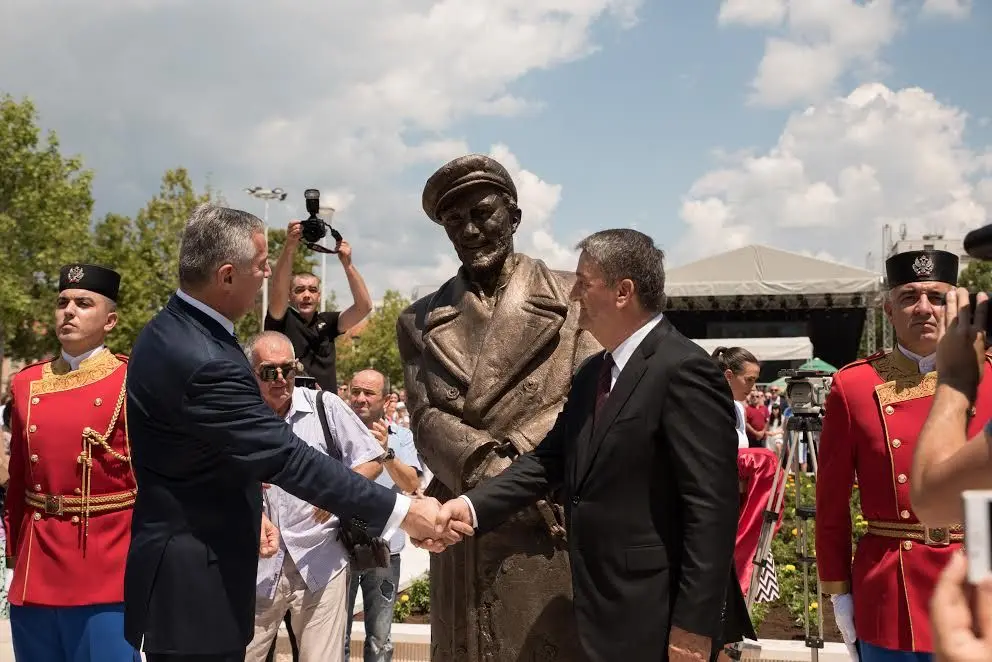
One of the most prominent restoration projects was carried out in 2018, when then-Podgorica mayor Ivan Vukovic unveiled a monument to Josip Broz Tito, making the capital one of the few cities in the former Yugoslavia to host a statue of the Yugoslav leader.
The statue is an original 1948 bronze casting by sculptor Antun Augustincic, relocated in the early 1990s to a military barracks after the capital reverted to the name ‘Podgorica’ from the socialist era ‘Titograd’.
Also in 2018, local authorities in Montenegro’s second city of Niksic unveiled a statue of Partisan war hero Cedomir ‘Ljubo’ Cupic, popularly known as the Montenegrin Che Guevara; the monument depicted Cupic’s smiling face and shackled hands moments before he was shot dead by nationalist Chetniks in 1942. It was the first new monument honouring the Partisans since the breakup of Yugoslavia.
Nevertheless, Kukic said Montenegro does not do enough to promote such monuments and the country’s anti-fascist heritage.
“The state’s approach to Yugoslav memorial architecture can be described as neglectful and insufficiently engaged,” she said. “Sporadic social events near the monuments, such as a concerts or performance, and cleaning and maintenance actions, are not systematic nor are they the rule, but rather the exception.”
Vukanovic said the National Liberation Struggle legacy is often used for short-term political gain.
“Anti-fascism is reduced to slogans for daily political use, without strategy or understanding,” he said. “While it is exploited politically, many local monuments remain neglected, and students learn little about the Partisan movement.”
Cases of vandalism have been reported.
In 2011, a bust of Partisan commander Sava Kovacevic was found in a landfill, and a decade later a man in Niksic was sentenced to 10 months in prison for urinating on the monument to Cupic.
Rise of revisionism